Question
 The EM waves when travel into different media gets:

Answer

  1. Reflected

Need a full question paper?

Generate a complete, print-ready paper with questions like this in minutes — across 16+ boards, with answer keys.

Start Generating Free

Similar questions

In nuclear reaction $2^{\mathrm{He}^4}+z^{\mathrm{X}^{\mathrm{A}}} \rightarrow \mathrm{z}+2^{\mathrm{Y}^{\mathrm{A}+\mathrm{s}}}+\mathrm{A}$ A denotes
A point charge is brought in an electric field. The electric field at a nearby point.
Two strings A and B, made of same material, are stretched by same tension. The radius of string A is double of the radius of B. A transverse wave travels on A with speed $\nu_\text{A}$ and on B with speed $\nu_\text{B}.$ The ratio $\frac{\nu_\text{A}}{\nu_\text{B}}$ is:
  1. $\frac{1}{2}$
  2. $2$
  3. $\frac{1}{4}$
  4. $4.$
When an electric dipole $\overrightarrow{ p }$ is placed in a uniform electric field $\overrightarrow{ E }$ then at what angle between $\overrightarrow{ p }$ and $\overrightarrow{ E }$ the value of torque will be maximum
Compton effect shows that(a) X-rays are waves(b) X-rays have high energy(c) X-rays can penetrate matter(d) Photons have momentum
   
   
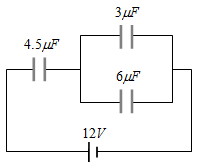
In the circuit shown in the figure, the potential difference across the $4.5\ mF$ capacitor is
Two metal spheres of radii $R_1$ and $R _2$ are charged to the same potential. The ratio of charges on the spheres is
If an interference pattern have maximum and minimum intensities in 36 : 1 ratio then what will be the ratio of amplitudes(a) 5 : 7(b) 7 : 4(c) 4 : 7(d) 7 : 5
       
Two circular coils can be arranged in any of the three situations shown in the figure. Their mutual inductance will be.
Image
To get maximum current in a resistance of 3 ohms, one can use n rows of m cells (connected in series) connected in parallel. If the total number of cells is 24 and the internal resistance of a cell is 0.5 ohms then: