The energy emitted per second by a black body at ${27^o}C$ is $10\;J$. If the temperature of the black body is increased to ${327^o}C$, the energy emitted per second will be ......... $J$
Medium
Download our app for free and get started
(d) ${(Q)_{Black\,body}} = A\sigma {T^4}t$ ==> $Q \propto {T^4}$
==> ${Q_2} = {Q_1}{\left( {\frac{{{T_2}}}{{{T_1}}}} \right)^4}$$ = 10\,{\left( {\frac{{273 + 327}}{{273 + 27}}} \right)^4}$$ = 10\,{\left( {\frac{{600}}{{300}}} \right)^4} = 160J$

Download our appand get started for free
Experience the future of education. Simply download our apps or reach out to us for more information. Let's shape the future of learning together!No signup needed.*
Similar Questions
- 1Assertion : The equivalent thermal conductivity of two plates of same thickness in contact is less than the smaller value of thermal conductivity.View Solution
Reason : For two plates of equal thickness in contact the equivalent thermal conductivity is given by : $\frac{1}{K} = \frac{1}{{{K_1}}} + \frac{1}{{{K_2}}}$ - 2$A$ wall has two layers $A$ and $B$ made of different materials. The thickness of both the layers is the same. The thermal conductivity of $A$ and $B$ are $K_A$ and $K_B$ such that $K_A = 3K_B$. The temperature across the wall is $20°C$ . In thermal equilibriumView Solution
- 3A cylinder of radius $R$ is surrounded by a cylindrical shell of inner radius $R$ and outer radius $2R$. The thermal conductivity of the material of the inner cylinder is $K_1$ and that of the outer cylinder is $K_2$. Assuming no loss of heat, the effective thermal conductivity of the system for heat flowing along the length of the cylinder isView Solution
- 4A liquid cools from $50^oC$ to $45^oC$ in 5 minutes and from $45 ^o C$ to $41.5 ^o C$ in the next $5$ minutes. The temperature of the surrounding is ...... $^oC$View Solution
- 5View SolutionWhen red glass is heated in dark room it will seem
- 6A metallic rod of cross-sectional area $9.0\,\,cm^2$ and length $0.54 \,\,m$, with the surface insulated to prevent heat loss, has one end immersed in boiling water and the other in ice-water mixture. The heat conducted through the rod melts the ice at the rate of $1 \,\,gm$ for every $33 \,\,sec$. The thermal conductivity of the rod is ....... $ Wm^{-1} K^{-1}$View Solution
- 7A black body radiates heat energy at the rate of $2\times10^5\, J/sm^2$ at temp. of $127\,^oC$. The temp of black body at which rate becomes $32\times10^5\, J/s-m^2%$ is ....... $^oC$View Solution
- 8The power radiated by a black body is $P$ and it radiates maximum energy at wavelength,$\lambda_0.$ If the temperature of the black body is now changed so that it radiates maximum energy at wavelength $\frac{3}{4}\lambda_0$, the power radiated by it becomes $nP$. The value of $n$ isView Solution
- 9A body cools in a surrounding which is at a constant temperature of ${\theta _0}$. Assume that it obeys Newton's law of cooling. Its temperature $\theta $ is plotted against time $t$ . Tangents are drawn to the curve at the points $P(\theta = {\theta _1})$ and $Q(\theta = {\theta _2})$. These tangents meet the time axis at angles of ${\varphi _2}$and ${\varphi _1}$, as shownView Solution

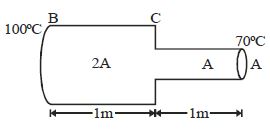
- 10A metal rod of length $2\, m$ has cross-sectional areas $2A$ and $A$ as shown in the following figure. The two ends are maintained at temperatures $100\,^oC$ and $70\,^oC$. The temperature of middle point $C$ is ........ $^oC$View Solution