Question
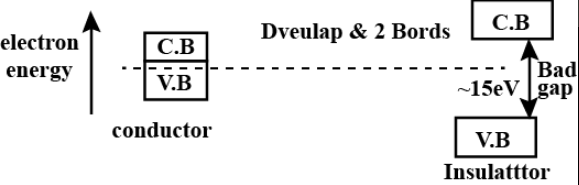
The energy gap in a conductor at room temperature is ________ .

Answer

  1. Less than that in a insulator.
Explanation:
The energy band gap is the energy difference between 2 bands i.e. valence band and the conduction band. In case of conductors, energy band gap is very small almost overlapping whereas, in case of insulators, the band gap is ∼6 eV. So. band gap of conductors is less than insulators.

Need a full question paper?

Generate a complete, print-ready paper with questions like this in minutes — across 16+ boards, with answer keys.
Start Generating Free

Similar questions

A steady potential difference of 100V produces heat at a constant rate in a resistor. The alternating voltage which will produce half the heating effect in the same resister will be.
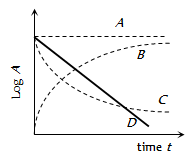
The graph which represents the correct variation of logarithm of activity $(\log\ A)$ versus time, in figure is
The radioactive nucleus $7^{N^{18}}$ decays to $6^{C^{18}}$  through the emission of
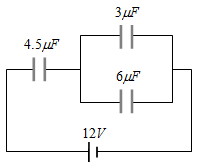
In the circuit shown in the figure, the potential difference across the $4.5\ mF$ capacitor is
A very long bar magnet is placed with its north pole coinciding with the centre of a circular loop carrying as electric current i. The magnetic field due to the magnet at a point on the periphery of the wire is B. The radius of the loop is a. The force on the wire is:
  1. Very nearly $2\pi\text{aiB}$ perpendicular to the plane of the wire.
  2. $2\pi\text{aiB}$ in the plane of the wire.
  3. $\pi\text{aiB}$ along the magnet.
  4. Zero.
An electron falls from rest through a vertical distance h in a uniform and vertically upward directed electric field E. The direction of electric field is now reversed, keeping its magnitude the same. A proton is allowed to fall from rest in it through the same vertical distance h. The time of fall of the electron, in comparison to the time of fall of the proton is:
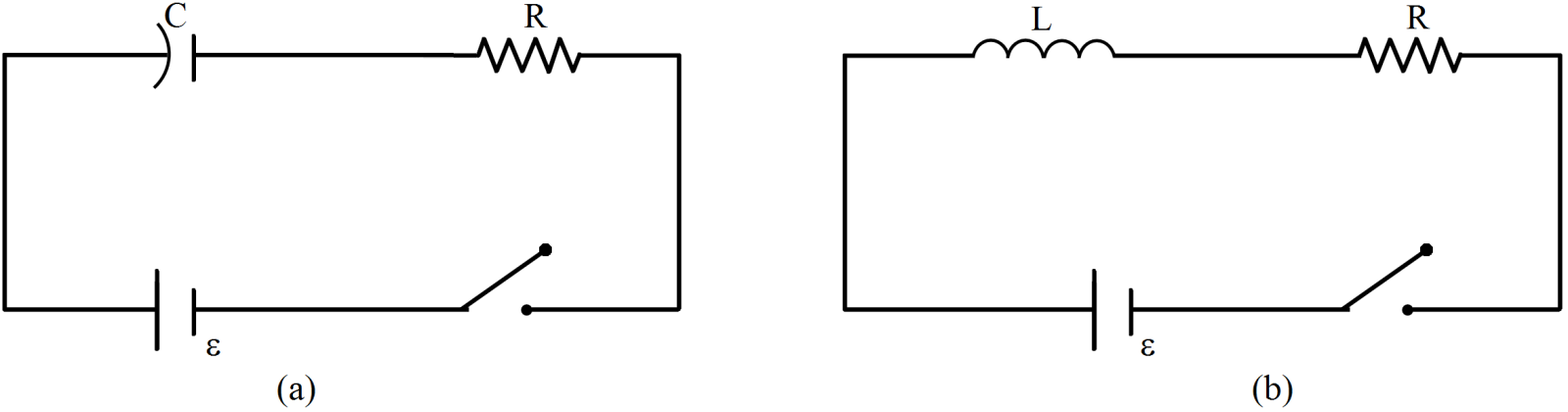
The switches in figure are closed at $t = 0$ and reopened after a long time at $t = t_0:$
A steady current is passing through a linear conductor of non uniform cross-section. The net quantity of charge crossing any cross section per second is:
A sonometer wire of length l vibrates in fundamental mode when excited by a tuning fork of frequency $416\ Hz$. If the length is doubled keeping other things same, the string will:
A point charge q is rotated along a circle in the electric field generated by another point charge Q. The work done by the electric field on the roatating charge in one complete revolution is: