The energy required to charge a capacitor of $5\,\mu \,F$ by connecting a $d.c$. source of $20\, kV$ is......$kJ$
Easy
Download our app for free and get started
(d) $U = \frac{1}{2}C{V^2} = \frac{1}{2}5 \times {10^{ - 6}} \times {(20 \times {10^3})^2} = 1\,kJ$

Download our appand get started for free
Experience the future of education. Simply download our apps or reach out to us for more information. Let's shape the future of learning together!No signup needed.*
Similar Questions
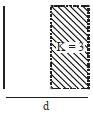
- 1A parallel plate capacitor with plate area $A$ and plate separation $d =2 \,m$ has a capacitance of $4 \,\mu F$. The new capacitance of the system if half of the space between them is filled with a dielectric material of dielectric constant $K =3$ (as shown in figure) will be .........$ \mu \,F$View Solution
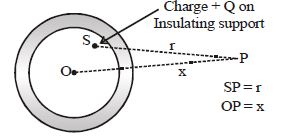
- 2The adjacent diagram shows a charge $+Q$ held on an insulating support $S$ and enclosed by a hollow spherical conductor. $O$ represents the centre of the spherical conductor. and $P$ is a point such that $OP = x $ and $SP = r$ . The electric field at point $P$ will beView Solution
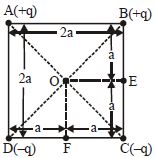
- 3The ratio of electric potentials at the point $E$ to that at the point $F$ isView Solution
- 4The area of each plate of a parallel plate capacitor is $20\,cm^2$ and separation between the plates is $2\,mm$. If dielectric strength of air is $3 \times 10^6\,V/m,$ the maximum possible value of emf of the battery, which can be connected across the plates of this capacitor and the corresponding charge on the plates isView Solution
- 5The capacitance of a parallel plate capacitor is $C$ when the region between the plate has air. This region is now filled with a dielectric slab of dielectric constant $k$. The capacitor is connected to a cell of $emf$ $E$, and the slab is taken outView Solution
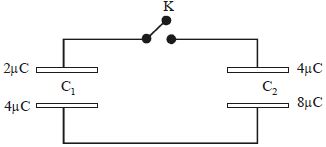
- 6Assertion : Charges are given to plates of two plane parallel plate capacitors $C_1$ and $C_2$ (such that $C_2 = 2C_1$ ) as shown in figure. Then the key $K$ is pressed to complete the circuit. Finally the net charge on upper plate and net charge the circuit. Finally the net charge on upper plate and net charge on lower plate of capacitor $C_1$ is positive.View Solution
Reason : In a parallel plate capacitor both plates always carry equal and opposite charge.
- 7Determine the electric field strength vector if the potential of this field depends on $x, y$ coordinates as $V=10$ axyView Solution
- 8Condenser $A$ has a capacity of $15\,\mu F$ when it is filled with a medium of dielectric constant $15$. Another condenser $B$ has a capacity of $1\,\mu F$ with air between the plates. Both are charged separately by a battery of $100\;V$. After charging, both are connected in parallel without the battery and the dielectric medium being removed. The common potential now is.....$V$View Solution
- 9Two charged particles of masses $m$ and $2m$ have charges $+2q$ and $+q$ respectively. They are kept in uniform electric field and allowed to move for some time. The ratio of their kinetic energies will beView Solution
- 10View SolutionDielectric constant for metal is