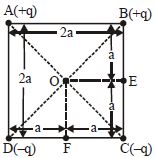
The ratio of electric potentials at the point $E$ to that at the point $F$ is
Medium


Download our appand get started for free
Experience the future of education. Simply download our apps or reach out to us for more information. Let's shape the future of learning together!No signup needed.*
Similar Questions
- 1The equivalent capacitance of three capacitors of capacitance ${C_1},{C_2}$ and ${C_3}$ are connected in parallel is $12$ units and product ${C_1}.{C_2}.{C_3} = 48$. When the capacitors ${C_1}$ and ${C_2}$ are connected in parallel, the equivalent capacitance is $6$ units. Then the capacitance areView Solution
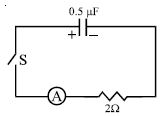
- 2A charged capacitor is allowed to discharge through a resistance $2\,\Omega $ by closing the switch $S $ at the instant $t = 0$. At time $t = ln$ $2$ $\mu s$, the reading of the ammeter falls half of its initial value. The resistance of the ammeter equal toView Solution
- 3A body of capacity $4\,\mu \,F$ is charged to $80\,V$ and another body of capacity $6\,\mu \,F$ is charged to $30\,V$. When they are connected the energy lost by $4\,\mu \,F$ capacitor is.......$mJ$View Solution
- 4An electron (charge = $1.6 \times {10^{ - 19}}$ $coulomb$) is accelerated through a potential of $1,00,000$ $volts$. The energy required by the electron isView Solution
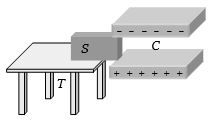
- 5A frictionless dielectric plate $S$ is kept on a frictionless table $T$. A charged parallel plate capacitance $C$ (of which the plates are frictionless) is kept near it. The plate $S$ is between the plates. When the plate $S$ is left between the platesView Solution
- 6A spherical drop of capacitance $1\,\,\mu F$ is broken into eight drops of equal radius. Then, the capacitance of each small drop is ......$\mu F$View Solution
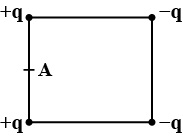
- 7Four electric charges $+q,+q, -q$ and $-q$ are placed at the comers of a square of side $2L$ (see figure). The electric potential at point $A,$ midway between the two charges $+q$ and $+q,$ isView Solution
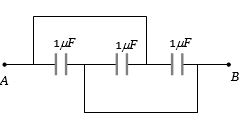
- 8The equivalent capacitance in the circuit between $A$ and $B$ will be.....$\mu \,F$View Solution
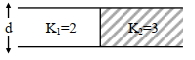
- 9A capacitor of $10 \mu \mathrm{F}$ capacitance whose plates are separated by $10 \mathrm{~mm}$ through air and each plate has area $4 \mathrm{~cm}^2$ is now filled equally with two dielectric media of $\mathrm{K}_1=2, \mathrm{~K}_2=3$ respectively as shown in figure. If new force between the plates is $8 \mathrm{~N}$. The supply voltage is . . . .. . .V.View Solution
- 10A capacitance of $2\ μF$ is required in an electrical circuit across a potential difference of $1.0\ kV$. A large number of $1\ μF$ capacitors are available which can withstand a potential difference of not more than $300\ V$. The minimum number of capacitors required to achieve this isView Solution