Question
The equation for the vibration of a string, fixed at both ends vibrating in its third harmonic, is given by$\text{y}=(0.4\text{cm})\sin\big[(0.314\text{cm}^{-1})\text{x}\big]\cos\big[(600\pi\text{s}^{-1})\text{t}\big]$
  1. What is the frequency of vibration?
  2. What are the positions of the nodes?
  3. What is the length of the string?
  4. What is the wavelength and the speed of two travelling waves that can interfere to give this vibration ?
Answer

The stationary wave equation is given by$\text{y}(0.4\text{cm})\sin\big[(0.314\text{cm}^{-1})\text{x}\big]\cos\big[(600\pi\text{s}^{-1})\text{t}\big]$
  1. $\omega=600\pi\Rightarrow2\pi\text{f}=600\pi\Rightarrow\text{f}=300\text{Hz}$
Wavelength,, $\lambda=\frac{2\pi}{0.314}=\frac{(2\times3.14)}{0.314}=20\text{cm}$
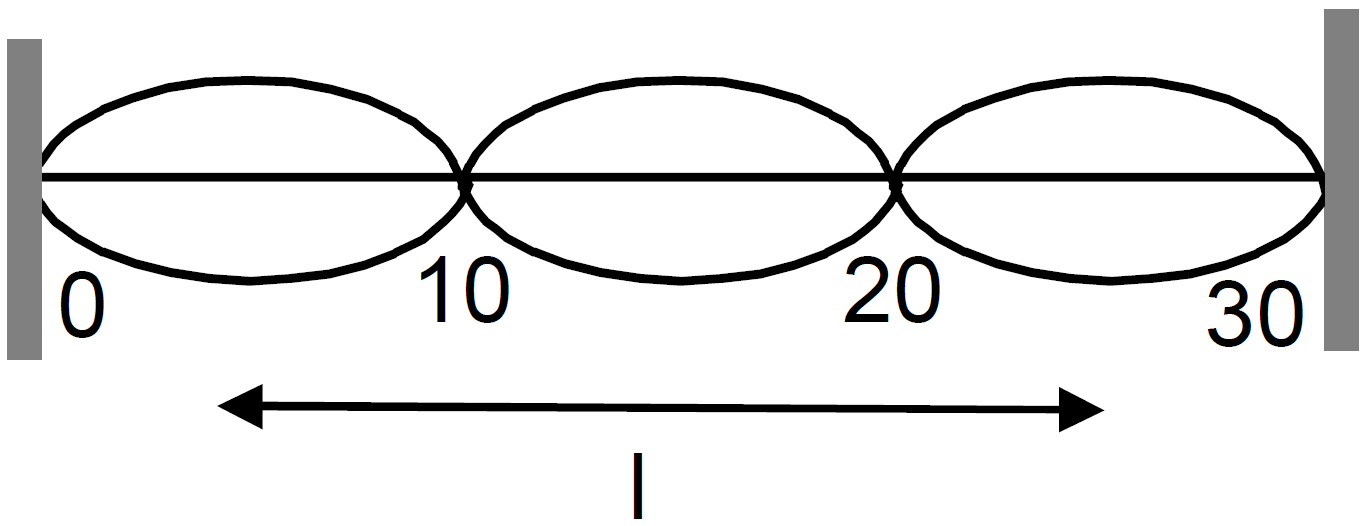
  1. Therefore nodes are located at, $0,\ 10\text{cm},\ 20\text{cm},\ 30\text{cm}$
  2. Length of the string $=\frac{3\lambda}{2}=3\times\frac{20}{2}=30\text{cm}$
  3. $\text{y}=0.4\sin(0.314\text{x})\cos(600\pi\text{t})$
$\Rightarrow0.4\sin\Big\{\big(\frac{\pi}{10}\big)\text{x}\Big\}\cos(600\pi\text{t})$
since $\lambda$ and $v$ are the wavelength and velocity of the waves that interfere to give this vibration $\lambda=20\text{cm}$
$\text{v}=\frac{\omega}{\text{k}}=6000\text{cm/sec}=60\text{m/s}$

Need a full question paper?

Generate a complete, print-ready paper with questions like this in minutes — across 16+ boards, with answer keys.

Start Generating Free

Similar questions

A body starting from rest accelerates uniformly along a straight line at the rate of $10ms^{-2}$? for 5 seconds. It moves for $2$ seconds with uniform velocity of $50ms^{-1}​​​​​​​$. Then it retards uniformly and comes to rest in $3s$. Draw velocity-time graph of the body and find the total distance travelled by the body.
A transverse wave described by$\text{y}=(0.02\text{m})\sin\Big[(1.0\text{m}^{-1})\text{x}+(30\text{s}^{-1})\text{t}\Big]$
propagates on a stretched string having a linear mass density of $1.2 \times 10^{-4}kg/m$. Find the tension in the string.
A particle starts from rest at $t = 0$ and has an acceleration as given in the figure below. Draw the v-t graph for $4$ seconds.
A uniform magnetic field B exists in a cylindrical region of radius 10cm as shown in figure. A uniform wire of length 80cm and resistance $4.0\Omega$ is bent into a square frame and is placed with one side along a diameter of the cylindrical region. If the magnetic field increases at a constant rate of 0.010T/s, find the current induced in the frame.
A body of mass 0.5kg travels in a straight line with velocity $\text{v}=\text{ax}^{3/2}$ where $\text{a}=5\text{m}^{-1/2}\text{s}^{-1}.$ What is the work done by the net force during its displacement from x = 0 to x = 2m?
Define centripetal acceleration. Give two examples.
State which of the following situations are possible and give an example for each of these?
  1. An object with a constant acceleration but with zero velocity.
  2. An object moving in a certain direction with acceleration in the perpendicular direction.
Write the expressions for $C_v$ and $C_p$ of a gas in terms of gas constant R and constant $\gamma,$ where $\gamma=\frac{\text{C}_\text{P}}{\text{C}_\nu}$
Two open tubes, whose length are 50 cm and 50.05 cm respectively. 10 beats are produced in 3 seconds. Find their fundamental frequencies.
Calculate the energy released by 1g of natural uranium assuming 200MeV is released in each fission event and that the fissionable isotope $^{235}U$ has an abundance of 0.7% by weight in natural uranium.