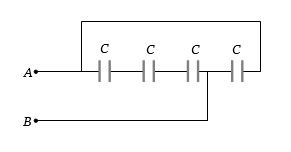
The equivalent capacitance between $A$ and $B$ is
Easy
Download our app for free and get started
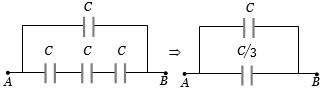
(d) ${C_{eq}} = \frac{C}{3} + C = \frac{{4C}}{3}$

Download our appand get started for free
Experience the future of education. Simply download our apps or reach out to us for more information. Let's shape the future of learning together!No signup needed.*
Similar Questions
- 1View SolutionA parallel plate capacitor after charging is kept connected to a battery and the plates are pulled apart with the help of insulating handles. Now which of the following quantities will decrease?
- 2A series combination of $n_1$ capacitors, each of value $C_1$ is charged by a source of potential difference $4\, V.$ When another parallel combination of $n_2$ capacitors, each of value $C_2,$ is charged by a source of potential difference $V$, it has the same (total) energy stored in it, as the first combination has. The value of $C_2,$ in terms of $C_1$ is thenView Solution
- 3Two point charges $-q$ and $+q$ are located at points $(0, 0, -a)$ and $(0, 0, a),$ respectively. The potential at a point $(0, 0, z)$ where $z > a$ isView Solution
- 4If on the $x$-axis electric potential decreases uniformly from $60 \,V$ to $20 \,V$ between $x=-2 \,m$ to $x=+2 \,m$, then the magnitude of electric field at the originView Solution
- 5View SolutionA table tennis ball which has been covered with conducting paint is suspended by a silk thread so that it hang between two plates, out of which one is earthed and other is connected to a high voltage generator. This ball
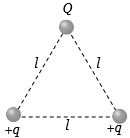
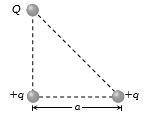
- 6Three charges $Q,\, + q$ and $ + q$ are placed at the vertices of a right-angled isosceles triangle as shown. The net electrostatic energy of the configuration is zero if $Q$ is equal toView Solution
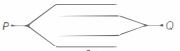
- 7Four metallic plates each of surface area (of one side) $A$, are placed at a distance $d$ apart from each other. The two outer plates are connected to a point $P$ and the two inner plates are connected to another point as shown in figure below. Then, the capacitance of the system isView Solution
- 8Two thin wire rings each having a radius $R$ are placed at a distance $d$ apart with their axes coinciding. The charges on the two rings are $ + q$ and $ - q$. The potential difference between the centres of the two rings isView Solution
- 9An electric dipole of moment $\vec p$ is lying along a uniform electric field $\vec E.$ The work done in rotating the dipole by $90^o $ isView Solution
- 10Three charges $Q,( + q)$ and $( + q)$ are placed at the vertices of an equilateral triangle of side l as shown in the figure. If the net electrostatic energy of the system is zero, then $Q$ is equal toView Solution