MCQ
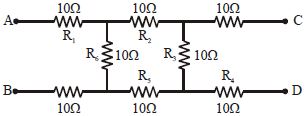
The equivalent resistance between the points $A$ and $D$ ................ $\Omega$
  • A
    $10$
  • B
    $20$
  • C
    $30$
  • D
    $40$

Answer

Need a full question paper?

Generate a complete, print-ready paper with questions like this in minutes — across 16+ boards, with answer keys.

Start Generating Free

Similar questions

The relative atomic masses of many elements are not whole numbers because:
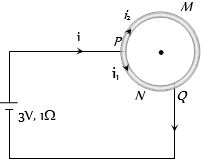
A wire of resistance $10$ $\Omega$ is bent to form a circle. $P$ and $Q$ are points on the circumference of the circle dividing it into a quadrant and are connected to a Battery of $3\, V$ and internal resistance $1$ $\Omega$ as shown in the figure. The currents in the two parts of the circle are
If an ammeter is to be used in place of a voltmeter then we must connect with the ammeter a
A plane electromagnetic wave travelling along the $X$-direction has a wavelength of $3\ mm$ . The variation in the electric field occurs in the $Y$-direction with an amplitude $66\  Vm^{-1}$. The equations for the electric and magnetic fields as a function of $x$ and $t$ are respectively :-
Width of slit in a single slit diffraction experiment such that $20$ maxima of double slit interference pattern are obtained within central maxima of the diffraction pattern is ....... $mm$ (Slit separation for double slit arrangement $=2 \,mm$ )
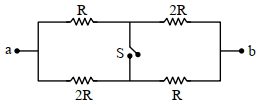
The ratio of the equivalent resistance of the network (shown in figure) between the points $a$ and ${b}$ when switch is open and switch is closed is ${x}: 8 .$ The value of ${x}$ is ..... .
A ray of light travelling inside a rectangular glass block of refractive index $\sqrt 2$ is incident on the glass–air surface at an angle of incidence of 45°. The refractive index of air is 1. Under these conditions the ray
Some electric bulbs are connected in series across a 220 V supply in a room. If one bulb is fused then remaining bulbs are connected again in series across the same supply. The illumination in the room will
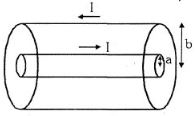
A long coaxial cable carries current $I$ (along its surface ). The current flows down the surface of inner cylinder of radius $a$ and back along the outer cylinder of radius $b$
Photoelectric emmision occurs only when the incident light has more than a certain minimum?