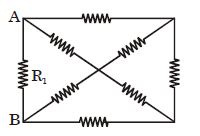
The equivalent resistance of resistors connected in series is always
Easy
Download our app for free and get started
(d) ${R_{{\rm{series}}}} = {R_1} + {R_2} + {R_3} + ......$

Download our appand get started for free
Experience the future of education. Simply download our apps or reach out to us for more information. Let's shape the future of learning together!No signup needed.*
Similar Questions
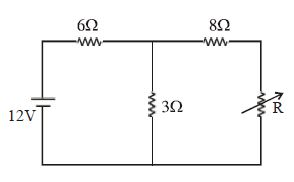
- 1The maximum power delivered to resistance $R$ is ............... $W$View Solution
- 2View SolutionConstantan wire is used in making standard resistances because its
- 3Resistance of a carbon resistor determined from colour codes is $(22000 \pm 5 \%) \Omega$. The colour of third band must be :View Solution
- 4$62.5 \times {10^{18}}$ electrons per second are flowing through a wire of area of cross-section $0.1\,{m^2}$, the value of current flowing will be ............ $A$View Solution
- 5View SolutionTo draw maximum current from a combination of cells, how should the cells be grouped
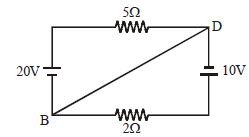
- 6Calculate the current in wire $BD$ ................ $A$View Solution
- 7View SolutionWhen a potential difference is applied across the ends of a linear metallic conductor
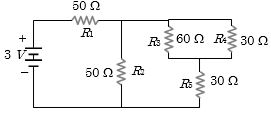
- 8In circuit shown below, the resistances are given in $ohms$ and the battery is assumed ideal with emf equal to $3\, volt$. The voltage across the resistance $R_4$ is ................. $V$View Solution
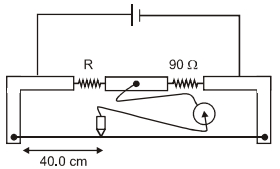
- 9During an experiment with a metre bridge, the galvanometer shows a null point when the joceky is pressed at $40.0 \ cm$ using a standard resistance of $90 \ \Omega$, as shown in the figure. The least count of the scale used in the meter bridge is $1 \ mm$. The unknown resistance is:View Solution
- 10As shown, the circuit is made of $8$ different resistors. It is found that when $R_1 = 4\,\,\Omega,$ the resistance between $A$ and $B$ is $2\,\,\Omega.$ Now replace $R_1$ by a $6\,\,\Omega$ resistor, what is the resistance between $A$ and $B$?View Solution