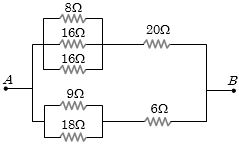
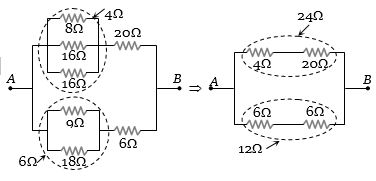
The equivalent resistance of the arrangement of resistances shown in adjoining figure between the points $A$ and $B$ is ............... $ohm$
Medium


Download our appand get started for free
Experience the future of education. Simply download our apps or reach out to us for more information. Let's shape the future of learning together!No signup needed.*
Similar Questions
- 1A heater of $220\, V$ heats a volume of water in $5\,\min$ time. A heater of $110\, V$ heats the same volume of water in ............... $min$View Solution
- 2Four resistances of $100$ $\Omega$ each are connected in the form of square. Then, the effective resistance along the diagonal points is .............. $\Omega$View Solution
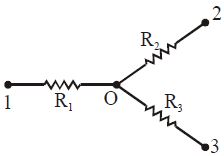
- 3.............. $A$ the current flowing through the resistance $R_2$ of the circuit shown in fig if the resistance are equal to $R_1 = 20\ \Omega, R_2 = 30 \ \Omega$ and $R_3 = 60 \ \Omega$ and potentials of points $1, 2$ and $3$ are equal to $V_1= 20\, V,$ $V_2 = 30\ V$ and $V_3 = 60\ V$View Solution
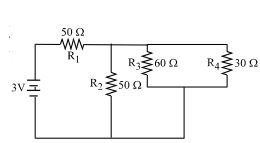
- 4In the circuit shown, the resistances are given in ohms and the battery is assumed ideal with $\mathrm{emf}$ equal to $3.0$ $\mathrm{volts}.$ The resistor that dissipates the most power isView Solution
- 5A galvanometer together with an unknown resistance in series is connected to two identical batteries each of $1.5\, V$. When the batteries are connected in series, the galvanometer records a current of $1\,A$, and when batteries are in parallel the current is $0.6\,A$. What is the internal resistance of the battery ?View Solution
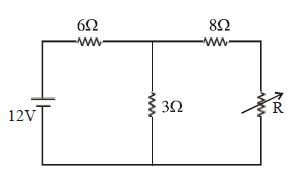
- 6A copper wire of length $10\,m$ and radius $\left(10^{-2} / \sqrt{\pi}\right) m$ has electrical resistance of $10 \,\Omega$. The current density in the wire for an electric field strength of $10( V / m )$ is :View Solution
- 7Give colors of the ring in sequence marked on a resistance of $56 \ k\Omega$ with tolerance $\pm 5\%$View Solution
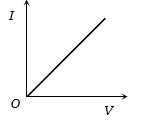
- 8$I-V$ characteristic of a copper wire of length $L$ and area of cross-section $A$ is shown in figure. The slope of the curve becomesView Solution
- 9Two electric bulbs, rated at $(25\, W, 220\, V)$ and $(100\, W, 220\, V)$, are connected in series acroos a $220\, V$ voltage source. If the $25\, W$ and $100\, W$ bulbs draw powers $P_1$ and $P_2$ respectively, thenView Solution
- 10The maximum power delivered to resistance $R$ is ............... $W$View Solution