Question
The excess pressure inside a soap bubble is twice the excess pressure inside a second soap bubble. The volume of the first bubble is n times the volume of the second where n is:
  1. 4
  2. 2
  3. 1
  4. 0.125.

Answer

  1. 0.125.
Explanation:
Let the excess pressure inside the second bubble be P.
$\therefore$ Excess pressure inside the first bubble = 2P
Let the radius of the second bubble be R.
Let the radius of the first bubble be x.
Excess pressure inside the 2nd soap bubble:
$\text{P}=\frac{4\text{s}}{\text{R}}\ \cdots(1)$
Excess pressure inside the 1 st soap bubble:
$2\text{P}=\frac{4\text{s}}{\text{x}}$
From (1), we get:
$2\Big(\frac{2\text{S}}{\text{R}}\Big)=\frac{\text{4S}}{\text{x}}$
$\Rightarrow\text{x}=\frac{\text{R}}{2}$
Volume of the fust bubble $=\frac{4}{3}\pi\text{x}^3$
Volume of the second bubble $=\frac{4}{3}\pi\text{x}^3$
$\Rightarrow\frac{4}{3}\pi\text{x}^3=\text{n}\frac{4}{3}\pi\text{R}^3$
$\Rightarrow\text {x}^3=\text{n}\text{R}^3$
$\Rightarrow\Big(\frac{\text{R}}{2}\Big)^3=\text{n}\text{R}^3$
$\Rightarrow\text{n}=\frac{1}{8}=0.125$

Need a full question paper?

Generate a complete, print-ready paper with questions like this in minutes — across 16+ boards, with answer keys.
Start Generating Free

Similar questions

The coil of the moving coil galvanometer is wound over an aluminium frame:
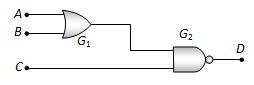
For the given combination of gates, if the logic states of inputs $\text{A, B, C}$ are as follows $A = B = C = 0$ and $A = B = 1, C = 0$ then the logic states of output $D$ are
Beta particle An unknown particle is being studied in a magnetic field of variable intensity and direction. When the magnetic field is turned off, the particle is observed to move toward the earth. When the magnetic field is turned on, the particle is observed to continue to move toward the earth, no matter the strength or the direction of the magnetic field. Which of the particles listed below is most likely the unknown particle?
The phenomenon of radioactivity is(a) Exothermic change which increases or decreases with temperature(b) Increases on applied pressure(c) Nuclear process does not depend on external factors (d) None of the above


Water is flowing in streamliries motion through a tube with its axis horizontal Consider two points A and B in the tube at the same horizontal level:
  1. The pressures at A and B are equal for any shape of the tube.
  2. The pressures are never equal.
  3. The pressures are equal if the tube has a uniform cross section.
  4. The pressures may be equal even if the tube has a nonuniform cross section.
$ 1 \text { Tesla = } $ $\qquad$ Gauss
Boolean algebra is essentially based on(a) Truth(b) Logic (c) Symbol(d) Numbers
       
Two infinitely long parallel conducting plates having surface charge densities $+\sigma$ and $-\sigma$ respectively, are separated by a small distance. The medium between the plates is vacuum. If $\varepsilon_0$ is the dielectric permittivity of vacuum, then the electric field in the region between the plates is
Two circuits have mutual inductance of 0.1 H. What average e.m.f. is induced in one circuit when the current in the other circuit changes from 0 to 20 A in 0.02 s(a) 240 V                                            (b) 230 V(c) 100 V(d) 300 V
       
Let the angle between two nonzero vectors $\overrightarrow{\text{A}}$ and $\overrightarrow{\text{B}}$ be 120° and its resultant be $\vec{\text{c}}:$
  1. C must be equal to $|\text{A}-\text{B}|$
  2. C must be less than $|\text{A}-\text{B}|$
  3. C must be greater than $|\text{A}-\text{B}|$
  4. C may be equal to $|\text{A}-\text{B}|$