MCQ
The expansion in volume of a substance due to increase in temperature does not depend :
  • A
    at temperature difference
  • B
    at initial volume
  • at initial temperature
  • D
    all of the above

Answer

Correct option: C.
at initial temperature
C

Need a full question paper?

Generate a complete, print-ready paper with questions like this in minutes — across 16+ boards, with answer keys.
Start Generating Free

Similar questions

A body thrown vertically up from the ground passes the height $10.2m$ twice at an interval of $10s.$ What was its initial velocity? $($in $m/ s)$
Three photons coming from excited atomic-hydrogen sample are picked up. Their energies are 12.1eV, 10.2 eV and 1.9eV. These photons must come from:
In a thermally isolated system, two boxes filled with an ideal gas are connected by a valve. When the valve is in closed position, states of the box $1$ and $2$ respectively, are ( $1 \,atm , V, T)$ and $(0.5 \,atm , 4 V, T)$. When the valve is opened, then the final pressure of the system is approximately ............... $atm$
Consider a mixture of oxygen and hydrogen kept at room temperature. AB compared to a hydrogen molecule an oxygen molecule hits the wall:
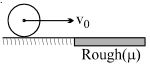
$A$ ring of mass $M$ and radius $R$ sliding with a velocity $v_0$ suddenly enters into rough surface where the coefficient of friction is $\mu$ , as shown in figure.  Choose the correct statement $(s)$
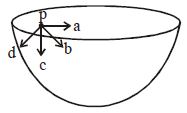
Figure shows a hemispherical shell. The direction of gravitational field intensity at point $p$ will be along
The dimensional formula ${M^0}{L^2}{T^{ - 2}}$ stands for

      Column $-I$

    Angle of projection

    Column $-II$
  $A.$ $\theta \, = \,{45^o}$   $1.$ $\frac{{{K_h}}}{{{K_i}}} = \frac{1}{4}$
  $B.$ $\theta \, = \,{60^o}$   $2.$ $\frac{{g{T^2}}}{R} = 8$
  $C.$ $\theta \, = \,{30^o}$   $3.$ $\frac{R}{H} = 4\sqrt 3 $
  $D.$ $\theta \, = \,{\tan ^{ - 1}}\,4$   $4.$ $\frac{R}{H} = 4$

$K_i :$ initial kinetic energy

$K_h :$ kinetic energy at the highest point

The number of significant figure in $6.25\times10^5$ is
A man throws balls with the same speed vertically upwards one after the other at an interval of $2\, seconds$. What should be the speed of the throw so that more than two balls are in the sky at any time (Given $g = 9.8\,m/{s^2}$)