MCQ
The dimensional formula ${M^0}{L^2}{T^{ - 2}}$ stands for
  • A
    Torque
  • B
    Angular momentum
  • Latent heat
  • D
    Coefficient of thermal conductivity

Answer

Correct option: C.
Latent heat
c
Latent Heat $L = \frac{Q}{m} = \frac{{{\rm{Energy}}}}{{{\rm{mass}}}} = \frac{{[M{L^2}{T^{ - 2}}]}}{{[M]}} = [{L^2}{T^{ - 2}}]$

Need a full question paper?

Generate a complete, print-ready paper with questions like this in minutes — across 16+ boards, with answer keys.
Start Generating Free

Similar questions

Let $\mathrm{n}_{\mathrm{r}}$ and $\mathrm{n}_{\mathrm{b}}$ be the number of photons emitted by a red bulb and a blue bulb, respectively, of equal power in a given time:
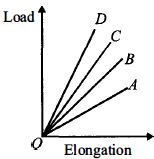
The load versus elongation graphs for four wires of same length and made of the same material are shown in the figure. The thinnest wire is represented by the line
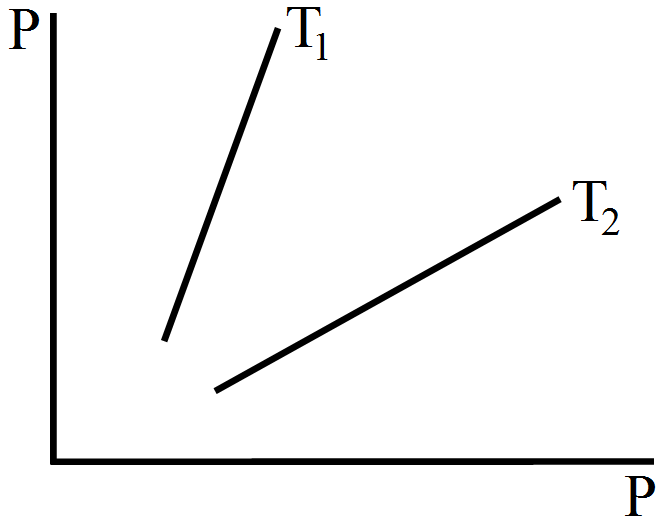
Figure. shows graphs of pressure vs density for an ideal gas at two temperatures $T_1$ and $T_2$.
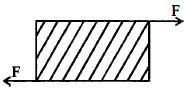
As shown in the figure, forces of $10^5\,N$ each are applied in opposite directions, on the upper and lower faces of a cube of side $10\,cm$, shifting the upper face parallel to itself by $0.5\,cm$ . If the side of another cube of the same material is, $20\,cm$ then under similar conditions as above, the displacement will be......... $cm$
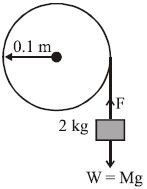
The moment of inertia of a solid flywheel about its axis is $0.1\,kg-m^2$. A tangential force of $2\,kg\,wt$. is applied round the circumference of the flyweel with the help of a string and mass arrangement as shown in the figure. If the radius of the wheel is $0.1\,m,$ find the angular acceleration of the solid fly wheel (in $rad/sec^2$)
A motor cyclist going round in a circular track at constant speed has
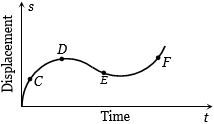
The displacement-time graph of moving particle is shown below. The instantaneous velocity of the particle is negative at the point
Two masses $m_1$ and $m_2$ are suspended together by a massless spring of spring constant $k.$ When the masses are in equilibrium $m_1$ is removed without disturbing the system, then the angular velocity of oscillation of $m_2$ is:
A uniform thin rod of length $l$ is suspended from one of its ends and is rotated at $f$ rotations per second. The rotational kinetic energy of the rod will be
The bob of a pendulum of length $1$ is pulled aside from its equilibrium position through an angle $\theta$ and then released. The bob will then pass through its equilibrium position with a speed $v,$ where $v$ equals: