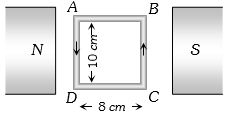
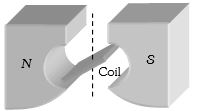
The figure below shows the north and south poles of a permanent magnet in which $n$ turn coil of area of cross-section $A$ is resting, such that for a current $ i$ passed through the coil, the plane of the coil makes an angle $\theta $ with respect to the direction of magnetic field $B.$ If the plane of the magnetic field and the coil are horizontal and vertical respectively, the torque on the coil will be
Medium
Download our app for free and get started
(a)Plane of coil is having angle $\theta $ with the magnetic field.
$\therefore \;\tau = MB\sin (90 - \theta )$ or $\tau = niAB\cos \theta $ [As $M =niA$]
$\therefore \;\tau = MB\sin (90 - \theta )$ or $\tau = niAB\cos \theta $ [As $M =niA$]

Download our appand get started for free
Experience the future of education. Simply download our apps or reach out to us for more information. Let's shape the future of learning together!No signup needed.*
Similar Questions
- 1A steel wire has a magnetic moment $M.$ What will be its magnetic moment if it is bent into a semi-circular arc ?View Solution
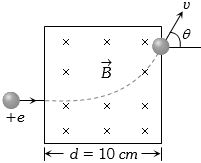
- 2A proton accelerated by a potential difference $500\;KV$ moves though a transverse magnetic field of $0.51\;T$ as shown in figure. The angle $\theta $through which the proton deviates from the initial direction of its motion is......$^o$View Solution
- 3At a specific instant emission of radioactive compound is deflected in a magnetic field. The compound can emitView Solution
$(i)$ Electrons $(ii)$ Protons $(iii)$ $H{e^{2 + }}$ $(iv)$ Neutrons
The emission at the instant can be
- 4Field at the centre of a circular coil of radius $r$, through which a current $I$ flows isView Solution
- 5The coil of a galvanometer consists of $100$ $turns$ and effective area of $1\, square-cm$. The restoring couple is ${10^{ - 8}}\,N - m/radian$. The magnetic field between the pole pieces is $5\, T$. The current sensitivity of this galvanometer will beView Solution
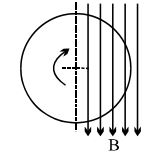
- 6A thin non conducting disc of radius $R$ is rotating clockwise (see figure) with an angular velocity $w$ about its central axis, which is perpendicular to its plane. Both its surfaces carry $+ve$ charges of uniform surface density. Half the disc is in a region of a uniform, unidirectional magnetic field $B$ parallel to the plane of the disc, as shown. Then,View Solution
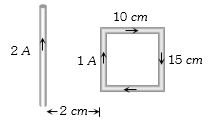
- 7View SolutionWhat is the net force on the square coil
- 8Two parallel wires of length $9\, m$ each are separated by a distance $0.15\, m$. If they carry equal currents in the same direction and exerts a total force of $30 \times 10^{-7} \,N$ on each other, then the value of current must be........$amp$View Solution
- 9A beam of protons with speed $4 \times 10^{5}\, ms ^{-1}$ enters a uniform magnetic field of $0.3\, T$ at an angle of $60^{\circ}$ to the magnetic field. The pitch of the resulting helical path of protons is close to....$cm$View Solution
(Mass of the proton $=1.67 \times 10^{-27}\, kg$, charge of the proton $=1.69 \times 10^{-19}\,C$)
- 10A $100$ $turns$ coil shown in figure carries a current of $2\, amp$ in a magnetic field $B = 0.2\,Wb/{m^2}$. The torque acting on the coil isView Solution