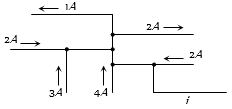
The figure here shows a portion of a circuit. What are the magnitude and direction of the current i in the lower right-hand wire .................... $A$
Medium
Download our app for free and get started
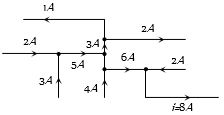
(b) By using Kirchoff's junction law as shown below.

Download our appand get started for free
Experience the future of education. Simply download our apps or reach out to us for more information. Let's shape the future of learning together!No signup needed.*
Similar Questions
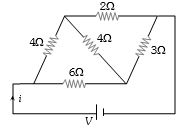
- 1For the network shown in the figure the value of the current $i$ isView Solution
- 2View SolutionElectric current has both magnitude and direction. It is a
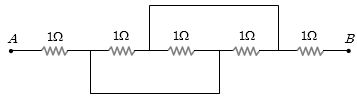
- 3Equivalent resistance between the points $A$ and $B$ is (in $\Omega$)View Solution
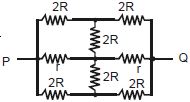
- 4The effective resistance between points $P$ and $Q$ of the electrical circuit shown in the figure isView Solution
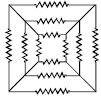
- 5Twelve resistors each of resistance $16 \,\Omega $ are connected in the circuit as shown. The net resistance between $AB$ (any two conjugate points of outer square) is ............... $\Omega$View Solution
- 6In a region $10^{19}$ $\alpha -$ particels and $10^{19}$ protons per second move to the left, while $10^{19}$ electrons moves to the right per second. The current isView Solution
- 7View SolutionA steel wire has a resistance twice that of an aluminium wire. Both of them are connected with a constant voltage supply. More heat will be dissipated in
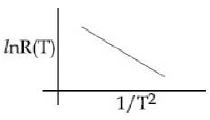
- 8View SolutionIn an experiment, the resistance of a material is plotted as a function of temperature (in some range). As shown in the figure, it is a straight line. One may conclude that:
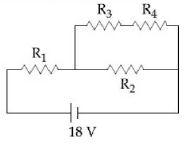
- 9In the given circuit the internal resistance of the $18\,V$ cell is negligible. If $R_1 = 400 \,\Omega ,\,R_3 = 100\,\Omega $ and $R_4 = 500\,\Omega $ and the reading of an ideal voltmeter across $R_4$ is $5\,V,$ then the value of $R_2$ will be ........... $\Omega$View Solution
- 10The length of a potentiometer wire is $l$. $A$ cell of $\mathrm{emf}$ $E$ is balanced at a length $l/3$ from the positive end of the wire. If the length of the wire is increased by $l/2$. At what distance will the same cell give a balance point.View Solution