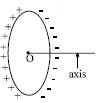
The figure shows a nonconducting ring which has positive and negative charge non uniformly distributed on it such that the total charge is zero. Which of the following statements is true?
A
The potential at all the points on the axis will be zero.
B
The electric field at all the points on the axis will be zero.
C
The direction of electric field at all points on the axis will be along the axis.
D
If the ring is placed inside a uniform external electric field then net torque and force acting on the ring would be zero.
Diffcult
Download our app for free and get started
A
The potential at all the points on the axis will be zero.
a By symmetry potential due to negative part $=$(potential due to particle part). (Also every small charge is equidistant from axis)
$\therefore$ Potential at all potential axis is zero
Direction of field is perpendicular to axis and towards negative side
There will be a torque when placed in uniform field
Download our app
and get started for free
Experience the future of education. Simply download our apps or reach out to us for more information. Let's shape the future of learning together!No signup needed.*
The parallel combination of two air filled parallel plate capacitors of capacitance $C$ and $nC$ is connected to a battery of voltage, $V$. When the capacitor are fully charged, the battery is removed and after that a dielectric material of dielectric constant $K$ is placed between the two plates of the first capacitor. The new potential difference of the combined system is
In a region, the potential is represented by $V(x, y, z) = 6x - 8xy - 8y + 6yz$, where $V$ is in volts and $x, y, z$ are in metres. The electric force experienced by a charge of $2$ coulomb situated at point $( 1, 1, 1)$ is
A point charge $q$ of mass $m$ is suspended vertically by a string of length $l$. A point dipole of dipole moment $\overrightarrow{ p }$ is now brought towards $q$ from infinity so that the charge moves away. The final equilibrium position of the system including the direction of the dipole, the angles and distances is shown in the figure below. If the work done in bringing the dipole to this position is $N \times( mgh )$, where $g$ is the acceleration due to gravity, then the value of $N$ is. . . . . . (Note that for three coplanar forces keeping a point mass in equilibrium, $\frac{F}{\sin \theta}$ is the same for all forces, where $F$ is any one of the forces and $\theta$ is the angle between the other two forces)
What will be the capacity of a parallel-plate capacitor when the half of parallel space between the plates is filled by a material of dielectric constant ${\varepsilon _r}$ ? Assume that the capacity of the capacitor in air is $C$
Let $C$ be the capacitance of a capacitor discharging through a resistor $R$. Suppose $t_{1}$ is the time taken for the energy stored in the capacitor to reduce to half its initial value and $t_{2}$ is the time taken for the charge to reduce to one-fourth its initial value. The the ratio $t _{1} / t _{2}$ will be
A capacitor having capacitance $C$ is charged to a voltage $V$. It is then removed and connected in parallel with another identical capacitor which is uncharged. The new charge on each capacitor is now