MCQ
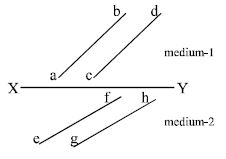
The figure shows a surface $XY$ separating two transparent media, medium - $1$ and medium- $2$. The lines $ab$ and $cd$ represent wavefronts of a light wave traveling in medium- $1$ and incident on $XY$. The lines $ef$ and $gh$ represent wavefronts of the light wave in medium- $2$ after refraction.

The phases of the light wave at $c, d, e$ and $f$ are $\phi_c,\phi_d, \phi_e$ and $\phi_f$  respectively. It is given that $\phi_c \neq \phi_f.$
  • A
    $\phi_c$ cannot be equal to $\phi_d$
  • B
    $\phi_d$ can be equal to $\phi_e$
  • $(\phi_d -\phi_f)$ is equal to $(\phi_c -\phi_e)$
  • D
    $(\phi_d -\phi_c)$ is not equal to $(\phi_f -\phi_e)$
Answer

Correct option: C.
$(\phi_d -\phi_f)$ is equal to $(\phi_c -\phi_e)$
c
$\phi_{c}=\phi_{d}$

$\phi_{e}=\phi_{f}$

on subtracts

$\phi_{c}-\phi_{e}=\phi_{d}-\phi_{f}$

Need a full question paper?

Generate a complete, print-ready paper with questions like this in minutes — across 16+ boards, with answer keys.

Start Generating Free

Similar questions

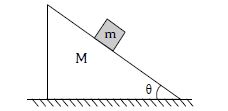
A block of mass $m$ slides down on a wedge of mass $M$ as shown in figure. Let $\vec a_1$ be the acceleration of the wedge and $\vec a_2$  the acceleration of block w.r.t. ground. $N_1$ is the normal reaction between block and wedge and $N_2$ the normal reaction between wedge and ground. Friction is absent everywhere. Select the incorrect alternative
A milli voltmeter of $25$ $milli$ $volt$ range is to be converted into an ammeter of $25$ $ampere$ range. The value (in $ohm$) of necessary shunt will be
The minimum frequency $\nu $ of continuous $X-$ rays is related to the applied potential difference $V$ as
Two discs of same thickness but of different radii are made of two different materials such that their masses are same. The densities of the materials are in the ratio $1 : 3$.  The moments of inertia of these discs about the respective axes passing through their centres and perpendicular to their planes will be in the ratio 
The total charge enclosed in an incremental volume of $2 \times 10^{-9} \,{m}^{3}$ located at the origin is ...... $nC,$ if electric flux density of its field is found as $D=e^{-x} \sin y \hat{i}-e^{-x} \cos y \hat{j}+2 z \hat{k}\, C / m^{2}$
A conductor has $14.4 \times {10^{ - 19}}coulombs$ positive charge. The conductor has(Charge on electron $ = 1.6 \times {10^{ - 19}}coulombs$)
Put a uniform meter scale horizontally on your extended index fingers with the left one at $0.00 cm$ and the right one at $90.00 cm$. When you attempt to move both the fingers slowly towards the center, initially only the left finger slips with respect to the scale and the right finger does not. After some distance, the left finger stops and the right one starts slipping. Then the right finger stops at a distance $x_R$ from the center ( $50.00 cm$ ) of the scale and the left one starts slipping again. This happens because of the difference in the frictional forces on the two fingers. If the coefficients of static and dynamic friction between the fingers and the scale are $0.40$ and $0.32$ , respectively, the value of $x_R($ in $cm )$ is. . . . . . . 
Which of the following can form diminished, virtual and erect image of your face.
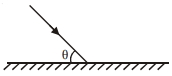
A ball of mass $m$ moving with speed $u$ collides with a smooth horizontal surface at angle $\theta$ with it as shown in figure. The magnitude of impulse imparted to surface by ball is [Coefficient of restitution of collision is $e$]
To an astronaut in a spaceship, the sky appears