MCQ
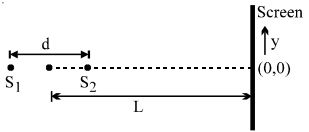
The figure shows two points source which emit light of wavelength $\lambda$ in phase with each other and are at a distance $d = 5.5 \lambda$ apart along a line which is perpendicular to a large screen at a distance $L$ from the centre of the source. Assume that $d$ is much less than $L$. Which of the following statement is (are) correct?
  • A
    Only five bright fringes appear on the screen
  • B
    Only six bright fringes appear on the screen
  • C
    Point $y = 0$ corresponds to dark fringe.
  • Both $(A)$ and $(C)$

Answer

Correct option: D.
Both $(A)$ and $(C)$
d

Need a full question paper?

Generate a complete, print-ready paper with questions like this in minutes — across 16+ boards, with answer keys.

Start Generating Free

Similar questions

The number of turns in an air core solenoid of length $25cm$ and radius $4cm$ is $100.$ Its self inductance will be.
The key feature of Bohr's theory of spectrum of hydrogen atom is the quantization of angular momentum when an electron is revolving around a proton. We will extend this to a general rotational motion to find quantized rotational energy of a diatomic molecule assuming it to be rigid. The rule to be applied is Bohr's quantization condition.

$1.$ A diatomic molecule has moment of inertia I. By Bohr's quantization condition its rotational energy in the $\mathrm{n}^{\text {th }}$ level ( $\mathrm{n}=0$ is not allowed) is

$(A)$ $\frac{1}{\mathrm{n}^2}\left(\frac{\mathrm{h}^2}{8 \pi^2 \mathrm{I}}\right)$ $(B)$ $\frac{1}{\mathrm{n}}\left(\frac{\mathrm{h}^2}{8 \pi^2 \mathrm{I}}\right)$

$(C)$ $n\left(\frac{h^2}{8 \pi^2 \mathrm{I}}\right)$ $(D)$ $\mathrm{n}^2\left(\frac{\mathrm{h}^2}{8 \pi^2 \mathrm{I}}\right)$

$2.$ It is found that the excitation frequency from ground to the first excited state of rotation for the $\mathrm{CO}$ molecule is close to $\frac{4}{\pi} \times 10^{11} \mathrm{~Hz}$. Then the moment of inertia of $\mathrm{CO}$ molecule about its centre of mass is close to (Take $\mathrm{h}=2 \pi \times 10^{-34} \mathrm{Js}$ )

$(A)$ $2.76 \times 10^{-46} \mathrm{~kg} \mathrm{~m}^2$ $(B)$ $1.87 \times 10^{-46} \mathrm{~kg} \mathrm{~m}^2$

$(C)$ $4.67 \times 10^{-47} \mathrm{~kg} \mathrm{~m}^2$ $(D)$ $1.17 \times 10^{-47} \mathrm{~kg} \mathrm{~m}^2$

$3.$ In a $\mathrm{CO}$ molecule, the distance between $\mathrm{C}$ (mass $=12$ a.m.u) and $\mathrm{O}$ (mass $=16$ a.m.u.), where $1$ a.m.u. $=\frac{5}{3} \times 10^{-27} \mathrm{~kg}$, is close to

$(A)$ $2.4 \times 10^{-10} \mathrm{~m}$ $(B)$ $1.9 \times 10^{-10} \mathrm{~m}$

$(C)$ $1.3 \times 10^{-10} \mathrm{~m}$ $(D)$ $4.4 \times 10^{-11} \mathrm{~m}$

Give the answer question $1,2$ and $3.$
Earth magnetic field at equator is approximately $0.4\,G$ then earth's dipole moment would be (nearly) (ralius of earth $= 6.4 \times 10^6\,m$ )
The angle of a prism is $60^{\circ}$. When light is incident at an angle of $60^{\circ}$ on the prism, the angle of emergence is $40^{\circ}$. The angle of incidence $i$ for which the light ray will deviate the least is such that
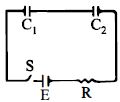
In the following circuit, the switch $S$  is closed at $t = 0.$  The charge on the capacitor  $C_1$  as a function of time will be given by $\left( {{C_{eq}}\, = {\kern 1pt} \,\frac{{{C_1}{C_2}}}{{{C_1} + {C_2}}}} \right).$
The number of dry cells, each of $e.m.f.$ $1.5\,volt$ and internal resistance $0.5\, ohm$ that must be joined in series with a resistance of $20\, ohm$ so as to send a current of $0.6\,A$ through the circuit is
Susceptibility of ferromagnetic substance is
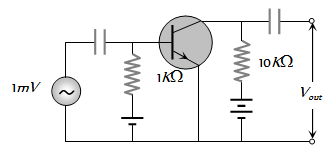
In the following common emitter configuration an NPN transistor with current gain b = 100 is used. The output voltage of the amplifier will be
Uniform electric field of magnitude $100$ $V/m$ in space is directed along the line $y = 3 + x$. Find the potential difference between point $A$ $ (3, 1)$ $\&$ $B$ $(1, 3)$.......$V$
Electric potential at an equatorial point of a small dipole with dipole moment $P$ ($r$, distance from the dipole) is