MCQ
The first ball of mass $m$ moving with the velocity $v$ collides head on with the second ball of mass $m$ at rest. If the coefficient of restitution is $e$, then the ratio of the velocities of the first and the second ball after the collision is:
  • $\frac{1-\text{ e}}{1+\text{ e}}$
  • B
    $\frac{1+\text{e}}{1-\text{e}}$
  • C
    $\frac{1+ \text{ e}}{2}$
  • D
    $\frac{1-\text{ e}}{2}$

Answer

Correct option: A.
$\frac{1-\text{ e}}{1+\text{ e}}$
Here, $\text{m}_1=\text{m}_2=\text{m},\text{u}_1=\text{u},\text{u}_2=0$.
Let $\text{v}_1,\text{v}_2$ be their velocities after collision.
According to principle of conservation of linear momentum.
$\text{mu}+0=\text{m}(\text{v}_1+\text{v}_2)$ or $\text{ v}_1+\text{v}_2=\text{u}\dots\text{(i})$
By definition,
$\text{e}=\frac{\text{v}_2-\text{v}_1}{\text{u}-0}$ or $\text{ v}_2-\text{v}_1=\text{eu}\dots\text{(ii)}$
Add $(i)$ and $(ii),$
$\text{v}_2=\frac{\text{u(1+ e)}}{2}$
$\therefore\frac{\text{v}_1}{\text{v}_2}=\frac{1-\text{ e}}{1+\text{ e}}$

Need a full question paper?

Generate a complete, print-ready paper with questions like this in minutes — across 16+ boards, with answer keys.

Start Generating Free

Similar questions

Let $\overrightarrow{\text{A}}$ be a unit vector along the axis of rotation of a purely rotating body and $\overrightarrow{\text{B}}$ be a unit vector along the velocity of a particle P of the body away from the axis. The value of $\overrightarrow{\text{A}}.\overrightarrow{\text{B}}$ is:
Two trains, one coming towards and another going away from an observer both at $4\; m/s$ produce whistle simultaneously of frequency $300 \;Hz$. Find the number of beats produced
A road is banked at an angle of $30^o$ to the horizontal for negotiating a curve of radius $10\sqrt 3 m$. At what velocity will a car experience no friction while negotiating the curve? ............... $km/hr$
A person says that he measured the acceleration of a particle to be non-zero while no force was acting on the particle:
The sum of three forces ${\vec F_1} = 100\,N,{\vec F_2} = 80\,N$ and ${\vec F_3} = 60\,N$ acting on a particle is zero. The angle between $\vec F_1$ and $\vec F_2$ is nearly .......... $^o$
A stone of mass $1\,kg$ is tied to end of a massless string of length $1\,m$. If the breaking tension of the string is $400\,N$, then maximum linear velocity, the stone can have without breaking the string, while rotating in horizontal plane, is $.......\,ms^{-1}$
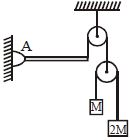
Consider the situation shown in the figure. Uniform rod of length $L$ can rotate freely about the hinge $A$ in vertical plane. Pulleys and string are light and frictionless. If therod remains horizontal at rest when the system is released then the mass of the rod is :
Which of the following can not determine the state of a thermodynamic system
A diwali rocket of mass $100\,g$ lifts up with acceleration of $5\,m/s^2$. If gases eject out of rocket at a rate of $10\,g/s$, then find the velocity of ejection of gas w.r.t rocket. ............ $m/s$
Water and turpentine oil (specific heat less than that of water) are both heated to same temperature. Equal amounts of these placed in identical calorimeters are then left in air