In suspended type moving coil galvanometer, quartz suspension is used because
Easy


Download our appand get started for free
Experience the future of education. Simply download our apps or reach out to us for more information. Let's shape the future of learning together!No signup needed.*
Similar Questions
- 1A force of ${10^3}$ newton stretches the length of a hanging wire by $1$ millimetre. The force required to stretch a wire of same material and length but having four times the diameter by $1$ millimetre isView Solution
- 2On applying a stress of $20 \times {10^8}N/{m^2}$ the length of a perfectly elastic wire is doubled. Its Young’s modulus will beView Solution
- 3The Young's modulus of a steel wire of length $6\,m$ and cross-sectional area $3\,mm ^2$, is $2 \times 11^{11}\,N / m ^2$. The wire is suspended from its support on a given planet. A block of mass $4\,kg$ is attached to the free end of the wire. The acceleration due to gravity on the planet is $\frac{1}{4}$ of its value on the earth. The elongation of wire is (Take $g$ on the earth $=10$ $\left.m / s ^2\right):$View Solution
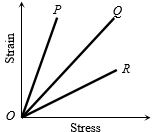
- 4The strain-stress curves of three wires of different materials are shown in the figure. $P, Q$ and $R$ are the elastic limits of the wires. The figure shows thatView Solution
- 5A wire suspended vertically from one end is stretched by attaching a weight $200 \,N$ to the lower end. The weight stretches the wire by $1 \,mm$. The elastic potential energy gained by the wire is ....... $J$View Solution
- 6Force constant of a spring $(K)$ is synonymous toView Solution
- 7The pressure that has to be applied to the ends of a steel wire of length $10\ cm$ to keep its length constant when its temperature is raised by $100^o C$ is: (For steel Young's modulus is $2 \times 10^{11}$ $Nm^{-1}$ and coefficient of thermal expansion is $1.1 \times 10^{-5}$ $K^{-1}$ )View Solution
- 8One end of a slack wire (Young's modulus $Y$, length $L$ and cross-sectional area $A$ ) is clamped to a rigid wall and the other end to a block (mass $m$ ), which rests on a smooth horizontal plane. The block is set in motion with a speed $v$. What is the maximum distance, then the block will travel after the wire becomes taut?View Solution
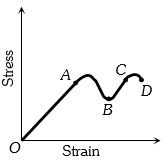
- 9In the below graph, point $D$ indicatesView Solution
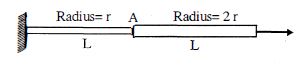
- 10Two steel wires of same length but radii $r$ and $2r$ are connected together end to end and tied to a wall as shown. The force stretches the combination by $10\ mm$ . How far does the midpoint $A$ move ......... $mm$View Solution