Question
The following techniques are used to quantitatively estimate extra elements in organic compound. Identify the name of the method and the element estimated by this method.
  1. A known mass of an organic compound is heated with fuming HNO3 in presence of AgNO3.
  2. Organic compound is heated with dry copper oxide in atmosphere of CO2.
  3. Organic compound is heated with conc. H2SO4.
Answer

  1. Estimation of halogen by Carius method.
  2. Estimation of nitrogen by Dumas method.
  3. Estimation of nitrogen by Kjeldahl's method.

Need a full question paper?

Generate a complete, print-ready paper with questions like this in minutes — across 16+ boards, with answer keys.

Start Generating Free

Similar questions

How many $\sigma$ and $\sigma-$bonds are present in $\text{CH}_2=\text{C}-\text{CH}=\text{CH}_2?$
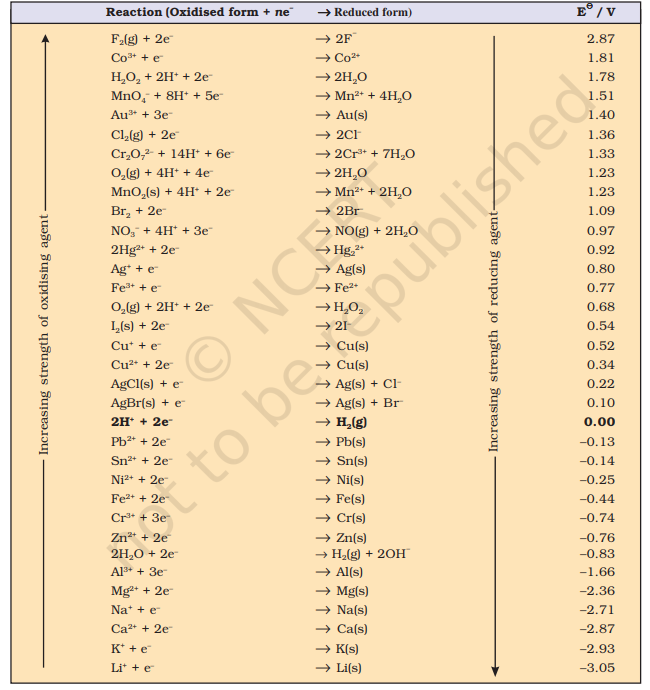
Using the standard electrode potentials given in the Table, predict if the reaction between the following is feasible:

Ag+(aq) and Cu(s).

Which of the following has higher dipole moment:
1-butene or 1-butyne, why?
Give the appropriate reason.
  1. It is preferable to determine the change in enthalpy rather than the change in internal energy.
  2. It is necessary to define the 'standard state'.
  3. It is necessary to specify the phases of the reactants and products in a thermochemical equation.
The reaction, $\text{CO (g) + 3H}_2\text{ (g)}\rightleftharpoons\text{CH}_4\text{ (g) + }\text{H}_2\text{O (g)}$

is at equilibrium at 1300K in a 1L flask. It also contain 0.30mol of CO, 0.10molof H2 and 0.02mol of H2O and an unknown amount of CH4 in the flask. Determine the concentration of CH4 in the mixture. The equilibrium constant, Kc for the reaction at the given temperature is 3.90.


An ideal gas is allowed to expand against a constant pressure of 2 bar from 10L to 50L in one step. Calculate the amount of work done by the gas. If the same expansion were carried out reversibly, will the work done be higher or lower than the earlier case? (Given that 1L bar = 100J)
If ice and water are in equilibrium at $0^{\circ} C$ then $\Delta H =6.0 kJ mol ^{-1}$. Find value of $\Delta S$ and $\Delta G$.
Calculate the standard enthalpy of formation of $CH _3 OH ( l )$ from the following data :
(i) $CH _3 OH ( l )+\frac{3}{2} O _2(g) \rightarrow CO _2(g)+2 H _2 O ( l )$;$\Delta_r H ^{\ominus}=-726 kJ mol ^{-1}$
(ii) C (graphite) $+ O _2(g) \rightarrow CO _2(g)$;$\Delta_c H ^{\ominus}=-393 kJ mol ^{-1}$
(iii) $H _2(g)+\frac{1}{2} O _2(g) \rightarrow H _2 O ( l ) ; \Delta_f H ^{\ominus}=-286 kJ mol ^{-1}$.
Calculate the pH of the resultant mixtures:
10mL of 0.2M Ca(OH)2 + 25mL of 0.1M HCl
Yellow light emitted from a sodium lamp has a wavelength $(\lambda)$ of 580 nm. Calculate the frequency (ν) and wavenumber $(\bar{\text{v}})$ of the yellow light.