MCQ
The force constant of a wire does not depend on
  • A
    Nature of the material
  • B
    Radius of the wire
  • C
    Length of the wire
  • None of the above

Answer

Correct option: D.
None of the above
d
(d) $K = \frac{{YA}}{L} = \frac{{Y \times \pi {r^2}}}{L} \Rightarrow K \propto \frac{{Y{r^2}}}{L}$

i.e. force constant of a wire depends on young's modules (nature of the material), radius of the wire and length of the wire.

Need a full question paper?

Generate a complete, print-ready paper with questions like this in minutes — across 16+ boards, with answer keys.
Start Generating Free

Similar questions

A missile is fired for maximum range at your town from a place $100\, km$ away from you. If the missile is first detected at its half way point, how much warning time will you have ? (Take $g = 10\, m/s^2$) what was the speed of missile when it was detected ?
If two vectors $\vec{A}$ and $\vec{B}$ having equal magnitude $\mathrm{R}$ are inclined at an angle $\theta$, then
A body executes simple harmonic motion under the action of a force $F_1$ with a time period $(4/5)\, sec$. If the force is changed to $F_2$ it executes $SHM$ with time period $(3/5)\, sec$. If both the forces $F_1$ and $F_2$ act simultaneously in the same direction on the body, its time period (in $seconds$ ) is
The apparent frequency of a note, when a listener moves towards a stationary source, with velocity of $40 m/s$ is $200 Hz$. When he moves away from the same source with the same speed, the apparent frequency of the same note is $160 Hz$. The velocity of sound in air is (in $m/s$)
It is desired to increase the fundamental resonance frequency in a tube which is closed at one end. This can be achieved by
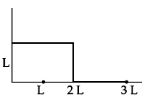
The position vector of the centre of mass $\vec r\, cm$ of an asymmetric uniform bar of negligible area of cross-section as shown in figure is
Two plates $A$ and $B$ have thermal conductivities $84\,Wm ^{-1}\,K ^{-1}$ and $126\,Wm ^{-1}\,K ^{-1}$ respectively. They have same surface area and same thickness. They are placed in contact along their surfaces. If the temperatures of the outer surfaces of $A$ and $B$ are kept at $100^{\circ}\,C$ and $0{ }^{\circ}\,C$ respectively, then the temperature of the surface of contact in steady state is $..........\,{ }^{\circ} C$.
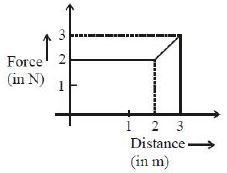
A particle moves in one dimension from rest under the influence of a force that varies with the distance traveled by the particle as shown in the figure. The kinetic energy of the particle after it has traveled $3\, m$ is ................ $\mathrm{J}$
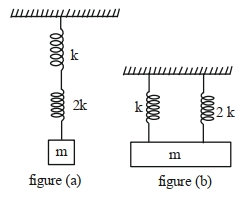
As per given figures, two springs of spring constants $K$ and $2\,K$ are connected to mass $m$. If the period of oscillation in figure $(a)$ is $3 s$, then the period of oscillation in figure $(b)$ will be $\sqrt{ x }$ s. The value of $x$ is$.........$
$STATEMENT- 1$ The total translational kinetic energy of all the molecules of a given mass of an ideal gas is $1.5$ times the product of its pressure and its volume. because

$STATEMENT-2$ The molecules of a gas collide with each other and the velocities of the molecules change due to the collision.