The force constant of a wire does not depend on
Medium


Download our appand get started for free
Experience the future of education. Simply download our apps or reach out to us for more information. Let's shape the future of learning together!No signup needed.*
Similar Questions
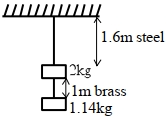
- 1Two wires each of radius $0.2\,cm$ and negligible mass, one made of steel and other made of brass are loaded as shown in the figure. The elongation of the steel wire is $.........\times 10^{-6}\,m$. [Young's modulus for steel $=2 \times 10^{11}\,Nm ^{-2}$ and $g =10\,ms ^{-2}$ ]View Solution
- 2If Young's modulus of iron is $2 \times {10^{11}}\,N/{m^2}$ and the interatomic spacing between two molecules is $3 \times {10^{ - 10}}$metre, the interatomic force constant is ......... $N/m$View Solution
- 3The interatomic distance for a metal is $3 \times {10^{ - 10}}\,m$. If the interatomic force constant is $3.6 \times {10^{ - 9}}\,N/{{\buildrel _{\circ} \over {\mathrm{A}}}}$, then the Young's modulus in $N/{m^2}$ will beView Solution
- 4The work done per unit volume to stretch the length of area of cross-section $2 \,mm ^2$ by $2 \%$ will be ....... $MJ / m ^3$ $\left[Y=8 \times 10^{10} \,N / m ^2\right]$View Solution
- 5A wire of length $L$ and cross-sectional area $A$ is made of a material of Young's modulus $Y.$ It is stretched by an amount $x$. The work done isView Solution
- 6$K$ is the force constant of a spring. The work done in increasing its extension from ${l_1}$ to ${l_2}$ will beView Solution
- 7The lower surface of a cube is fixed. On its upper surface, force is applied at an angle of $30°$ from its surface. The change will be of the typeView Solution
- 8On applying a stress of $20 \times {10^8}N/{m^2}$ the length of a perfectly elastic wire is doubled. Its Young’s modulus will beView Solution
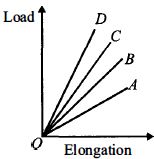
- 9View SolutionThe load versus elongation graphs for four wires of same length and made of the same material are shown in the figure. The thinnest wire is represented by the line
- 10A rigid bar of mass $15\,kg$ is supported symmetrically by three wire each of $2 \,m$ long. These at each end are of copper and middle one is of steel. Young's modulus of elasticity for copper and steel are $110 \times 10^9 \,N / m ^2$ and $190 \times 10^9 \,N / m ^2$ respectively. If each wire is to have same tension, ratio of their diameters will be $ ............$View Solution