The interatomic distance for a metal is $3 \times {10^{ - 10}}\,m$. If the interatomic force constant is $3.6 \times {10^{ - 9}}\,N/{{\buildrel _{\circ} \over {\mathrm{A}}}}$, then the Young's modulus in $N/{m^2}$ will be
Medium


Download our appand get started for free
Experience the future of education. Simply download our apps or reach out to us for more information. Let's shape the future of learning together!No signup needed.*
Similar Questions
- 1Overall changes in volume and radii of a uniform cylindrical steel wire are $0.2 \%$ and $0.002 \%$ respectively when subjected to some suitable force. Longitudinal tensile stress acting on the wire is ($Y = 2.0 × 10^{11} Nm^{-2}$)View Solution
- 2A wire of length $L$ and radius $r$ is clamped rigidly at one end. When the other end of the wire is pulled by a force $f$, its length increases by $l$. Another wire of same material of length $2 L$ and radius $2 r$ is pulled by a force $2 f$. Then the increase in its length will beView Solution
- 3View SolutionThe quality of the material which opposes the change in shape, volume or length is called
- 4If the potential energy of a spring is $V$ on stretching it by $2\, cm$, then its potential energy when it is stretched by $10 \,cm$ will beView Solution
- 5View SolutionIf the length of a wire is reduced to half, then it can hold the ......... load
- 6If average depth of an ocean is $4000 \mathrm{~m}$ and the bulk modulus of water is $2 \times 10^9 \mathrm{Nm}^{-2}$, then fractional compression $\frac{\Delta V}{V}$ of water at the bottom of ocean is $\alpha \times 10^{-2}$. The value of $\alpha$ is ___________(Given, $\mathrm{g}=10 \mathrm{~ms}^{-2}, \rho=1000 \mathrm{~kg} \mathrm{~m}^{-3}$ )View Solution
- 7Consider two wires of same material having their ratio of radii to be $2: 1$. If these two wires are stretched by equal force, then the ratio of stress produced in them isView Solution
- 8If the compressibility of water is $\sigma $ per unit atmospheric pressure, then the decrease in volume $V$ due to $P$ atmospheric pressure will beView Solution
- 9The breaking stress of aluminium is $7.5 \times 10^7 \,Nm ^{-2}$. The greatest length of aluminium wire that can hang vertically without breaking is ......... $\times 10^3 \,m$ (Density of aluminium is $2.7 \times 10^3 \,kg m ^{-3}$ )View Solution
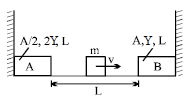
- 10In the given figure, two elastic rods $A$ & $B$ are rigidly joined to end supports. $A$ small mass $‘m’$ is moving with velocity $v$ between the rods. All collisions are assumed to be elastic & the surface is given to be frictionless. The time period of small mass $‘m’$ will be : [$A=$ area of cross section, $Y =$ Young’s modulus, $L=$ length of each rod ; here, an elastic rod may be treated as a spring of spring constant $\frac{{YA}}{L}$ ]View Solution