Question
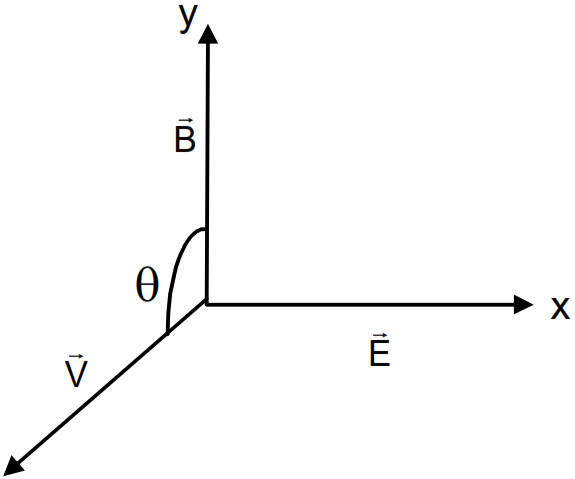
The force on a charged particle due to electric and magnetic fields is given by $\overrightarrow{\text{F}}=\text{q}\overrightarrow{\text{E}}+\text{q}\overrightarrow{\text{v}}\times\overrightarrow{\text{B}}.$ Suppose $\overrightarrow{\text{E}}$ is along the X-axis and $\overrightarrow{\text{B}}$ along the Y-axis. In what direction and with what minimum speed v should a positively charged particle be sent so that the net force on it is zero?
Answer

Given $\overrightarrow{\text{F}}=\text{q}\overrightarrow{\text{E}}+\text{q}(\overrightarrow{\text{v}}\times\overrightarrow{\text{B}})=0$$\Rightarrow\overrightarrow{\text{E}}=-(\overrightarrow{\text{v}}\times\overrightarrow{\text{B}})$
So, the direction of $\overrightarrow{\text{v}}\times\overrightarrow{\text{B}}$ should be opposite to the direction of $\overrightarrow{\text{E}}.$ Hence, $\overrightarrow{\text{v}}$ should be in the positive yz-plane. Again, $\text{E = vB}\sin\theta\Rightarrow\text{v}=\frac{\text{E}}{\text{B}\sin\theta}$ For v to be minimum, $\theta=90^{\circ}$ and so $\text{v}_{\text{min}}=\frac{\text{F}}{\text{B}}$ So, the particle must be projected at a minimum speed of E/B along +ve z-axis$(\theta=90^{\circ})$ as shown in the figure, so that the force is zero.

Need a full question paper?

Generate a complete, print-ready paper with questions like this in minutes — across 16+ boards, with answer keys.

Start Generating Free

Similar questions

Name three conservation laws from nature.
A body rotates about a fixed axis with an angular acceleration of one radian/ second/ second. Through what angle does it rotate during the time in which its angular velocity increases from 5rad/s to 15rad/s.
Define temperature on the basis of the zeroth law of thermodynamics.
Estimate the number of collisions per second suffered by a molecule in a sample of hydrogen at STP. The mean free path (average distance covered by a molecule between successive collisions) $=1.38 \times 10^{-5} \mathrm{~cm}$.
Pressure of a gas in a closed cylinder is expressed in the following way : $\text{P}=\text{P}_\text{a}+\text{h}\rho\text{g}$
Identify the expressions for:
  1. Absolute pressure of the gas.
  2. Gauge pressure of the gas.
Is a 'single isolated force' possible in nature?
Can a particle have acceleration at an instant if its velocity is zero at that instant? Give example.
Light from Balmer series of hydrogen is able to eject photoelectrons from a metal. What can be the maximum work function of the metal?
Give the magnitude and direction of the net force acting on a stone of mass 0.1 kg , (Neglect air resistance throughout.) Just after it is dropped from the window of a train accelerating with $1 \mathrm{~ms}^{-2}$.
A body starts from rest and moves along a straight line. It has uniformly accelerated motion upto time $t_1$. During the interval $t_2-t_1$ it moves with uniform velocity. After time $t_2$ its motion is retarded, and it comes to rest at time $t_3$. Draw the velocity-time graph.