Question
The force per unit charge is known as ____________.

Answer

  1. Electric field
Explanation:
The force per unit charge is known as the electric field.

Need a full question paper?

Generate a complete, print-ready paper with questions like this in minutes — across 16+ boards, with answer keys.
Start Generating Free

Similar questions

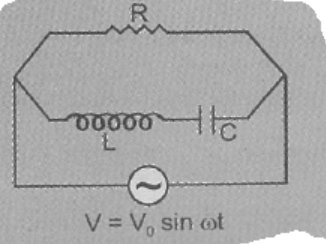
The Current in resistance $R$ at resonance is.
Image
Assertion :   A paramagnetic sample display greater magnetisation (for the same magnetising field) when cooled.
Reason     : The magnetisation does not depend on temperature.(a) If both assertion and reason are true and the reason is the correct explanation of the assertion.(b) If both assertion and reason are true but reason is not the correct explanation of the assertion.(c) If assertion is true but reason is false.(d) If the assertion and reason both are false.


Let the angle between two nonzero vectors $\overrightarrow{\text{A}}$ and $\overrightarrow{\text{B}}$ be 120° and its resultant be $\vec{\text{c}}:$
  1. C must be equal to $|\text{A}-\text{B}|$
  2. C must be less than $|\text{A}-\text{B}|$
  3. C must be greater than $|\text{A}-\text{B}|$
  4. C may be equal to $|\text{A}-\text{B}|$
A proton of energy 8 eV is moving in a circular path in a uniform magnetic field. The energy of an alpha particle moving in the same magnetic field and along the same path will be (a) 4 eV(b) 2 eV(c) 8 eV   (d) 6 eV
       
Putting a dielectric substance between two plates of condenser, capacity, potential and potential energy respectively(a) Increase, decrease, decrease(b) Decrease, increase, increase(c) Increase, increase, increase(d) Decrease, decrease, decrease
   
   
The length of a conductor is doubled and its radius is halved, its specific resistance is:
Radius of ${ }_{\mathrm{f}}^4 \mathrm{He}$ nucleus is $3$ Fermi. The radius of ${ }_{\mathrm{f}}^{206} \mathrm{~Pb}$ nucleus will be
The electric potential at a point $(x, y)$ in the $x - y$ plane is given by $V = -kxy$. The field intensity at a distance $r$ from the origin varies as
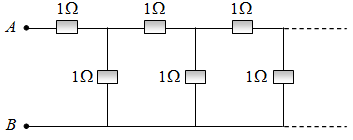
The equivalent resistance between points $A$ and $B$ of an infinite network of resistances each of $1 \Omega$ connected as shown, is
The value of yellow colour in colour code in carbon resistance :