Question
The force which makes magnet move:

Answer

  1. Magnetic field
Explanation:
Magnetic field created by the electric coils in the guideway walls and track propel the magnet to move forward.

Need a full question paper?

Generate a complete, print-ready paper with questions like this in minutes — across 16+ boards, with answer keys.
Start Generating Free

Similar questions

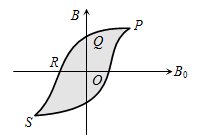
The figure illustrate how $B$, the flux density inside a sample of unmagnetised ferromagnetic material varies with $B_0,$ the magnetic flux density in which the sample is kept. For the sample to be suitable for making a permanent magnet
 
If the path difference between the slits $S_1$​ and $S_2​$ is $\lambda$, the central fringe will have an intensity of$:$
An electric dipole is put in north-south direction in a sphere filled with water. Which statement is correct
A thick wire is stretched so that its length become two times. Assuming that there is no change in its density, then what is the ratio of change in resistance of wire to the initial resistance of wire(a) 2 : 1(b) 4 : 1(c) 3 : 1(d) 1 : 4
       
A Young's double slit experiment is performed with white light:
  1. The central fringe will be white.
  2. There will not be a completely dark fringe.
  3. The fringe next to the central will be red.
  4. The fringe next to the central will be violet.
The change in frequency due to Doppler effect does not depend on:
  1. The speed of the source.
  2. The speed of the observer.
  3. The frequency of the source.
  4. Separation between the source and the observer.
A voltmeter of resistance 1000 Ω  gives full scale deflection when a current of 100 mA flow through it. The shunt resistance required across it to enable it to be used as an ammeter reading 1 A at full scale deflection is(a) 10000 Ω(b) 9000 Ω(c) 222 Ω(d) 111 Ω
       
Colours observed on a CD (Compact Disk) is due to
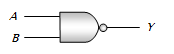
Which gates is represented by this figure
A point object O is placed on the principal axis of a convex lens of focal length 20 cm at a distance of 40 cm to the left of it. The diameter of the lens is 10 cm. If the eye is placed 60 cm to the right of the lens at a distance h below the principal axis, then the maximum value of h to see the image will be(a) 0 (b) 5 cm(c) 2.5 cm(d) 10 cm