The frequency of a tuning fork is $256\, Hz$. The velocity of sound in air is $344\, ms^{-1}$. The distance travelled (in $meters$) by the sound during the time in which the tunning fork complete $32$ vibrations is
Medium


Download our appand get started for free
Experience the future of education. Simply download our apps or reach out to us for more information. Let's shape the future of learning together!No signup needed.*
Similar Questions
- 1Two trains $A$ and $B$ are moving with speeds $20 \mathrm{~m} / \mathrm{s}$ and $30 \mathrm{~m} / \mathrm{s}$ respectively in the same direction on the same straight track, with $B$ ahead of $A$. The engines are at the front ends. The engine of train $A$ blows a long whistle.View Solution
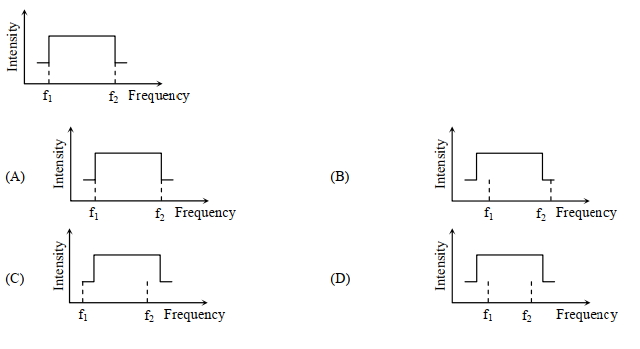
Assume that the sound of the whistle is composed of components varying in frequency from $f_1=800 \mathrm{~Hz}$ to $f_2=1120 \mathrm{~Hz}$, as shown in the figure. The spread in the frequency (highest frequency - lowest frequency) is thus $320 \mathrm{~Hz}$. The speed of sound in still air is $340 \mathrm{~m} / \mathrm{s}$.
$1.$ The speed of sound of the whistle is
$(A)$ $340 \mathrm{~m} / \mathrm{s}$ for passengers in $A$ and $310 \mathrm{~m} / \mathrm{s}$ for passengers in $B$
$(B)$ $360 \mathrm{~m} / \mathrm{s}$ for passengers in $A$ and $310 \mathrm{~m} / \mathrm{s}$ for passengers in $B$
$(C)$ $310 \mathrm{~m} / \mathrm{s}$ for passengers in $A$ and $360 \mathrm{~m} / \mathrm{s}$ for passengers in $B$
$(D)$ $340 \mathrm{~m} / \mathrm{s}$ for passengers in both the trains
$2.$ The distribution of the sound intensity of the whistle as observed by the passengers in train $\mathrm{A}$ is best represented by
$Image$
$3.$ The spread of frequency as observed by the passengers in train $B$ is
$(A)$ $310 \mathrm{~Hz}$ $(B)$ $330 \mathrm{~Hz}$ $(C)$ $350 \mathrm{~Hz}$ $(D)$ $290 \mathrm{~Hz}$
Give the answer question $1,2$ and $3.$
- 2The equation of the progressive wave, where $t$ is the time in second, $x$ is the distance in metre is $y=A \cos 240\left(t-\frac{x}{12}\right)$. The phase difference (in $SI$ units) between two positions $0.5 \,m$ apart is ...........View Solution
- 3View SolutionLearned Indian classical vocalists do not like the accompaniment of a harmonium because
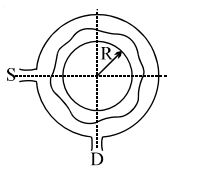
- 4A narrow tube is bent in the form of a circle of radius $R,$ as shown in the figure. Two small holes $S$ and $D$ are made in the tube at the positions right angle to each other. A source placed at $S$ generated a wave of intensity $I_0$ which is equally divided into two parts : One part travels along the longer path, while the other travels along the shorter path. Both the part waves meet at the point $D$ where a detector is placed The maximum value of $\lambda$ to produce a maxima at $D$ is given byView Solution
- 5An open pipe resonates with a tuning fork of frequency $500 Hz$. it is observed that two successive nodes are formed at distances $16$ and $46 cm $ from the open end. The speed of sound in air in the pipe is ..... $m/s$View Solution
- 6Two waves are given by ${y_1} = a\sin (\omega t - kx)$ and ${y_2} = a\cos (\omega \,t - kx)$ The phase difference between the two waves isView Solution
- 7A sound source $S$ is moving along a straight track with speed $v,$ and is emitting sound of frequency $v_{o}$ (see figure). An observer is standing at a finite clistance, at the point $O$, from the track. The time variation of frequency heard by the observer is best represented byView Solution
$\left(t_{0}\right.$ represents the instant when the distance between the source and observer is minimum)
- 8Two cars are approaching each other at an equal speed of $7.2\, km / hr$. When they see each other, both blow horns having frequency of $676\, Hz$. The beat frequency heard by each driver will be $.....\, Hz$. [Velocity of sound in air is $340\,m / s .]$View Solution
- 9A closed pipe of length $10 \,cm$ has its fundamental frequency half that of the second overtone of an open pipe. The length of the open pipe ......... $cm$View Solution
- 10A car $'A'$ chasing another car $'B'$ with a speed of $20\, m/s$ sounding a horn of $180\, Hz$. While both cars are moving towards a stationary siren of frequency $170\, Hz$. What is the speed of car $B$ so that it can't hear any beat ....$m/s$ (speed of sound $= 340\, m/s$)View Solution