The frequency of a whistle of an engine is $600\, cycles/sec$ is moving with the speed of $30 \,m/sec$ towards an observer. The apparent frequency will be .... $cps$ (velocity of sound $= 330 \,m/s$)
Medium
Download our app for free and get started
(b) $n' = n\,\left( {\frac{v}{{v - {v_S}}}} \right) = 600\,\left( {\frac{{330}}{{300}}} \right) = 660$ $cps$

Download our appand get started for free
Experience the future of education. Simply download our apps or reach out to us for more information. Let's shape the future of learning together!No signup needed.*
Similar Questions
- 1$Assertion :$ When a beetle moves along the sand within a few tens of centimeters of a sand scorpion, the scorpion immediately turns towards the beetle and dashes towards itView Solution
$Reason :$ When a beetle disturbs the sand, it sends pulses along the sand's surface. One set of pulses is longitudinal while the other set is transverse. - 2View SolutionTwo waves of same frequency and intensity superimpose with each other in opposite phases, then after superposition the
- 3It is found that an increase in pressure of $100\, kPa$ causes a certain volume of water to decrease by $5 × 10^{-3}$ percent of its original volume. Then the speed of sound in the water is about .... $m/s$ (density of water $10^3 \,kg/m^3$)View Solution
- 4A sinusoidal progressive wave is generated in a string. It’s equation is given by $y = (2\,\, mm) sin (2\pi x - 100 \pi t + \pi /3)$. The time when particle at $x = 4$ $m$ first passes through mean position, will beView Solution
- 5The equation of a wave on a string of linear mass density $0.04\, kgm^{-1}$ is given by : $y = 0.02\,\left( m \right)\,\sin \,\left[ {2\pi \left( {\frac{t}{{0.04\left( s \right)}} - \frac{x}{{0.50\left( m \right)}}} \right)} \right]$. The tension in the string is ..... $N$View Solution
- 6When a sound wave of frequency $300 Hz$ passes through a medium the maximum displacement of a particle of the medium is $0.1 cm$. The maximum velocity of the particle is equal toView Solution
- 7View SolutionA musical scale is constructed by providing intermediate frequencies between a note and its octave which
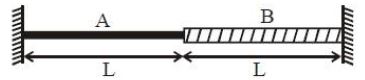
- 8A wire of length $2\,L$ is made by joining two wires $A$ and $B$ of same lengths but different radii $r$ and $2r$ and made of the same material. It is vibrating at a frequency such that the joint of the two wires forms a node. If the number of antinodes in wire $A$ is $p$ and that in $B$ is $q$ then the ratio $p : q$ isView Solution
- 9If the threshold of hearing is assumed to be the reference $(0\ dB)$ , then the threshold of pain is taken to be $120\ dB$ . Let the corresponding sound intensities be $I_0$ and $I$ respectively. Then $\frac{{{I_0}}}{I}$ isView Solution
- 10Which of the following functions for $y$ can never represent a travelling wave?View Solution
$(a)$ $\left(x^2-v t\right)^2$
$(b)$ $\log \left[\frac{(x+v t)}{x_0}\right]$
$(c)$ $e^{\left\{-\frac{(x+v t)}{x_0}\right\}^2}$
$(d)$ $\frac{1}{x+v t}$