Question
The frequency order of for $\gamma-$ rays $(b)\; X-$ rays $(a)\; UV-$ rays $(c)$

Answer

(a)${\nu _{\gamma - rays}} > {\nu _{X - rays}} > {\nu _{UV - rays}}$

Need a full question paper?

Generate a complete, print-ready paper with questions like this in minutes — across 16+ boards, with answer keys.
Start Generating Free

Similar questions

The difference between the apparent frequency of a source of sound as perceived by an observer during its approach and recession is $2\%$ of the natural frequency of the source. If the velocity of sound in air is $300 \,m/sec,$ the velocity of the source is ... $m/sec$ (It is given that velocity of source $<<$ velocity of sound)
If $I = 50\,kg-m^2$ , then ......... $N-m$ torque will be applied to stop it in $10\,sec$ . Its initial angular speed is $20\,rad/sec$ 
Electrons accelerated from rest by an electrostatic potential are collimated and sent through a Young's double slit experiment. The fringe width is $\omega$. If the accelerating potential is doubled, then the width is now close to ............. $\omega$
The force constants of two springs are ${K_1}$ and ${K_2}$. Both are stretched till their elastic energies are equal. If the stretching forces are ${F_1}$ and ${F_2}$, then ${F_1}:{F_2}$ is
Which of the following is the longitudinal wave
A flask contains argon and oxygen in the ratio of $3: 2$ in mass and the mixture is kept at $27^{\circ} C$. The ratio of their average kinetic energy per molecule respectively will be ...........
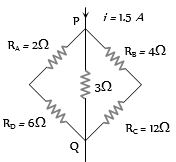
Potential difference between the points $P$ and $Q$ in the electric circuit shown is ................. $V$
A proton of mass $m$ collides elastically with a particle of unknown mass at rest. After the collision, the proton and the unknown particle are seen moving at an angle of $90^o$ with respect to each other. The mass of unknown particle is
When a glass rod is rubbed with silk, it
An electron is constrained to move along the $y-$axis with a speed of $0.1\, c$ (c is the speed of light) in the presence of electromagnetic wave, whose electric field is $\overrightarrow{ E }=30 \hat{ j } \sin \left(1.5 \times 10^{7} t -5 \times 10^{-2} x \right)\, V / m$ The maximum magnetic force experienced by the electron will be: (given $c=3 \times 10^{8}\, ms ^{-1}$ and electron charge $\left.=1.6 \times 10^{-19} C \right)$