MCQ
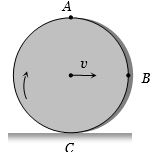
A solid disc rolls clockwise without slipping over a horizontal path with a constant speed $\upsilon $. Then the magnitude of the velocities of points $A, B$ and $C$ (see figure) with respect to a standing
  • A
    $\upsilon ,\,\upsilon {\rm{ \,and\, }}\upsilon $
  • $2\upsilon ,\,\sqrt 2 \upsilon {\rm{ \,and\,}}\,{\rm{zero}}$
  • C
    $2\upsilon ,\,2\upsilon {\rm{\,and\,}}\,{\rm{zero}}$
  • D
    $2\upsilon ,\,\sqrt 2 \upsilon {\rm{\,and\,}}\,\sqrt 2 \upsilon $
Answer

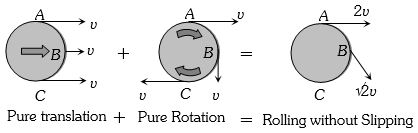
Correct option: B.
$2\upsilon ,\,\sqrt 2 \upsilon {\rm{ \,and\,}}\,{\rm{zero}}$
b
(b)

Need a full question paper?

Generate a complete, print-ready paper with questions like this in minutes — across 16+ boards, with answer keys.

Start Generating Free

Similar questions

Boyle’s law is applicable for an:
Velocity of sound in air

$I.$ Increases with temperature

$II.$ Decreases with temperature

$III.$ Increase with pressure

$IV.$ Is independent of pressure

$V.$ Is independent of temperature

Choose the correct answer.

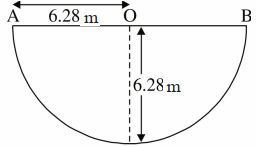
When a particle moving in a circular orbit of radius 6.28 meters reaches from one end of the diameter to the other, then the ratio between the distance covered and the displacement will be :
Image
A projectile is thrown into space so as to have a maximum possible horizontal range of $400$ metres. Taking the point of projection as the origin, the co-ordinates of the point where the velocity of the projectile is minimum are
A cylinder of $5$ litre capacity, filled with air at $N.T.P.$ is connected with another evacuated cylinder of $30$ litres of capacity. The resultant air pressure in both the cylinders will be ...... $cm$ of $Hg$
A cyclist taking turn bends inwards while a car passenger taking same turn is thrown outwards. The reason is
A pendulum bob on a $2\, m$ string is displaced $60^{°}$ from the vertical and then released. What is the speed of the bob as it passes through the lowest point in its path .......... $m/s$
The type of waves that can be propagated through solid is
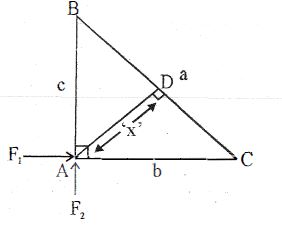
Two forces acting on point $A$ along their side and having magnitude reciprocal to length of side then resultant of these forces will be proportional to
The angle between vectors $\vec a$ and $\vec b$ is $\frac{\pi }{6}$. The angle between vectors $ - 3\vec a$ and $ 2\vec b$ is