MCQ
The function $f : A \rightarrow B$ defined by $f(x) = -x^2 + 6x- 8$ is a bijection if,
  • $\text{A}=(-\infty,3]$ and $\text{B}=(-\infty,1]$
  • B
    $\text{A}=[-3,\infty)$ and $\text{B}=(-\infty,1]$
  • C
    $\text{A}=(-\infty,3]$ and $\text{B}=[1,\infty)$
  • D
    $\text{A}=[3,\infty)$ and $\text{B}=[1,\infty)$
Answer

Correct option: A.
$\text{A}=(-\infty,3]$ and $\text{B}=(-\infty,1]$
$f(x) = -x^2 + 6x - 8,$ is a polynomial function and the domain of polynomial function is real number.
$\therefore\ \text{x}\in\text{R}$
$f(x) = -x^2 + 6x - 8$
$= -(x^2 - 6x + 8)$
$= -(x^2 - 6x + 9 - 1)$
$= -(x - 3)^2 + 1$
Maximum value of $-(x - 3)^2$ woud be $0$
$\therefore$ Maximum value of $-(x - 3)^2 + 1$ woud be $1$
$\therefore\ \text{f(x)}\in(-\infty,1]$

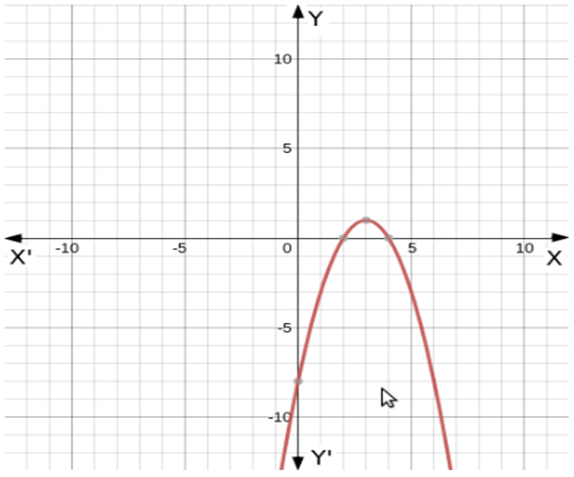
We can see from the given graph that function is symmetrical about $x = 3$ and the given function is bijective.
So$, x$ would be either $(-\infty,3]\text{ or }[3,\infty)$
The correct option which satisfy $A$ and $B$ both is :
$\text{A}=(-\infty,3]$ and $\text{B}=(-\infty,1]$

Need a full question paper?

Generate a complete, print-ready paper with questions like this in minutes — across 16+ boards, with answer keys.

Start Generating Free

Similar questions

If a line has the direction ratio 18, 12, 4, then its direction cosines are:
$\int_{0}^{\frac{\pi^2}{4}}\frac{\sin\sqrt{\text{y}}}{\sqrt{\text{y}}}.$
  1. $1$
  2. $2$
  3. $\frac{\pi}{4}$
  4. $\frac{\pi^2}{8}$
$\int\limits^\text{e}_1\log\text{x}\text{ dx}=$
  1. 1
  2. e - 1
  3. e + 1
  4. 0
A bag $X$ contains $2$ white and $3$ black balls and another bag $Y$ contains $4$ white and $2$ black balls. One bag is selected at random and a ball is drawn from it. Then, the probability chosen to be white is,
Feasible region for an L.P.P. is shown shaded in the following figure. Minimum of $Z=4 x+3 y$ occurs at the point
Image
A line makes angles $\alpha, \beta$ and $\gamma$ with the co-ordinate axes. If $\alpha+\beta=90^{\circ}$, then the value of angle $\gamma$ is
If order of a matrix is 3 × 3, then it is a?
  1. square matrix
  2. rectangular matrix
  3. unit matrix
  4. None of these
Which of the following equation is a linear differential equation of order 3?
[Note: The original question asks for linear equation, but it should be linear differential equation]:
  1. $\frac{\text{d}^3\text{y}}{\text{dx}^3}+\frac{\text{d}^2\text{y}\text{ dx}}{\text{dx}^2\text{dx}}+\text{y}=\text{x}$
  2. $\frac{\text{d}^3\text{y}}{\text{dx}^3}+\frac{\text{d}^2\text{y}}{\text{dx}^2}+\text{y}^2=\text{x}^2$
  3. $\text{x}\frac{\text{d}^3\text{y}}{\text{dx}^3}+\frac{\text{d}^2\text{y}}{\text{dx}^2}=\text{e}^\text{x}$
  4. $\frac{\text{d}^2\text{y}}{\text{dx}^2}+\frac{\text{dy}}{\text{dx}}=\log\text{x}$
Find the value of $p$ for which the points $(−5, 1), (1, p)$ and $(4, −2)$ are collinear.
$\int e ^{5 \log x} dx$ is equal to: