Question
The function f(x) will be discontinuous at x = a if f(x) has
  • Discontinuity of first kind : $\lim\limits_{\text{h}\rightarrow0}\text{f}(\text{a}-\text{h})$ and $\lim\limits_{\text{h}\rightarrow0}\text{f}(\text{a}+\text{h})$ both exist but are not equal. If is also known as irremovable discontinuity.
  • Discontinuity of second kind : If none of the limits $\lim\limits_{\text{h}\rightarrow0}\text{f}(\text{a}-\text{h})$ and $\lim\limits_{\text{h}\rightarrow0}\text{f}(\text{a}+\text{h})$ exist.
  • Removable discontinuity : $\lim\limits_{\text{h}\rightarrow0}\text{f}(\text{a}-\text{h})$ and $\lim\limits_{\text{h}\rightarrow0}\text{f}(\text{a}+\text{h})$ both exist and equal but not equal to f(a).
Based on the above information, answer the following questions.
  1. If $\text{f}(\text{x})=\begin{cases}\frac{\text{x}^2-9}{\text{x}-3},&\text{for x}\neq3\\4,&\text{for x}=3\end{cases},$ then at x = 3
  1. f has removable discontinuity.
  2. f is continuous.
  3. f has irremovable discontinuity.
  4. None of these.
  1. Let $\text{f}(\text{x})=\begin{cases}\text{x}+2,&\text{if x}\leq4\\\text{x}+4,&\text{if x}\geq4\end{cases}$ then at x = 4
  1. f is continuous.
  2. f has removable discontinuit.
  3. f has irremovable discontinuit.
  4. None of thesee.
  1. Consider the function f(x) defined as $\text{f}(\text{x})=\begin{cases}\frac{\text{x}^2-4}{\text{x}-2},&\text{for x}\neq2\\5,&\text{for x}=2\end{cases},$ then at x = 2
  1. f has removable discontinuity.
  2. f has irremovable discontinuity.
  3. f is continuous.
  4. f is continuous if f(2) = 3
  1. If $\text{f}(\text{x})=\begin{cases}\frac{\text{x}-|\text{x}|}{\text{x}},&\text{x}\neq0\\2,&\text{x}=0\end{cases},$ then at x = 0
  1. f is continuous.
  2. f has removable discontinuity.
  3. f has irremovable discontinuity.
  4. None of these.
  1. If $\text{f}(\text{x})=\begin{cases}\frac{\text{e}^\text{x}-1}{\log(1+2\text{x})},&\text{if x}\neq0\\7,&\text{if x}=0\end{cases},$ then at x = 0
  1. fis continuous if f(0) = 2
  2. f is continuous
  3. f has irremovable discontinuity.
  4. f has removable discontinuity.

Answer

  1. (a) f has removable discontinuity.

Solution:

f(3) = 4

$\lim\limits_{\text{x}\rightarrow3}\text{f}(\text{x})=\lim\limits_{\text{x}\rightarrow3}\frac{\text{x}^2-9}{\text{x}-3}=\lim\limits_{\text{x}\rightarrow3}\frac{(\text{x}+3)(\text{x}-3)}{(\text{x}-3)}$

$=\lim\limits_{\text{x}\rightarrow3}(\text{x}+3)=6\because\lim\limits_{\text{x}\rightarrow3}\text{f}(\text{x})\neq\text{f}(3)$

$\therefore$ f(x) has removable discontinuity at x = 3.

  1. (c) f has irremovable discontinuit.

Solution:

$\lim\limits_{\text{x}\rightarrow4^-}\text{f}(\text{x})=\lim\limits_{\text{x}\rightarrow4}(\text{x}+2)=4+2=6$

$\lim\limits_{\text{x}\rightarrow4^+}\text{f}(\text{x})=\lim\limits_{\text{x}\rightarrow4}(\text{x}+4)=4+4=8$

$\therefore\lim\limits_{\text{x}\rightarrow4^-}\text{f}(\text{x})\neq\lim\limits_{\text{x}\rightarrow4^+}\text{f}(\text{x})$

$\therefore$ f(x) has an irremovable discontinuity at x = 4.

  1. (a) f has removable discontinuity.

Solution:

$\lim\limits_{\text{x}\rightarrow2}\text{f}(\text{x})=\lim\limits_{\text{x}\rightarrow2}\frac{(\text{x}^2-4)}{(\text{x}-2)}=\lim\limits_{\text{x}\rightarrow2}(\text{x}+2)=4$

and f(2) = 5 (given) $\therefore\lim\limits_{\text{x}\rightarrow2}\text{f}(\text{x})\neq\text{f}(2)$

$\therefore$ f(x) has removable discontinuity at x = 2.

  1. (c) f has irremovable discontinuity.

Solution:

f(0) = 2

$\lim\limits_{\text{x}\rightarrow0^-}\text{f}(\text{x})=\lim\limits_{\text{x}\rightarrow0}\frac{\text{x}+\text{x}}{\text{x}}=2$

$\lim\limits_{\text{x}\rightarrow0^+}\text{f}(\text{x})=\lim\limits_{\text{x}\rightarrow0}\frac{\text{x}-\text{x}}{\text{x}}=0$

$\because\lim\limits_{\text{x}\rightarrow0^-}\text{f}(\text{x})\neq\lim\limits_{\text{x}\rightarrow0^+}\text{f}(\text{x})$

$\therefore$ f(x) has an irremovable discontinuity at x = 0.

  1. (d) f has removable discontinuity.

Solution:

f(0) = 7

$\lim\limits_{\text{x}\rightarrow0}\text{f}(\text{x})=\lim\limits_{\text{x}\rightarrow0}\frac{\text{e}^\text{x}-1}{\log(1+2\text{x})}=\lim\limits_{\text{x}\rightarrow0}\frac{\Big(\frac{\text{e}^\text{x}-1}{\text{x}}\Big)}{\frac{\log(1+2\text{x})}{2\text{x}}\cdot2}=\frac{1}{2}$

$\because\lim\limits_{\text{x}\rightarrow0}\text{f}(\text{x})\neq\text{f}(0)$

$\therefore$ f(x) has removable discontinuity at x = 0.

Need a full question paper?

Generate a complete, print-ready paper with questions like this in minutes — across 16+ boards, with answer keys.

Start Generating Free

Similar questions

If the area of a circle increases at a uniform rate, then prove that perimeter varies inversely as the radius.
Three slogans on chart papers are to be placed on a school bulletin board at the points A, Band C displaying A (Hub of Learning), B (Creating a better world for tomorrow) and C (Education comes first). The coordinates of these points are (1, 4, 2), (3, -3, -2) and (-2, 2, 6) respectively.

Based on the above information, answer the following questions.
  1. Let $\vec{\text{a}},\vec{\text{b}}$ and $\vec{\text{c}}$ be the position vectors of points A, B and C respectively, then $\vec{\text{a}}+\vec{\text{b}}+\vec{\text{c}}$ is equal to:
  1. $2\hat{\text{i}}+3\hat{\text{j}}+6\hat{\text{k}}$
  2. $2\hat{\text{i}}-3\hat{\text{j}}-6\hat{\text{k}}$
  3. $2\hat{\text{i}}+8\hat{\text{j}}+3\hat{\text{k}}$
  4. $2(7\hat{\text{i}}+8\hat{\text{j}}+3\hat{\text{k}})$
  1. Which of the following is not true?
  1. $\overline{\text{AB}}+\overline{\text{BC}}+\overline{\text{CA}}=\vec{0}$
  2. $\overline{\text{AB}}+\overline{\text{BC}}-\overline{\text{AC}}=\vec{0}$
  3. $\overline{\text{AB}}+\overline{\text{BC}}-\overline{\text{CA}}=\vec{0}$
  4. $\overline{\text{AB}}-\overline{\text{CB}}+\overline{\text{CA}}=\vec{0}$
  1. Area of $\triangle\text{ABC}$ is:
  1. 19 sq. units
  2. $\sqrt{1937}\text{sq}.\text{units}$
  3. $\frac{1}{2}\sqrt{1937}\text{sq}.\text{units}$
  4. $\sqrt{1837}\text{sq}.\text{units}$
  1. Suppose, if the given slogans are to be placed on a straight line, then the value of $|\vec{\text{a}}\times\vec{\text{b}}+\vec{\text{b}}\times\vec{\text{c}}+\vec{\text{c}}\times\vec{\text{a}}|$ will be equal to:
  1. -1
  2. -2
  3. 2
  4. 0
  1. If $\vec{\text{a}}=2\hat{\text{i}}+3\hat{\text{j}}+6\hat{\text{k}},$ then unit vector in the direction of vector $\vec{\text{a}}$ is:
  1. $\frac{2}{7}\hat{\text{i}}-\frac{3}{7}\hat{\text{j}}-\frac{6}{7}\hat{\text{k}}$
  2. $\frac{2}{7}\hat{\text{i}}+\frac{3}{7}\hat{\text{j}}+\frac{6}{7}\hat{\text{k}}$
  3. $\frac{3}{7}\hat{\text{i}}+\frac{2}{7}\hat{\text{j}}+\frac{6}{7}\hat{\text{k}}$
  4. None of these
If a real valued function f{x) is finitely derivable at any point of its domain, it is necessarily continuous at that point. But its converse need not be true.
For example, every polynomial, constant function are both continuous as well as differentiable and inverse trigonometric functions are continuous and differentiable in its domains etc.
Based on the above information, answer the following questions.
  1. If $\text{f}(\text{x})=\begin{cases}\text{x},\text{for x}\leq0\\0,\text{for x}>0\end{cases},$ then at x = 0
  1. f(x) is differentiable and continuous.
  2. f(x) is neither continuous nor differentiable.
  3. f(x) is continuous but not differentiable.
  4. None of these.
  1. If $\text{f}(\text{x})=|\text{x}-1|,\text{x }\in\text{ R},$ then at x = 1
  1. f(x) is not continuous.
  2. f(x) is continuous but not differentiable.
  3. f(x) is continuous and differentiable.
  4. None of these.
  1. f(x) = x3 is:
  1. Continuous but not differentiable at x = 3
  2. Continuous but not differentiable at x = 3
  3. Neither continuous nor differentiable at x = 3
  4. None of these.
  1. If $\text{f}(\text{x})=[\sin\text{x}],$ then which of the following is true?
  1. f(x) is continuous and differentiable at x = 0.
  2. f(x) is discontinuous at x = 0.
  3. f(x) is continuous at x = 0 but not differentiable.
  4. f(x) is differentiable but not continuous at $\text{x}=\frac{\pi}{2}.$
  1. If $\text{f}(\text{x})=\sin^{-1}\text{x},-1\leq\text{x}\leq1,$ then:
  1. f(x) is both continuous and differentiable.
  2. f(x) is neither continuous nor differentiable.
  3. f(x) is continuous but not differentiable.
  4. None of these.
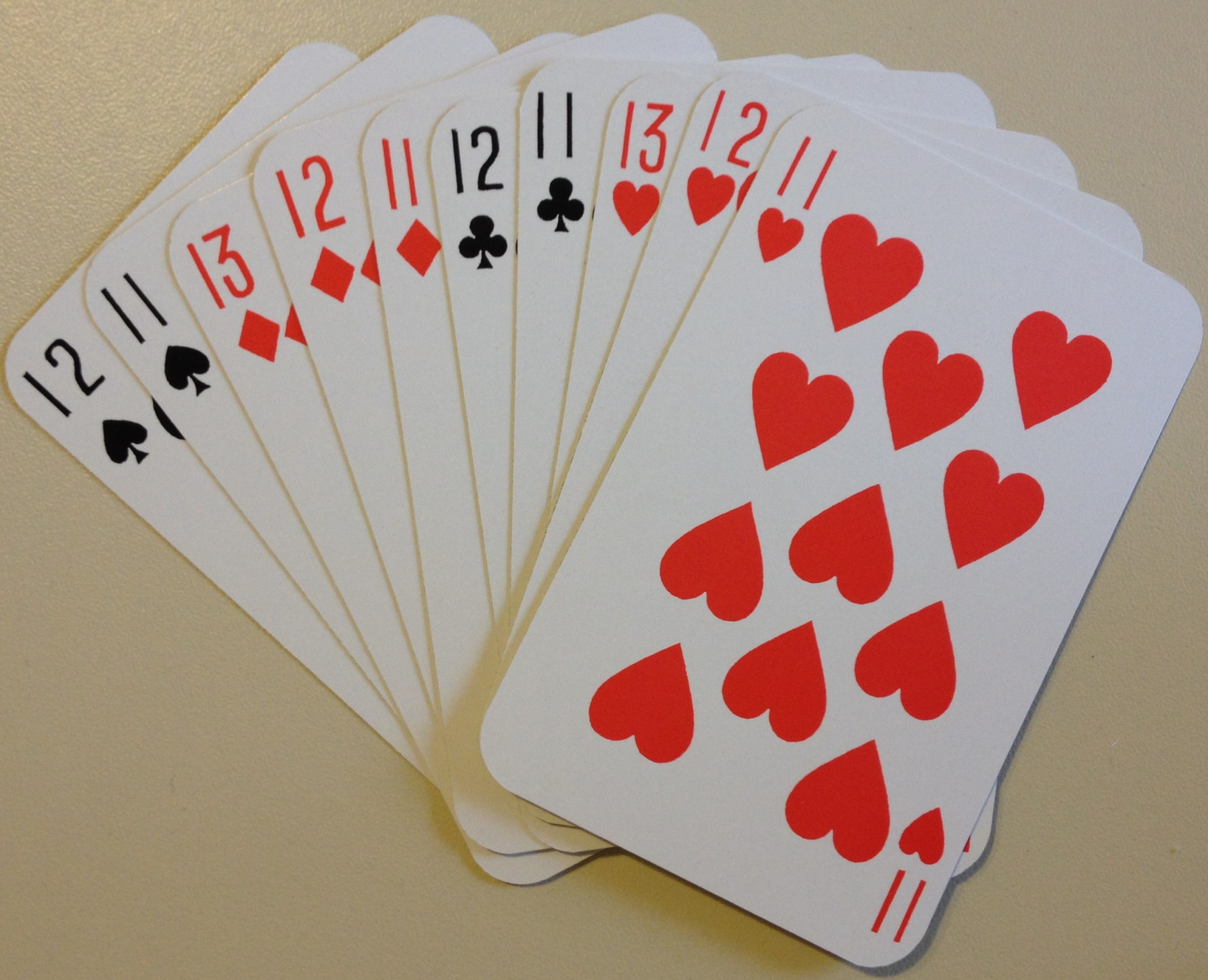
 A card is lost from a pack of 52 cards. From the remaining cards two cards are drawn at random.

Based on the above information, answer the following questions.

  1. The probability of drawing two diamonds, given that a card of diamond is missing, is:
  1. $\frac{21}{425}$

  2. $\frac{22}{425}$

  3. $\frac{23}{425}$

  4. $\frac{1}{425}$

  1. The probability of drawing two diamonds, given that a card of heart is missing, is:
  1. $\frac{26}{425}$

  2. $\frac{22}{425}$

  3. $\frac{19}{425}$

  4.  $\frac{23}{425}$

  1. Let A be the event of drawing two diamonds from remaining 51 cards and E1, E2, E3 and E4 be the events that lost card is of diamond, club, spade and heart respectively, then the approximate value of $\displaystyle\sum_{\text{i}=1}^{4}\text{P(A|E}_\text{i})$ is:
  1. 0.17
  2. 0.24
  3. 0.25
  4. 0.18
  1. AU of a sudden, missing card is found and, then two cards are drawn simultaneously without replacement. Probability that both drawn cards are king is:
  1. $\frac{1}{52}$

  2. $\frac{1}{221}$

  3. $\frac{1}{121}$

  4. $\frac{2}{221}$

  1. If two cards are drawn from a well shuffled pack of 52 cards, one by one with replacement, then probability of getting not a king in 1st and 2nd draw is:
  1. $\frac{144}{169}$

  2. $\frac{12}{169}$

  3. $\frac{64}{169}$

  4. None of these 

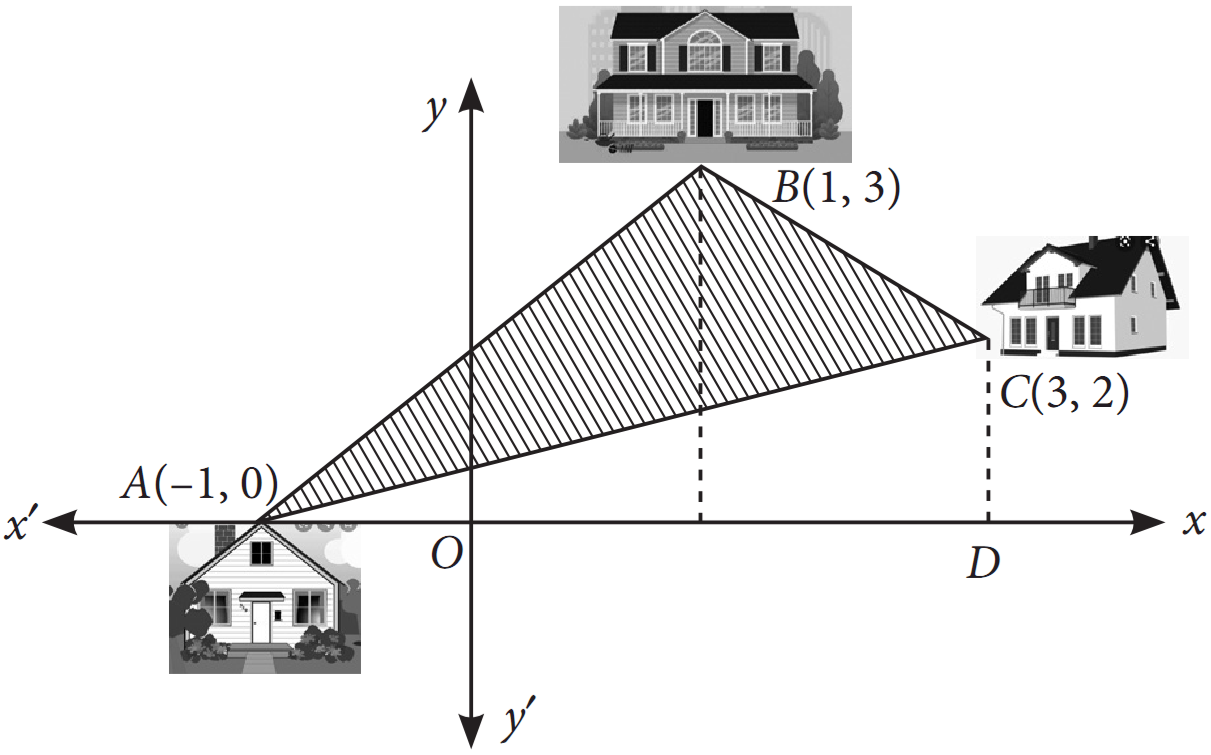
Location of three houses of a society is represented by the points A(-1, 0), B(1, 3) and C(3, 2) as shown in figure.

Based on the above information, answer the following questions
  1. Equation of line AB is.
    1. $\text{y}=\frac{3}{2}(\text{x}+1)$
    2. $\text{y}=\frac{3}{2}(\text{x}-1)$
    3. $\text{y}=\frac{1}{2}(\text{x}+1)$
    4. $\text{y}=\frac{1}{2}(\text{x}-1)$
  2. Equation of line BC is.
    1. $\text{y}=\frac{1}{2}\text{x}-\frac{7}{2}$
    2. $\text{y}=\frac{3}{2}\text{x}-\frac{7}{2}$
    3. $\text{y}=\frac{-1}{2}\text{x}+\frac{7}{2}$
    4. $\text{y}=\frac{3}{2}\text{x}+\frac{7}{2}$
  3. Area of region ABCD is.
  1. 2 sq. units
  2. 4 sq. units
  3. 6 sq. units
  4. 8 sq. units
  1. Area of $\triangle\text{ADC}$ is,
  1. 4 sq. units
  2. 8 sq. units
  3. 16 sq. units
  4. 32 sq. units
  1. Area of $\triangle\text{ABC}$ is.
  1. 3 sq. units
  2. 4 sq. units
  3. 5 sq. units
  4. 6 sq. units
Three car dealers, say A, B and C, deals in three types of cars, namely Hatchback cars, Sedan cars, SUV cars. The sales figure of 2019 and 2020 showed that dealer A sold 120 Hatchback, 50 Sedan, 10 SUV cars in 2019 and 300 Hatchback, 150 Sedan, 20 SUV cars in 2020; dealer B sold 100 Hatchback, 30 Sedan, 5 SUV cars in 2019 and 200 Hatchback, 50 Sedan, 6 SUV cars in 2020; dealer C sold 90 Hatchback, 40 Sedan, 2 SUV cars in 2019 and 100 Hatchback, 60 Sedan, 5 SUV cars in 2020.

Image

(i) Write the matrix summarizing sales data of 2019 and 2020.

(ii) Find the matrix summarizing sales data of 2020.

(iii) Find the total number of cars sold in two given years, by each dealer?

OR

If each dealer receives a profit of ₹ 50000 on sale of a Hatchback, ₹100000 on sale of a Sedan and ₹200000 on sale of an SUV, then find the amount of profit received in the year 2020 by each dealer.

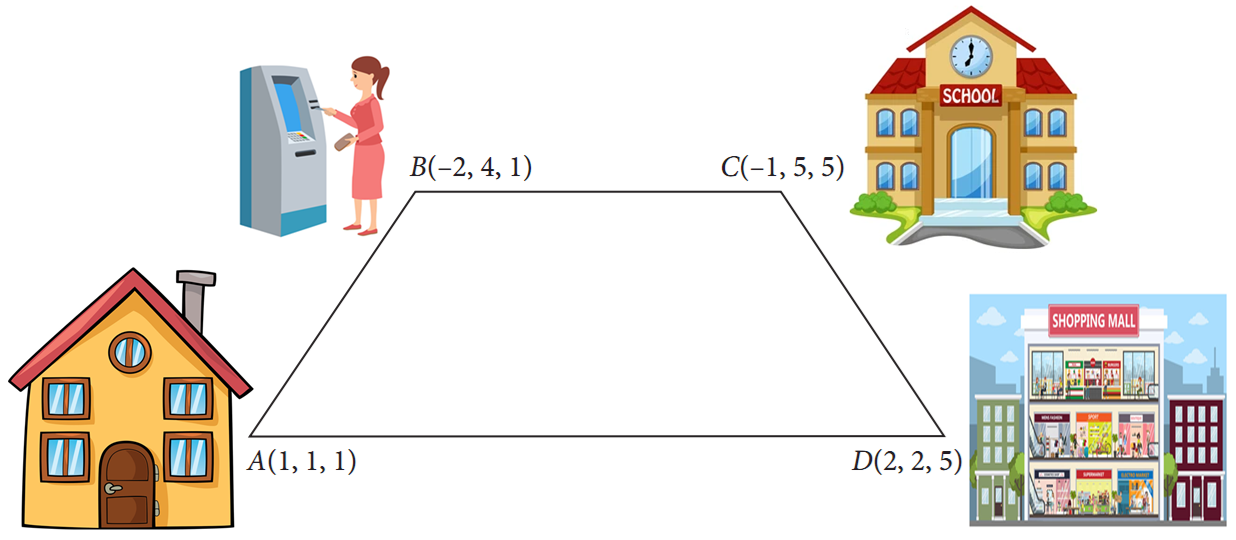
Ritika starts walking from his house to shopping mall. Instead of going to the mall directly, she first goes to a ATM, from there to her daughter's school and then reaches the mall. ln the diagram, A, B, C, and D represent the coordinates of House, ATM, School and Mall respectively.

Based on the above information, answer the following questions.
  1. Distance between House (A) and ATM (B) is:
  1. $3\text{ units}$
  2. $3\sqrt{2}\text{ units}$
  3. $\sqrt{2}\text{ units}$
  4. $4\sqrt{2}\text{ units}$
  1. Distance between ATM (B) and School (C) is:
  1. $\sqrt{2}\text{ units}$
  2. $2\sqrt{2}\text{ units}$
  3. $3\sqrt{2}\text{ units}$
  4. $4\sqrt{2}\text{ units}$
  1. Distance between School (C) and Shopping mall (D) is:
  1. $3\sqrt{2}\text{ units}$
  2. $5\sqrt{2}\text{ units}$
  3. $7\sqrt{2}\text{ units}$
  4. $10\sqrt{2}\text{ units}$
  1. What is the total distance travelled by Ritika:
  1. $4\sqrt{2}\text{ units}$
  2. $6\sqrt{2}\text{ units}$
  3. $8\sqrt{2}\text{ units}$
  4. $9\sqrt{2}\text{ units}$
  1. What is the extra distance travelled by Ritika in reaching the shopping mall?
  1. $3\sqrt{2}\text{ units}$
  2. $5\sqrt{2}\text{ units}$
  3. $6\sqrt{2}\text{ units}$
  4. $7\sqrt{2}\text{ units}$
A differential equation is said to be in the variable separable form if it is expressible in the form f(x) dx = g(y) dy.
The solution of this equation is given by
$\int\text{f(x)dx}=\int\text{g(y)dy}+\text{c},$ where c is the constant of integration.
Based on the above information, answer the following questions.
  1. If the solution of the differential equation $\frac{\text{dy}}{\text{dx}}=\frac{\text{ax+3}}{\text{2y+f}}$ represents a circle, then the value of 'a' is:
  1. 2
  2. -2
  3. 3
  4. -4
  1. The differential equation $\frac{\text{dy}}{\text{dx}}=\frac{\sqrt{1-\text{y}^2}}{\text{y}}$ determines a family of circle with.
  1. Variable radii and fixed centre (0, 1)
  2. Variable radii and fixed centre (0, -1)
  3. Fixed radius 1 and variable centre on x-axis
  4. Fixed radius 1 and variable centre on y-axis
  1. If = y'+ 1, y(0) = 1, then y (In 2) =
  1. 1
  2. 2
  3. 3
  4. 4
  1. The solution of the differential equation $\frac{\text{dy}}{\text{dx}}=\text{e}^\text{x-y}+\text{x}^2\text{e}^\text{-y}$ is:
  1. $\text{e}^\text{x}=\frac{\text{y}^3}{3}+\text{e}^\text{y}+\text{c}$
  2. $\text{e}^\text{y}=\frac{\text{x}^2}{3}+\text{e}^\text{x}+\text{c}$
  3. $\text{e}^\text{y}=\frac{\text{x}^3}{3}+\text{e}^\text{x}+\text{c}$
  4. None of these
  1. If $\frac{\text{dy}}{\text{dx}}=\text{y}\sin2\text{x},\ \text{y}(0)=1,$ then its solution is:
  1. $\text{y}=\text{e}^{\sin^2}\text{x}$
  2. $\text{y}={\sin^2}\text{x}$
  3. $\text{y}={\cos^2}\text{x}$
  4. $\text{y}=\text{e}^{\cos^2}\text{x}$
A rumour on whatsapp spreads in a population of 5000 people at a rate proportional to the product of the number of people who have heard it and the number of people who have not. Also, it is given that 100 people initiate the rumour and a total of 500 people know the rumour after 2 days.

Based on the above information, answer the following questions.
  1. If y(t) denote the number of people who know the rumour at an instant t, then maximum value of y(t) is:
  1. 500
  2. 100
  3. 5000
  4. None of these
  1. $\frac{\text{dn}}{\text{dt}}$ is proportional to:
  1. (y - 5000)
  2. y(y - 500)
  3. y(500 - y)
  4. y(5000 - y)
  1. The value of y(0) is:
  1. 100
  2. 500
  3. 600
  4. 200
  1. The value of y(2) is:
  1. 100
  2. 500
  3. 600
  4. 200
  1. The value of y at any time t is given by:
  1. $\text{y}=\frac{5000}{_\text{e}-5000\text{kt}_{+1}}$
  2. $\text{y}=\frac{5000}{_\text{1+e}-5000\text{kt}}$
  3. $\text{y}=\frac{5000}{_\text{49e}-5000\text{kt}_{+1}}$
  4. $\text{y}=\frac{5000}{_\text{49}{(_\text{1+e}}-5000\text{kt})}$
Mr. Sahil is the owner of a high rise residential society having 50 apartments. When he set rent at ₹ 10000/ month, all apartments are rented. If he increases rent by ₹ 250/ month, one fewer apartment is rented. The maintenance cost for each occupied unit is ₹ 500/ month.

Based on the above information, answer the following questions.
  1. If P is the rent price per apartment and N is the number of rented apartment, then profit is given by.
  1. NP
  2. (N - 500)P
  3. N(P - 500)
  4. None of these
  1. If x represent the number of apartments which are not rented, then the profit expressed as a function of x is.
  1. (50 - x)(38 + x)
  2. (50 + x)(38 - x)
  3. 250(50 - x)(38 + x)
  4. 250(50 + x)(38 - x)
  1. If P = 10500, then N =
  1. 47
  2. 48
  3. 49
  4. 50
  1. If P = 11,000, then the profit is.
  1. ₹ 4,83,000
  2. ₹ 5,00,000
  3. ₹ 5,05,000
  4. ₹ 6,50,000
  1. The rent that maximizes the total amount of profit is.
  1. ₹ 11000
  2. ₹ 11500
  3. ₹ 15800
  4. ₹ 16500