Question
The function f(x) will be discontinuous at x = a if f(x) has
  • Discontinuity of first kind : $\lim\limits_{\text{h}\rightarrow0}\text{f}(\text{a}-\text{h})$ and $\lim\limits_{\text{h}\rightarrow0}\text{f}(\text{a}+\text{h})$ both exist but are not equal. If is also known as irremovable discontinuity.
  • Discontinuity of second kind : If none of the limits $\lim\limits_{\text{h}\rightarrow0}\text{f}(\text{a}-\text{h})$ and $\lim\limits_{\text{h}\rightarrow0}\text{f}(\text{a}+\text{h})$ exist.
  • Removable discontinuity : $\lim\limits_{\text{h}\rightarrow0}\text{f}(\text{a}-\text{h})$ and $\lim\limits_{\text{h}\rightarrow0}\text{f}(\text{a}+\text{h})$ both exist and equal but not equal to f(a).
Based on the above information, answer the following questions.
  1. If $\text{f}(\text{x})=\begin{cases}\frac{\text{x}^2-9}{\text{x}-3},&\text{for x}\neq3\\4,&\text{for x}=3\end{cases},$ then at x = 3
  1. f has removable discontinuity.
  2. f is continuous.
  3. f has irremovable discontinuity.
  4. None of these.
  1. Let $\text{f}(\text{x})=\begin{cases}\text{x}+2,&\text{if x}\leq4\\\text{x}+4,&\text{if x}\geq4\end{cases}$ then at x = 4
  1. f is continuous.
  2. f has removable discontinuit.
  3. f has irremovable discontinuit.
  4. None of thesee.
  1. Consider the function f(x) defined as $\text{f}(\text{x})=\begin{cases}\frac{\text{x}^2-4}{\text{x}-2},&\text{for x}\neq2\\5,&\text{for x}=2\end{cases},$ then at x = 2
  1. f has removable discontinuity.
  2. f has irremovable discontinuity.
  3. f is continuous.
  4. f is continuous if f(2) = 3
  1. If $\text{f}(\text{x})=\begin{cases}\frac{\text{x}-|\text{x}|}{\text{x}},&\text{x}\neq0\\2,&\text{x}=0\end{cases},$ then at x = 0
  1. f is continuous.
  2. f has removable discontinuity.
  3. f has irremovable discontinuity.
  4. None of these.
  1. If $\text{f}(\text{x})=\begin{cases}\frac{\text{e}^\text{x}-1}{\log(1+2\text{x})},&\text{if x}\neq0\\7,&\text{if x}=0\end{cases},$ then at x = 0
  1. fis continuous if f(0) = 2
  2. f is continuous
  3. f has irremovable discontinuity.
  4. f has removable discontinuity.

Answer

  1. (a) f has removable discontinuity.
Solution:

f(3) = 4

$\lim\limits_{\text{x}\rightarrow3}\text{f}(\text{x})=\lim\limits_{\text{x}\rightarrow3}\frac{\text{x}^2-9}{\text{x}-3}=\lim\limits_{\text{x}\rightarrow3}\frac{(\text{x}+3)(\text{x}-3)}{(\text{x}-3)}$

$=\lim\limits_{\text{x}\rightarrow3}(\text{x}+3)=6\because\lim\limits_{\text{x}\rightarrow3}\text{f}(\text{x})\neq\text{f}(3)$

$\therefore$ f(x) has removable discontinuity at x = 3.
  1. (c) f has irremovable discontinuit.
Solution:

$\lim\limits_{\text{x}\rightarrow4^-}\text{f}(\text{x})=\lim\limits_{\text{x}\rightarrow4}(\text{x}+2)=4+2=6$

$\lim\limits_{\text{x}\rightarrow4^+}\text{f}(\text{x})=\lim\limits_{\text{x}\rightarrow4}(\text{x}+4)=4+4=8$

$\therefore\lim\limits_{\text{x}\rightarrow4^-}\text{f}(\text{x})\neq\lim\limits_{\text{x}\rightarrow4^+}\text{f}(\text{x})$

$\therefore$ f(x) has an irremovable discontinuity at x = 4.
  1. (a) f has removable discontinuity.
Solution:

$\lim\limits_{\text{x}\rightarrow2}\text{f}(\text{x})=\lim\limits_{\text{x}\rightarrow2}\frac{(\text{x}^2-4)}{(\text{x}-2)}=\lim\limits_{\text{x}\rightarrow2}(\text{x}+2)=4$

and f(2) = 5 (given) $\therefore\lim\limits_{\text{x}\rightarrow2}\text{f}(\text{x})\neq\text{f}(2)$

$\therefore$ f(x) has removable discontinuity at x = 2.
  1. (c) f has irremovable discontinuity.
Solution:

f(0) = 2

$\lim\limits_{\text{x}\rightarrow0^-}\text{f}(\text{x})=\lim\limits_{\text{x}\rightarrow0}\frac{\text{x}+\text{x}}{\text{x}}=2$

$\lim\limits_{\text{x}\rightarrow0^+}\text{f}(\text{x})=\lim\limits_{\text{x}\rightarrow0}\frac{\text{x}-\text{x}}{\text{x}}=0$

$\because\lim\limits_{\text{x}\rightarrow0^-}\text{f}(\text{x})\neq\lim\limits_{\text{x}\rightarrow0^+}\text{f}(\text{x})$

$\therefore$ f(x) has an irremovable discontinuity at x = 0.
  1. (d) f has removable discontinuity.
Solution:

f(0) = 7

$\lim\limits_{\text{x}\rightarrow0}\text{f}(\text{x})=\lim\limits_{\text{x}\rightarrow0}\frac{\text{e}^\text{x}-1}{\log(1+2\text{x})}=\lim\limits_{\text{x}\rightarrow0}\frac{\Big(\frac{\text{e}^\text{x}-1}{\text{x}}\Big)}{\frac{\log(1+2\text{x})}{2\text{x}}\cdot2}=\frac{1}{2}$

$\because\lim\limits_{\text{x}\rightarrow0}\text{f}(\text{x})\neq\text{f}(0)$

$\therefore$ f(x) has removable discontinuity at x = 0.

Need a full question paper?

Generate a complete, print-ready paper with questions like this in minutes — across 16+ boards, with answer keys.

Start Generating Free

Similar questions

Three slogans on chart papers are to be placed on a school bulletin board at the points A, Band C displaying A (Hub of Learning), B (Creating a better world for tomorrow) and C (Education comes first). The coordinates of these points are (1, 4, 2), (3, -3, -2) and (-2, 2, 6) respectively.

Based on the above information, answer the following questions.
  1. Let $\vec{\text{a}},\vec{\text{b}}$ and $\vec{\text{c}}$ be the position vectors of points A, B and C respectively, then $\vec{\text{a}}+\vec{\text{b}}+\vec{\text{c}}$ is equal to:
  1. $2\hat{\text{i}}+3\hat{\text{j}}+6\hat{\text{k}}$
  2. $2\hat{\text{i}}-3\hat{\text{j}}-6\hat{\text{k}}$
  3. $2\hat{\text{i}}+8\hat{\text{j}}+3\hat{\text{k}}$
  4. $2(7\hat{\text{i}}+8\hat{\text{j}}+3\hat{\text{k}})$
  1. Which of the following is not true?
  1. $\overline{\text{AB}}+\overline{\text{BC}}+\overline{\text{CA}}=\vec{0}$
  2. $\overline{\text{AB}}+\overline{\text{BC}}-\overline{\text{AC}}=\vec{0}$
  3. $\overline{\text{AB}}+\overline{\text{BC}}-\overline{\text{CA}}=\vec{0}$
  4. $\overline{\text{AB}}-\overline{\text{CB}}+\overline{\text{CA}}=\vec{0}$
  1. Area of $\triangle\text{ABC}$ is:
  1. 19 sq. units
  2. $\sqrt{1937}\text{sq}.\text{units}$
  3. $\frac{1}{2}\sqrt{1937}\text{sq}.\text{units}$
  4. $\sqrt{1837}\text{sq}.\text{units}$
  1. Suppose, if the given slogans are to be placed on a straight line, then the value of $|\vec{\text{a}}\times\vec{\text{b}}+\vec{\text{b}}\times\vec{\text{c}}+\vec{\text{c}}\times\vec{\text{a}}|$ will be equal to:
  1. -1
  2. -2
  3. 2
  4. 0
  1. If $\vec{\text{a}}=2\hat{\text{i}}+3\hat{\text{j}}+6\hat{\text{k}},$ then unit vector in the direction of vector $\vec{\text{a}}$ is:
  1. $\frac{2}{7}\hat{\text{i}}-\frac{3}{7}\hat{\text{j}}-\frac{6}{7}\hat{\text{k}}$
  2. $\frac{2}{7}\hat{\text{i}}+\frac{3}{7}\hat{\text{j}}+\frac{6}{7}\hat{\text{k}}$
  3. $\frac{3}{7}\hat{\text{i}}+\frac{2}{7}\hat{\text{j}}+\frac{6}{7}\hat{\text{k}}$
  4. None of these
DETERMINANTS: A determinant is a square array of numbers (written within a pair of vertical lines) which represents a certain sum of We can solve a system of equations using determinants, but it becomes very tedious for large systems. We will only do 2 × 2 and 3 × 3 systems using determinants. Using the properties of determinants solve the problem given below and answer the questions that follow:
Three shopkeepers Ram Lal, Shyam Lal, and Ghansham are using polythene bags, handmade bags (prepared by prisoners), and newspaper's envelope as carry bags. It is found that the shopkeepers Ram Lal, Shyam Lal, and Ghansham are using (20, 30, 40), (30, 40, 20), and (40, 20, 30) polythene bags, handmade bags, and newspapers envelopes respectively. The shopkeepers Ram Lal, Shyam Lal, and Ghansham spent ₹250, ₹270, and ₹200 on these carry bags respectively.
  1. What is the cost of one polythene bag?
  1. ₹ 1
  2. ₹ 2
  3. ₹ 3
  4. ₹ 5
  1. What is the cost of one handmade bag?
  1. ₹1
  2. ₹2
  3. ₹3
  4. ₹5
  1. What is the cost of one newspaper bag?
  1. ₹1
  2. ₹2
  3. ₹3
  4. ₹5
  1. Keeping in mind the social conditions, which shopkeeper is better?
  1. Ram Lal
  2. Shyam Lal
  3. Ghansham
  4. None of these
  1. Keeping in mind the environmental conditions, which shopkeeper is better?
  1. Ram Lal
  2. Shyam Lal
  3. Ghansham
  4. None of these
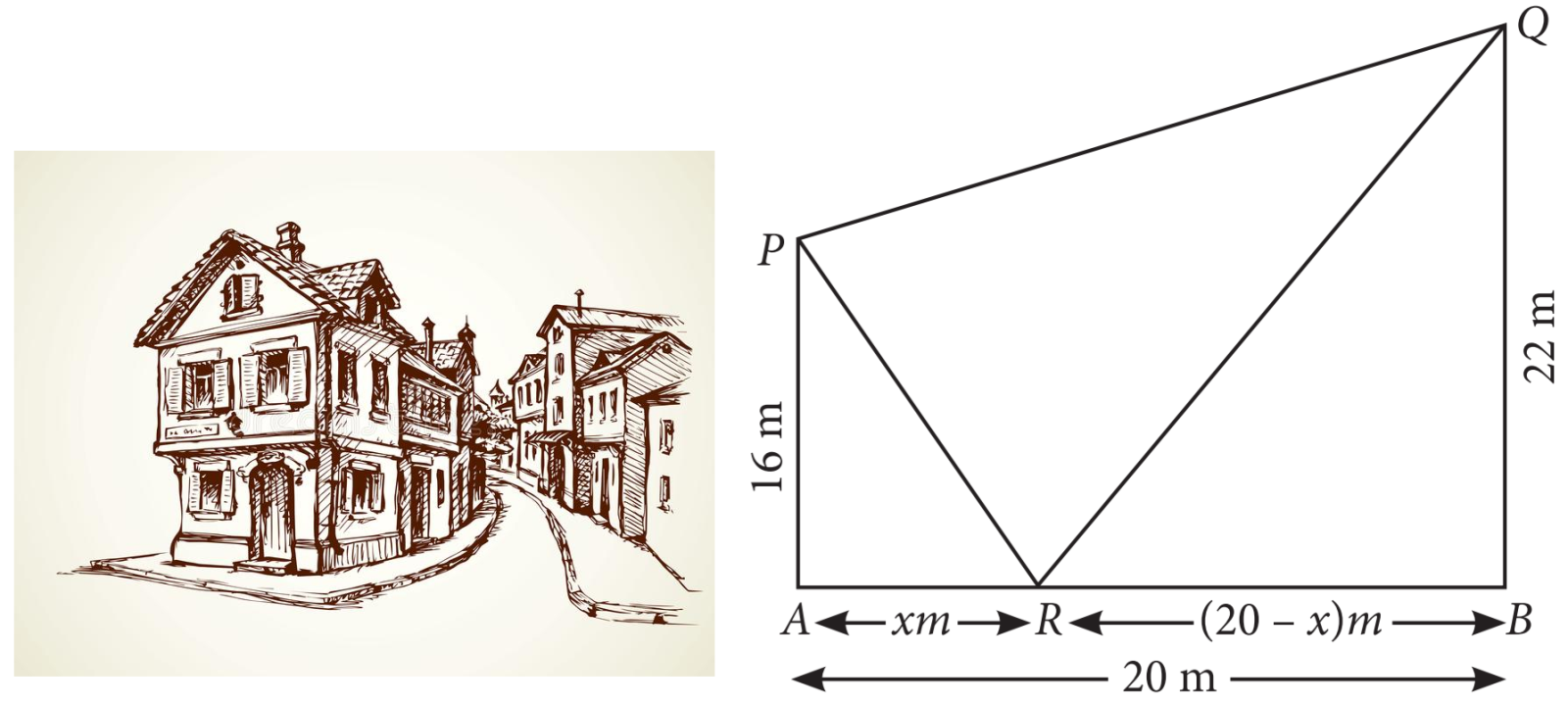
Two multi-storey buildings $($represented by $AP$ and $BQ)$ are on opposite side of a $20m$ wide road at point $A$ and $B$ respectively. There is a point $R$ on road as shown in figure.

Based on the above information, answer the following questions.
  1. Area of trapezium $ABQP$ is.
  1. $380$ sq. m
  2. $280$ sq. m
  3. $320$ sq. m
  4. $430$ sq. m
  1. The length $PQ$ is.
  1. $20.5m$
  2. $19.80m$
  3. $20.88m$
  4. $21m$
  1. Let there be a quantity $S$ such that $S = RP^2 + RQ^2,$ then $S$ is given by.
  1. $2x^2 - 40x - 1140$
  2. $2x^2 + 40x + 1140$
  3. $2x^2 - 40x + 1140$
  4. $2x^2 + 40x - 1140$
  1. Find the value of $x$ for which value of $S$ is minimum.
  1. $10$
  2. $0$
  3. $4$
  4. $-10$
  1. For minimum value of S, find the value of $PR$ and $RQ.$
  1. $18.50\ m,  19.36\ m$
  2. $18.86\ m, 24.17\ m$
  3. $17.56\ m, 23.29\ m$
  4. None of these
If the equation is of the form $\frac{\text{dy}}{\text{dx}}=\text{py}=\text{Q},$ where P, Q are functions of x, then the solution of the differential equation is given by $\text{ye}^{\int\text{pdx}}=\int\text{Q e}^{\int\text{pdx}}\text{dx}+\text{c},$ where $\text{e}^{\int\text{pdx}}$ is called the integrating factor (I.F.).
Based on the above information, answer the following questions.
  1. The integrating factor of the differential equation $\sin\text{x}\frac{\text{dy}}{\text{dx}}+2\text{y}\cos\text{x}=1$ is $(\sin\text{x})^\lambda,$ where $\lambda=$
  1. 0
  2. 1
  3. 2
  4. 3
  1. Integrating factor of the differential equation $(1-\text{x}^2)\frac{\text{dy}}{\text{dx}}-\text{xy}=1$ is:
  1. $-\text{x}$
  2. $\frac{\text{x}}{1+\text{x}^2}$
  3. $\sqrt{1-\text{x}^2}$
  4. $\frac{1}{2}\log(1-\text{x}^2)$
  1. The solution of $\frac{\text{dy}}{\text{dx}}+\text{y}=\text{e}^{-\text{x}},\text{ y}(0)=0,$ is:
  1. $\text{y}=\text{e}^\text{x}(\text{x}-1)$
  2. $\text{y}=\text{xe}^{-\text{x}}$
  3. $\text{y}=\text{xe}^{-\text{x}}+1$
  4. $\text{y}=(\text{x}+1)\text{e}^{-\text{x}}$
  1. General solution of $\frac{\text{dy}}{\text{dx}}+\text{y}\tan\text{x}=\sec\text{x}$ is:
  1. $\text{y}\sec\text{y}=\tan\text{x}+\text{c}$
  2. $\text{y}\tan\text{x}=\sec\text{x}+\text{c}$
  3. $\tan\text{x}=\text{y}\tan\text{x}+\text{c}$
  4. $\text{x}\sec\text{x}=\tan\text{y}+\text{c}$
  1. The integrating factor of differential equation $\frac{\text{dy}}{\text{dx}}-3\text{y}=\sin2\text{x}$ is:
  1. $\text{e}^{3\text{x}}$
  2. $\text{e}^{-2\text{x}}$
  3. $\text{e}^{-3\text{x}}$
  4. $\text{xe}^{-3\text{x}}$
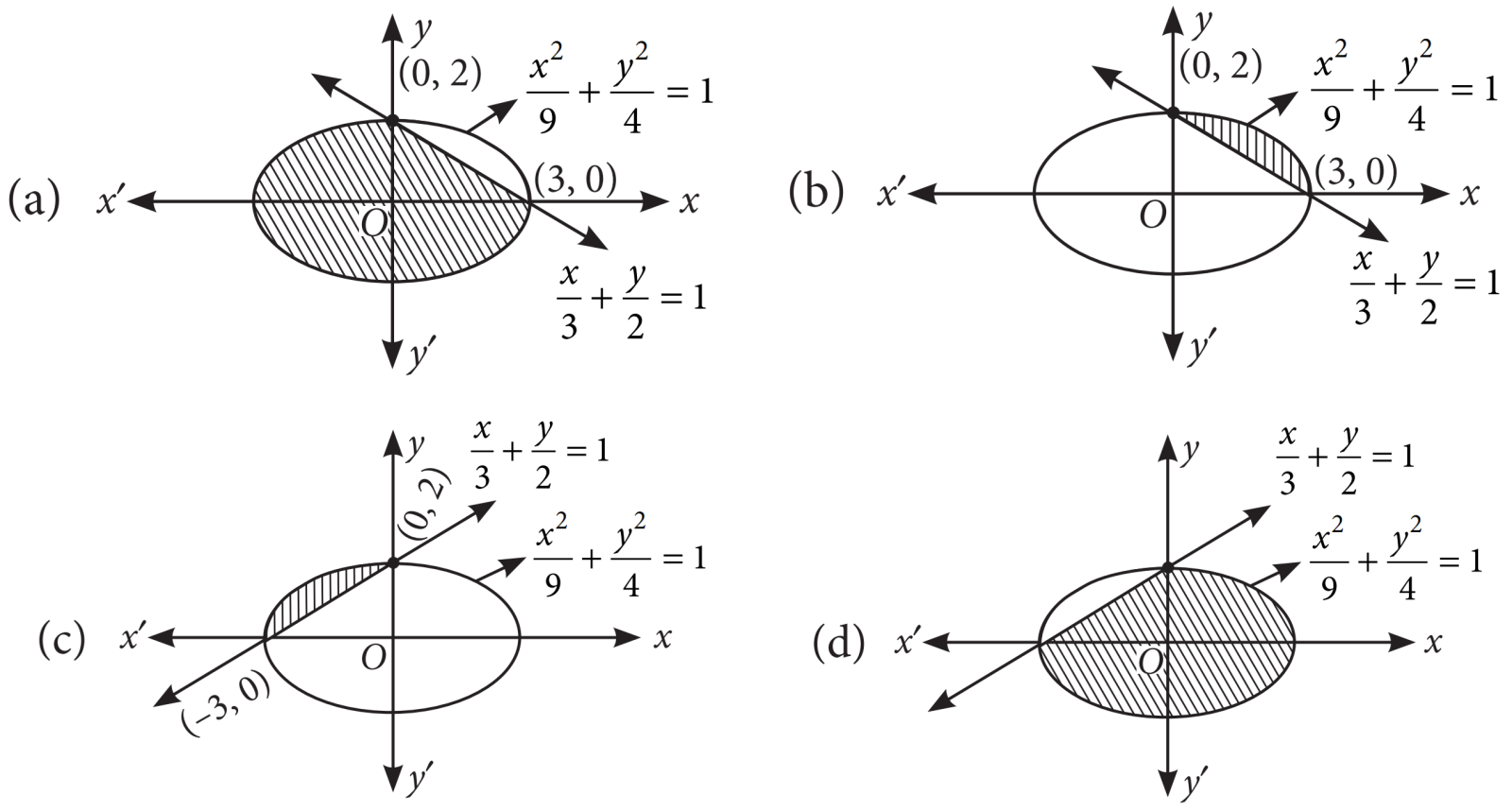
A mirror in the shape of an ellipse represented by $\frac{\text{x}^2}{9}+-\frac{\text{y}^2}{4}=1$ was hanging on the wall. Arun and his sister were playing with ball inside the house, even their mother refused to do so. All of sudden, ball hit the mirror and got a scratch in the shape of line represented by $\frac{\text{x}}{3}+\frac{\text{y}}{2}=1$

Based on the above information, answer the following questions.
  1. Point(s) of intersection of ellipse and scratch (straight line) is (are).
  1. (0, 2), (3, 0)
  2. (2, 0), (3, 0)
  3. (2, 3), (0, 0)
  4. (0, 3), (3, 0)
  1. Area of smaller region bounded by the ellipse and line is represented by.
  1. The value of $\frac{2}{3}\int\limits_{0}^{3}\sqrt{9-\text{x}^2}\text{dx}$ is.
    1. $\frac{\pi}{2}$
    2. $\pi$
    3. $\frac{3\pi}{2}$
    4. $\frac{\pi}{4}$
  1. The value of $2\int\limits_{0}^{3}\bigg(1-\frac{\text{x}}{3}\bigg)\text{dx}$ is.
    1. 0
    2. 1
    3. 2
    4. 3
  1. Area of the smaller region bounded by the mirror and scratch is.
  1. $3\Big(\frac{\pi}{2}+1\Big)\text{ sq.units}$
  2. $\Big(\frac{\pi}{2}+1\Big)\text{ sq.units}$
  3. $\Big(\frac{\pi}{2}-1\Big)\text{ sq.units}$
  4. $3\Big(\frac{\pi}{2}-1\Big)\text{ sq.units}$
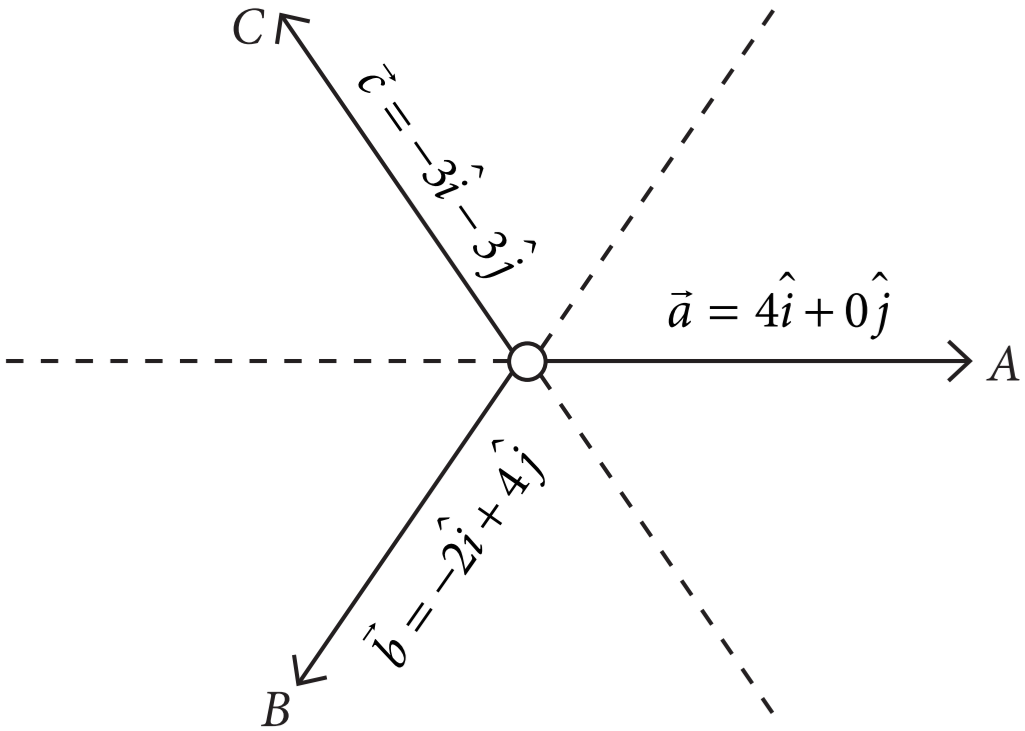
Teams A, B, Cwent for playing a tug of war game. Teams A, B, C have attached a rope to a metal ring and is trying to pull the ring into their own area ( team areas shown below).
Team A pulls with force $\text{F}_1=4\hat{\text{i}}+0\hat{\text{j}}\text{KN}$
Team $\text{B}\rightarrow\text{F}_2=-2\hat{\text{i}}+4\hat{\text{j}}\text{KN}$
Team $\text{C}\rightarrow\text{F}_3=-3\hat{\text{i}}+3\hat{\text{j}}\text{KN}$

Based on the above information, answer the following questions.
  1. Which team will win the game?
  1. Team B
  2. Team A
  3. Team C
  4. No one
  1. What is the magnitude of the teams combined force?
  1. 7KN
  2. 1.4KN
  3. 1.5KN
  4. 2KN
  1. In what direction is the ring getting pulled?
  1. 2.0 radian
  2. 2.5 radian
  3. 2.4 radian
  4. 3 radian
  1. What is the magnitude of the force of Team B?
  1. $2\sqrt{5}\text{KN}$
  2. 6 KN
  3. 2 KN
  4. $\sqrt{6}\text{KN}$
  1. How many KN force is applied by Team A?
  1. 5KN
  2. 4KN
  3. 2KN
  4. 16KN
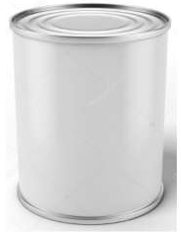
A tin can manufacturer designs a cylindrical tin can for a company making sanitizer and disinfectors. The tin can is made to hold 3 litres of sanitizer or disinfector. The cost of material used to manufacture the tin can is $₹ 100 / \mathrm{m}^2$.

Image

(i) If $\mathrm{r} \mathrm{cm}$ be the radius and $\mathrm{h} \mathrm{cm}$ be the height of the cylindrical tin can, then express the surface area as a function of radius (r)

(ii) Find the radius of the can that will minimize the cost of tin used for making can?

(iii) Find the height that will minimize the cost of tin used for making can ?

OR

Find the minimum cost of material used to manufacture the tin can.

A poster is to be formed for a company advertisement. The top and bottom margins of poster should be 9cm and the side margins should be 6cm. Also, the area for printing the advertisement should be $864cm^2$.

Based on the above information, answer the following questions.
  1. If a cm be the width and b cm be the height of Poster, then the area of poster, expressed in terms of a and b, is given by.
  1. $648 + 18a + 12b$
  2. $18a + 12b$
  3. $584 + 18a + 12b$
  4. None of these
  1. The relation between a and b is given by.
  1. $\text{a}=\frac{648+12\text{b}}{\text{b}-18}$
  2. $\text{a}=\frac{12\text{b}}{\text{b}-18}$
  3. $\text{a}=\frac{12\text{b}}{\text{b}+18}$
  4. $\text{None of these}$
  1. Area of poster in terms of bis given by.
  1. $\text{a}=\frac{12\text{b}^2}{\text{b}-18}$
  2. $\text{a}=\frac{648\text{b}+12\text{b}^2}{\text{b}-18}$
  3. $\text{a}=\frac{648\text{b}+12\text{b}^2}{\text{b}+18}$
  4. $\text{a}=\frac{12\text{b}^2}{\text{b}+18}$
  1. The value of b, so that area of the poster is minimized, is.
  1. 54
  2. 36
  3. 27
  4. 22
  1. The value of a, so that area of the poster is minimized, is.
  1. 24
  2. 36
  3. 40
  4. 22
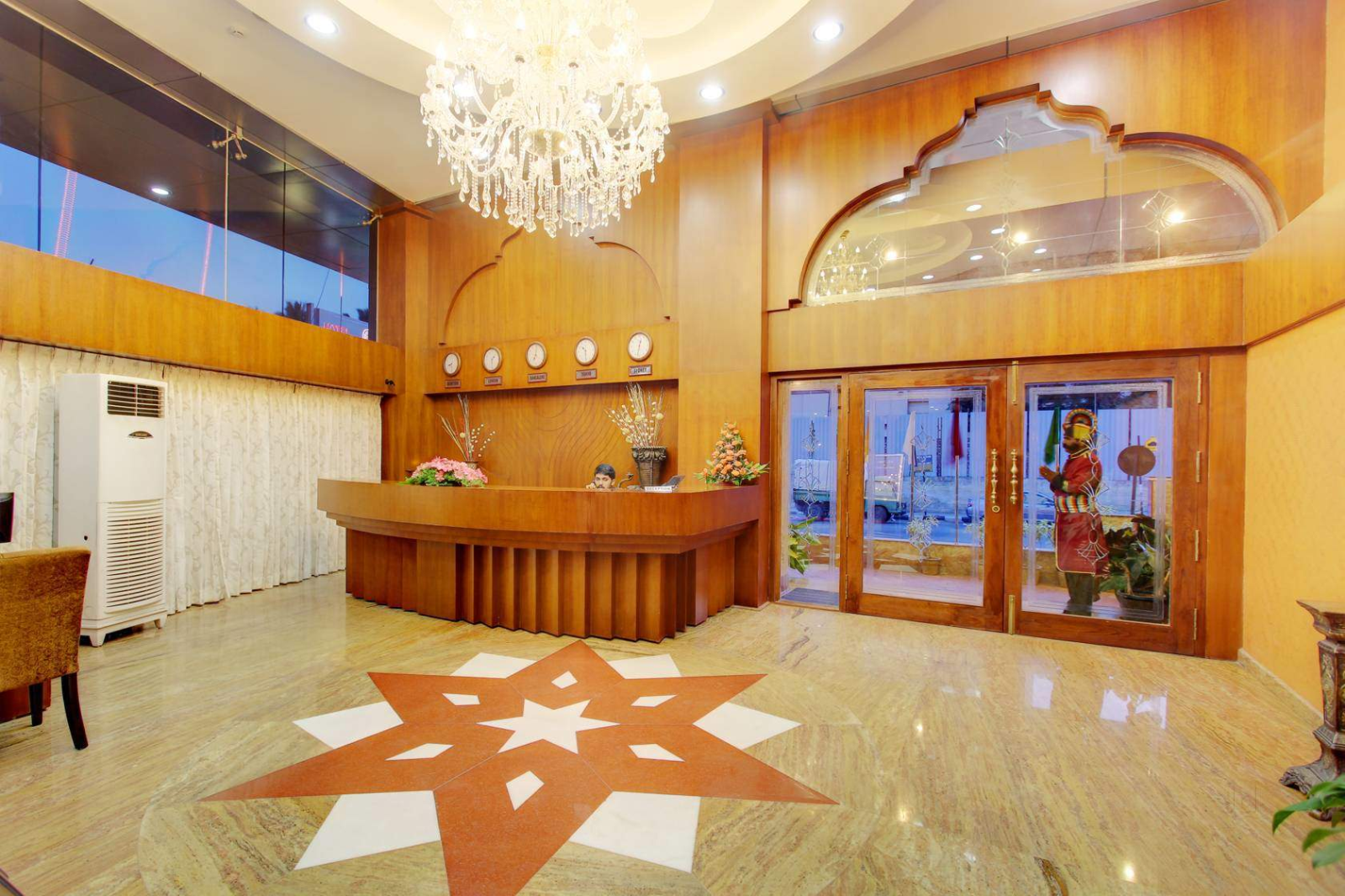
Suppose the floor of a hotel is made up of mirror polished Kota stone. Also, there is a large crystal chandelier attached at the ceiling of the hotel. Consider the floor of the hotel as a plane having equation $x - 2y + 2z = 3$ and crystal chandelier at the point $(3, -2, 1)$.

Based on the above information, answer the following questions.
  1. The d.r'.s of the perpendicular from the point $(3, -2, 1)$ to the plane $x - 2y + 2z = 3,$ is:
  1. $< 1, 2, 2 >$
  2. $< 1, -2, 2 >$
  3. $< 2, 1, 2 >$
  4. $< 2, -1, 2 >$
  1. The length of the perpendicular from the point $(3, -2, 1)$ to the plane $x - 2y + 2z = 3,$ is:
  1. $\frac{2}{3}\text{units}$
  2. $3$ units
  3. $2$ units
  4. None of these
  1. The equation of the perpendicular from the point $(3, -2, 1)$ to the plane $x - 2y + 2z = 3$, is:
  1. $\frac{\text{x}-3}{1}=\frac{\text{y}-2}{-2}=\frac{\text{z}-1}{2}$
  2. $\frac{\text{x}-3}{1}=\frac{\text{y}+2}{-2}=\frac{\text{z}-1}{2}$
  3. $\frac{\text{x}+3}{1}=\frac{\text{y}+2}{-2}=\frac{\text{z}-1}{2}$
  4. None of these
  1. The equation of plane parallel to the plane $x - 2y + 2z = 3,$ which is at a unit distance from the point $(3, -2, 1)$ is:
  1. $x - 2y + 2z = 0$
  2. $x - 2y + 2z = 6$
  3. $x - 2y + 2z = 12$
  4. Both $(b)$ and $(c)$
  1. The image of the point $(3, -2, 1)$ in the given plane is:
  1. $\Big(\frac{5}{3},\frac{2}{3},\frac{-5}{3}\Big)$
  2. $\Big(\frac{-5}{3},\frac{-2}{3},\frac{5}{3}\Big)$
  3. $\Big(\frac{-5}{3},\frac{2}{3},\frac{5}{3}\Big)$
  4. None of these
In a street, two lamp posts are 600 feet apart. The light intensity at a distanced from the first (stronger) lamp post is $\frac{1000}{\text{d}^2}$ the light intensity at distance d from the second (weaker) lamp post is $\frac{125}{\text{d}^2}$ (in both cases the light intensity is inversely proportional to the square of the distance to the light source). The combined light intensity is the sum of the two light intensities coming from both lamp posts.

Based on the above information, answer the following questions.
  1. If you are in between the lamp posts, at distance x feet from the stronger tight, then the formula for the combined light intensity coming from both lamp posts as function of x, is
  1. $\frac{1000}{\text{x}^2}+\frac{125}{\text{x}^2}$
  2. $\frac{1000}{\big(600-\text{x}^2\big)}+\frac{125}{\text{x}^2}$
  3. $\frac{1000}{\text{x}^2}+\frac{125}{\big(600-\text{x}^2\big)}$
  4. $\text{None of these}$
  1. The maximum value of x can not be.
  1. 100
  2. 200
  3. 600
  4. None of these
  1. The minimum value of x can not be.
  1. 0
  2. 100
  3. 200
  4. None of these
  1. If l(x) denote the combined tight intensity, then l(x) will be minimum when x =
  1. 200
  2. 400
  3. 600
  4. 800
  1. The darkest spot between the two lights is.
  1. At a distance of 200 feet from the weaker lamp post.
  2. At distance of 200 feet from the stronger lamp post.
  3. At a distance of 400 feet from the weaker lamp post.
  4. None of these