- A$(-\infty, 0) \cup\left(\frac{3}{7}, \infty\right)$
- ✓$(-\infty, 0) \cup\left(\frac{14}{15}, \infty\right)$
- C$\left(-\infty, \frac{14}{15}\right)$
- D$\left(-\infty,-\frac{14}{15}\right) \cup(0, \infty)$
$\Rightarrow \quad f(x)=3 x^{5 / 3}-7 x^{2 / 3}$
$\Rightarrow \quad f^{\prime}(x)=5 x^{2 / 3}-\frac{14}{3 x^{1 / 3}}$
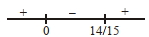
$=\frac{15 x-14}{3 x^{1 / 3}}>0$
$\therefore \quad f ^{\prime}( x )>0 \forall x \in(-\infty, 0) \cup\left(\frac{14}{15}, \infty\right)$
Generate a complete, print-ready paper with questions like this in minutes — across 16+ boards, with answer keys.
$f(x) = \left\{ {\begin{array}{*{20}{c}}
{x + 2,}&{if\,\,x\,\, < \,\,1}\\
{0,}&{if\,\,\,x = 1}\\
{x - 2,}&{if\,\,x\,\, > \,\,1}
\end{array}} \right.$
$x+y+z=6$
$x+2 y+\alpha z=10$
$x+3 y+5 z=\beta$, which one of the following is NOT true?
$\overrightarrow{\mathrm{a}} \times\{(\overrightarrow{\mathrm{r}}-\overrightarrow{\mathrm{b}}) \times \overrightarrow{\mathrm{a}}\}+\overrightarrow{\mathrm{b}} \times\{(\overrightarrow{\mathrm{r}}-\overrightarrow{\mathrm{c}}) \times \overrightarrow{\mathrm{b}}\}+\overrightarrow{\mathrm{c}} \times\{(\overrightarrow{\mathrm{r}}-\overrightarrow{\mathrm{a}}) \times \overrightarrow{\mathrm{c}}\}=\overrightarrow{0}$
then $\overrightarrow{\mathrm{r}}$ is equal to: