MCQ
The function $\text{log}_\text{a}(\omega\text{t})$
  • A
    Is a periodic function.
  • B
    Is a non-periodic function.
  • C
    Could represents oscillatory motion
  • D
    Can represent circular motion.

Answer

  1. Is a non-periodic function.

Need a full question paper?

Generate a complete, print-ready paper with questions like this in minutes — across 16+ boards, with answer keys.

Start Generating Free

Similar questions

If the measurement errors in all the independent quantities are known, then it is possible to determine the error in any dependent quantity. This is done by the use of series expansion and truncating the expansion at the first power of the error. For example, consider the relation $z=x / y$. If the errors in $x, y$ and $z$ are $\Delta x, \Delta y$ and $\Delta z$, respectively, then

$\mathrm{z} \pm \Delta \mathrm{z}=\frac{\mathrm{x} \pm \Delta \mathrm{x}}{\mathrm{y} \pm \Delta \mathrm{y}}=\frac{\mathrm{x}}{\mathrm{y}}\left(1 \pm \frac{\Delta \mathrm{x}}{\mathrm{x}}\right)\left(1 \pm \frac{\Delta \mathrm{y}}{\mathrm{y}}\right)^{-1} .$

The series expansion for $\left(1 \pm \frac{\Delta y}{y}\right)^{-1}$, to first power in $\Delta y / y$, is $1 \mp(\Delta y / y)$. The relative errors in independent variables are always added. So the error in $\mathrm{z}$ will be $\Delta \mathrm{z}=\mathrm{z}\left(\frac{\Delta \mathrm{x}}{\mathrm{x}}+\frac{\Delta \mathrm{y}}{\mathrm{y}}\right)$.

The above derivation makes the assumption that $\Delta x / x<<1, \Delta \mathrm{y} / \mathrm{y} \ll<1$. Therefore, the higher powers of these quantities are neglected.

($1$) Consider the ratio $\mathrm{r}=\frac{(1-\mathrm{a})}{(1+\mathrm{a})}$ to be determined by measuring a dimensionless quantity a.

If the error in the measurement of $\mathrm{a}$ is $\Delta \mathrm{a}(\Delta \mathrm{a} / \mathrm{a} \ll<1)$, then what is the error $\Delta \mathrm{r}$ in

$(A)$ $\frac{\Delta \mathrm{a}}{(1+\mathrm{a})^2}$ $(B)$ $\frac{2 \Delta \mathrm{a}}{(1+\mathrm{a})^2}$ $(C)$ $\frac{2 \Delta \mathrm{a}}{\left(1-\mathrm{a}^2\right)}$ $(D)$ $\frac{2 \mathrm{a} \Delta \mathrm{a}}{\left(1-\mathrm{a}^2\right)}$

($2$) In an experiment the initial number of radioactive nuclei is $3000$ . It is found that $1000 \pm$ $40$ nuclei decayed in the first $1.0 \mathrm{~s}$. For $|\mathrm{x}| \ll 1$, In $(1+\mathrm{x})=\mathrm{x}$ up to first power in $x$. The error $\Delta \lambda$, in the determination of the decay constant $\lambda$, in $\mathrm{s}^{-1}$, is

$(A) 0.04$    $(B) 0.03$    $(C) 0.02$   $(D) 0.01$

Give the answer quetion ($1$) and ($2$)
The pitch of the screw gauge is $1\, mm$ and there are $100$ divisions on the circular scale. When nothing is put in between the jaws, the zero of the circular scale lies $8$ divisions below the reference line. When a wire is placed between the jaws, the first linear scale division is clearly visible while $72^{\text {nd }}$ division on circular scale coincides with the reference line. The radius of the wire is.........$mm$
In an electric circuit containing a battery, the charge (assumed positive) inside the battery:
  1. Always goes from the positive terminal to the negative terminal.
  2. May go from the positive terminal to the negative terminal.
  3. Always goes from the negative terminal to the positive terminal
  4. Does not move.
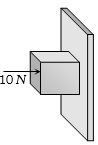
A horizontal force of $10 \,N$ is necessary to just hold a block stationary against a wall. The coefficient of friction between the block and the wall is $0.2$. the weight of the block is ........ $N$
An engine of mass one metric ton is ascending on a inclined plane, at an angle $\theta=\tan ^{-1}\left(\frac{1}{2}\right)$ with horizontal, with a speed of $36 \;km / h$. If the coefficient of friction of surface is $\left(\frac{1}{\sqrt{3}}\right)$ then the power 
If a spring extends by $x$ on loading, then the energy stored by the spring is (if $T$ is tension in the spring and $k$ is spring constant)
The average force necessary to stop a hammer having momentum $50\, N-S$ in $0.25\, \sec$  ...... $N$
What is the value of linear velocity, if  $\vec \omega \, = \,3\hat i\, - \,4\hat j\, + \hat k\,\,$  and  $\,\,\vec r \, = \,5\hat i\, - \,6\hat j\, + 6\hat k$
A vehicle travels $4\,km$ with speed of $3\,km / h$ and another $4\,km$ with speed of $5\,km / h$, then its average speed is $..........km/h$
Two particles of masses $m_1$ and $m_2$ in projectile motion have velocities ${\vec v_1}$ and ${\vec v_2}$ respectively at time $t$ = $0$ . they collide at time $t_0$ . Their velocities become ${\vec v_1'}$ and ${\vec v_2'}$ at time $2t_0$ while still moving in air. The value of $\left| {\left( {{m_1}{{\vec v}_1}' + {m_2}{{\vec v}_2}'} \right) - \left( {{m_1}{{\vec v}_1} + {m_2}{{\vec v}_2}} \right)} \right|$ is