MCQ
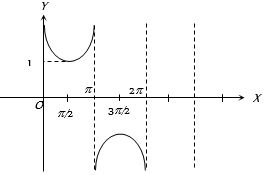
The function which is neither decreasing nor increasing in $\left( {{\pi \over 2},{{3\pi } \over 2}} \right)$ is
  • $cosec\, x$
  • B
    $\tan x$
  • C
    ${x^2}$
  • D
    $|x - 1|$

Answer

Correct option: A.
$cosec\, x$
a
(a) The graph of cosec $ x$  is opposite in $\left( {\frac{\pi }{2},\,\,\frac{{3\pi }}{2}} \right)$.

Need a full question paper?

Generate a complete, print-ready paper with questions like this in minutes — across 16+ boards, with answer keys.

Start Generating Free

Similar questions

For every point P(x, y, z) on the x-axis (except the origin),
  1. x = 0, y = 0, z ≠ 0
  2. y = 0, z = 0, y ≠ 0
  3. y = 0, z = 0, x ≠ 0
  4. x = y = z = 0
Solve system of linear equations, using matrix method. $5 x+2 y=4$ ; $7 x+3 y=5$
The value of $\lambda $ for which points $A(2,2,1)$ , $B(1,1,1)$ , $C(-\lambda ,2,1)$ and $D(3,0,-1)$ are coplanar, is $\lambda  =$  ............ 
Let $\mathrm{H}_1, \mathrm{H}_2, \ldots, \mathrm{H}_{\mathrm{n}}$ be mutually exclusive and exhaustive events with $\mathrm{P}\left(\mathrm{H}_{\mathrm{i}}\right)>0, \mathrm{i}=1,2, \ldots, \mathrm{n}$. Let $\mathrm{E}$ be any other event with $0<\mathrm{P}(\mathrm{E})<1$.

$STATEMENT -1$ : $\mathrm{P}\left(\mathrm{H}_{\mathrm{i}} \mid \mathrm{E}\right)>\mathrm{P}\left(\mathrm{E} \mid \mathrm{H}_{\mathrm{i}}\right) \cdot \mathrm{P}\left(\mathrm{H}_{\mathrm{i}}\right)$ for $\mathrm{i}=1,2, \ldots, \mathrm{n}$ because

$STATEMENT$ $-2: \sum_{1=1}^{\mathrm{n}} \mathrm{P}\left(\mathrm{H}_{\mathrm{i}}\right)=1$

If $x = 3\,tan\,t$ and $y = 3\,sec\,t,$ then the value of $\frac{{{d^2}y}}{{d{x^2}}}$ at $t = \frac {\pi }{4},$ is
If $a = i - j$ and $b = i + k$, then a unit vector coplanar with $a $ and  $ b $ and perpendicular to $a$  is
$\int\frac{1}{7+5\cos\text{x}}\text{ dx}=$
  1. $\frac{1}{\sqrt{6}}\tan^{-1}\Big(\frac{1}{\sqrt{6}}\tan\frac{\text{x}}{2}\Big)+\text{C}$
  2. $\frac{1}{\sqrt{3}}\tan^{-1}\Big(\frac{1}{\sqrt{3}}\tan\frac{\text{x}}{2}\Big)+\text{C}$
  3. $\frac{1}{4}\tan^{-1}\Big(\tan\frac{\text{x}}{2}\Big)+\text{C}$
  4. $\frac{1}{7}\tan^{-1}\Big(\tan\frac{\text{x}}{2}\Big)+\text{C}$
A rectangular parallelopiped is formed by planes drawn through the point (5, 7, 9) and (2, 3, 7) parallel to the coordinate planes. The length of an edge of this rectangular parallelopiped is:
  1. 2
  2. 3
  3. 4
  4. all of these
The solution of the differential equation $\frac{{dy}}{{dx}} = \sec x(\sec x + \tan x)$is
The minimum value of $\frac{{\tan \,\left( {x\,\, + \,\,{\textstyle{\pi \over 6}}} \right)}}{{\tan \,x}}$ is