Question
The function $(x-\sin x)$ decreases for

Answer

Let $f(x)=x-\sin x$
Differentiating w.r.t. $x$, we get $f^{\prime}(x)=1-\cos x$
For function to be decreasing, $f^{\prime}(x)<0$
$\Rightarrow 1-\cos x<0 \Rightarrow \cos x>1$,
which is not possible, because maximum value of $\cos x$ is 1 .
$\therefore \quad f(x)=(x-\sin x)$ doesn't decrease at any value of $x$.

Need a full question paper?

Generate a complete, print-ready paper with questions like this in minutes — across 16+ boards, with answer keys.
Start Generating Free

Similar questions

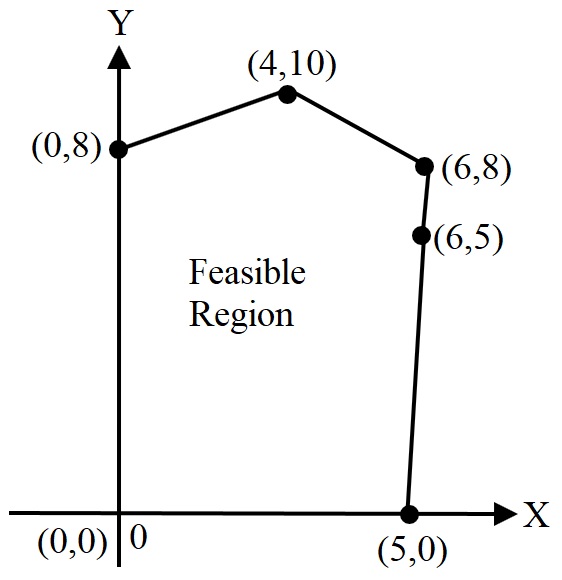
The feasible, region for an LPP is shown shaded in the figure. Let Z = 3x - 4y be the objective function. A minimum of Z occurs at:
The area bounded by display style $y = xe^{∣X∣} $ and $|x| = 1$ is:
The values of x for which the angle between $\vec{\text{a}}=2\text{x}^2\hat{\text{i}}+4\text{x}\hat{\text{j}}+\hat{\text{k}},\vec{\text{b}}=7\hat{\text{i}}-2\hat{\text{j}}+\text{x}\hat{\text{k}}$is obtuse and the angle between $\vec{\text{b}}$ and the z-axis is acute and less than $\frac{\pi}{6}$ are:
  1. $\text{x}>\frac{1}{2}$ or $\text{x}<0$
  2. $0<\text{x}<\frac{1}{2}$
  3. $\frac{1}{2}<\text{x}<15$
  4. $\phi$
Let $\text{f(x)}=|\cos\text{x}|.$ Then,
  1. f(x) is everywhere differentiable.
  2. f(x) is everywhere continuous but not differentiable at $\text{x}=\text{n}\pi,\text{n}\in\text{Z}$
  3. f(x) is everywhere continuous but not differentiable at $\text{x}=(2\text{n}+1)\frac{\pi}{2},\text{n}\in\text{Z}.$
  4. None of these.
Let * be a binary operation defined on set Q − {1} by the rule a * b = a + b − ab. Then, the identify element for * is:
  1. $1$
  2. $\frac{\text{a}-1}{\text{a}}$
  3. $\frac{\text{a}}{\text{a}-1}$
  4. $0$
Choose the correct answer in Exercise:
$\int\frac{\text{dx}}{\text{x}^2+2\text{x}+2}\text{equals}$
  1. $\text{x}\tan^{-1}(\text{x}+1)+\text{C}$
  2. $\tan^{-1}(\text{x}+1)+\text{C}$
  3. $(\text{x}+1)\tan^{-1}\text{x}+\text{C}$
  4. $\tan^{-1}\text{x}+\text{C}$
The differential equation of all parabolas whose axes are parallel to y-axis is:
  1. $\frac{\text{dy}}{\text{dx}}=-\frac{\text{c}^2}{\text{x}^2}$
  2. $\frac{\text{d}^2\text{x}}{\text{dy}^2}=\text{c}$
  3. $\frac{\text{d}^3\text{y}}{\text{dx}^3}+\frac{\text{d}^2\text{x}}{\text{dy}^2}=0$
  4. $\frac{\text{d}^2\text{y}}{\text{dx}^2}+2\frac{\text{dy}}{\text{dx}}=0$
The function $f(x)=x-\frac{1}{x}, x \in R, x \neq 0$ is
Let $\sin\text{y}=\text{x}\sin(\text{a}+\text{y}),$ then $\frac{\text{dy}}{\text{dx}}$ is:
  1. $\frac{\sin\text{a}}{\sin\text{a}\sin^2(\text{a}+\text{y})}$
  2. $\frac{\sin^2(\text{a}+\text{y})}{\sin\text{a}}$
  3. $\sin\text{a}\sin^2(\text{a}+\text{y})$
  4. $\frac{\sin^2(\text{a}+\text{y})}{\sin\text{a}}$
A line makes the same angle $\theta$ with each of thex and $z$ axis. If the angle $\beta$ which it makes with $y-$axis is such that $\sin^2\beta=3\sin^2\theta$ then $\cos^2\theta$ equals: