Question 11 Mark
A wire of length $20 cm$ is bent in the form of a sector of a circle. The maximum area that can be enclosed by the wire is
AnswerLet $r$ be the radius, $\theta$ be the central angle and $/$ be the length of the circular sector.
Given, $1+2 r=20$
$\Rightarrow r \theta+2 r=20(\because l=r \theta) \Rightarrow \theta=\frac{20-2 r}{r}
$Let $A$ be the area of the circular sector.
$\therefore \quad A=\frac{\pi r^2 \theta}{2 \pi}=\frac{r^2}{2} \cdot\left(\frac{20-2 r}{r}\right)=r(10-r) \Rightarrow \frac{d A}{d r}=10-2 r
$
For maximum or minimum value of $A$, we have
$\frac{d A}{d r}=0 \Rightarrow r=5 \text { and } \frac{d^2 A}{d r^2}=-2<0
$$\therefore \quad$ Area is maximum at $r=5$
$\therefore \quad$ Maximum area, $A=5(10-5)=25 cm ^2$
View full question & answer→Question 21 Mark
The value of $x$ for which $\left(x-x^2\right)$ is maximum, is
AnswerLet $f(x)=x-x^2 \therefore f^{\prime}(x)=1-2 x$
For critical point, $f^{\prime}(x)=0 \Rightarrow 1-2 x=0 \Rightarrow x=1 / 2$
Now, at $x=1 / 2, f^{\prime \prime}(x)=-2<0$
So, $f(x)$ has maximum value at $x=1 / 2$.
View full question & answer→Question 31 Mark
The least value of the function $f(x)=2 \cos x+x$ in the closed interval $\left[0, \frac{\pi}{2}\right]$ is
AnswerWe have, $f(x)=2 \cos x+x$
$\Rightarrow f^{\prime}(x)=-2 \sin x+1$
$\Rightarrow f^{\prime \prime}(x)=-2 \cos x$
For critical points, $f^{\prime}(x)=0$
$\Rightarrow -2 \sin x+1=0$
$\Rightarrow \sin x=\frac{1}{2}=\sin \left(\frac{\pi}{6}\right) \ \left(\because x \in\left[0, \frac{\pi}{2}\right]\right)$
$\Rightarrow x=\frac{\pi}{6}$
$f^{\prime \prime}(x)\left(\text { at } x=\frac{\pi}{6}\right)=-2 \cos \frac{\pi}{6}=-\sqrt{3}<0$
So, $x=\frac{\pi}{6}$ is the point of maxima .
Now, $f(0)=2$ and $f\left(\frac{\pi}{2}\right)=\frac{\pi}{2}=1.57$
$\Rightarrow$ Least value of $f(x)=1.57$ i.e., $\frac{\pi}{2}$
View full question & answer→Question 41 Mark
The value of $b$ for which the function $f(x)=x+\cos x+b$ is strictly decreasing over $R$ is
AnswerWe have, $f(x)=x+\cos x+b$
$\Rightarrow f^{\prime}(x)=1-\sin x \Rightarrow f^{\prime}(x) \geq 0 \forall x \in R$
$\Rightarrow \quad$ No such value of $b$ exists
View full question & answer→Question 51 Mark
The total surface area $(S)$ of the casted half cylinder will be
AnswerTotal surface area $, S=\frac{2 \pi r(r+h)}{2}+2 r h$
$=\pi r^2+\pi r h+2 r h$
View full question & answer→Question 61 Mark
For the given half-cylinder of volume $V$, the total surface area $S$ is minimum, when
Answer$\because S=\pi r^2+\frac{2 V(\pi+2)}{\pi r} \Rightarrow \frac{d S}{d r}=2 \pi r-\frac{2 V(\pi+2)}{\pi} \times \frac{1}{r^2}$ For $S$ to be minimum, $\frac{d S}{d r}=0$ $\Rightarrow 2 \pi r=\frac{2 V(\pi+2)}{\pi r^2} \Rightarrow \pi^2 r^3=V(\pi+2)$
View full question & answer→Question 71 Mark
The interval, in which function $y=x^3+6 x^2+6$ is increasing, is
View full question & answer→Question 81 Mark
The ratio $h$ : $2 r$ for which $S$ to be minimum will be equal to
Answer$\because V=\frac{1}{2} \pi r^2 h$
and $S$ will be minimum, when $(\pi+2) V =\pi^2 r^3$
$\Rightarrow V=\frac{\pi^2 r^3}{\pi+2}$
From (i) and (ii), we get
$\Rightarrow \frac{1}{2} \pi r^2 h=\frac{\pi^2 r^3}{\pi+2} \Rightarrow \pi r^2 h(\pi+2)=2 \pi^2 r^3$
$\Rightarrow h(\pi+2)=2 \pi r \Rightarrow \frac{h}{2 r}=\frac{\pi}{\pi+2}$
Thus, required ratio i.e., $h: 2 r$ is $\pi: \pi+2$.
View full question & answer→Question 91 Mark
The total cost of the train to travel $500 km$ at the most economical speed is
AnswerTotal cost for running the train for $500 km$
$=\frac{375}{4} v+\frac{600000}{v}$
$=\frac{375 \times 80}{4}+\frac{600000}{80}$=₹ 15000
View full question & answer→Question 101 Mark
The maximum value of $[x(x-1)+1]^{1 / 3}, 0 \leq x \leq 1$ is
AnswerLet $f(x)=[x(x-1)+1]^{1 / 3}, 0 \leq x \leq 1$
$\Rightarrow f^{\prime}(x)=\frac{2 x-1}{3\left(x^2-x+1\right)^{2 / 3}}$
For critical points, put $f^{\prime}(x)=0$
$\Rightarrow x=\frac{1}{2} \in[0,1]$
Now, $f(0)=1, f\left(\frac{1}{2}\right)=\left(\frac{3}{4}\right)^{1 / 3}$ and $f(1)=1$
$\therefore \quad$ Maximum value of $f(x)$ is 1 .
View full question & answer→Question 111 Mark
The real function $f(x)=2 x^3-3 x^2-36 x+7$ is
AnswerWe have $, f(x)=2 x^3-3 x^2-36 x+7$
$\Rightarrow f^{\prime}(x)=6 x^2-6 x-36=6\left(x^2-x-6\right)$
$=6(x-3)(x+2)$
$f^{\prime}(x)=0 $
$\Rightarrow(x-3)(x+2)=0, x=-2,3$
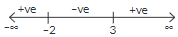
$\therefore f(x)$ is strictly increasing in $(-\infty,-2) \cup(3, \infty)$ and strictly View full question & answer→Question 121 Mark
Find the intervals in which the function $f$ given by $f(x)=x^2-4 x+6$ is strictly increasing.
AnswerWe have, $f(x)=x^2-4 x+6$
$
\Rightarrow f^{\prime}(x)=2 x-4
$
$\because f(x)$ is strictly increasing.
$
\begin{array}{ll}
\therefore & f^{\prime}(x)>0 \\
\Rightarrow & 2 x-4>0 \Rightarrow x>2 \\
\Rightarrow & x \in(2, \infty)
\end{array}
$
View full question & answer→Question 131 Mark
The volume ( $V$ ) of the casted half cylinder will be
Answer$\because$ Volume of cylinder $=\pi r^2 h$
$\therefore \quad V=$ Volume of casted half cylinder $=(1 / 2) \pi r^2 h$
View full question & answer→Question 141 Mark
The function $(x-\sin x)$ decreases for
AnswerLet $f(x)=x-\sin x$
Differentiating w.r.t. $x$, we get $f^{\prime}(x)=1-\cos x$
For function to be decreasing, $f^{\prime}(x)<0$
$\Rightarrow 1-\cos x<0 \Rightarrow \cos x>1$,
which is not possible, because maximum value of $\cos x$ is 1 .
$\therefore \quad f(x)=(x-\sin x)$ doesn't decrease at any value of $x$.
View full question & answer→Question 151 Mark
The area of a trapezium is defined by function $f$ and given by $f(x)=(10+x) \sqrt{100-x^2}$, then the area when it is maximised is
AnswerWe have, $f(x)=(10+x) \sqrt{100-x^2}$
Which will give some real area if $-10$
$\Rightarrow f^{\prime}(x)=\frac{(10+x) \times(-2 x)}{2 \sqrt{100-x^2}}+\sqrt{100-x^2} \times 1$
$\Rightarrow f^{\prime}(x)=\frac{-2 x^2-10 x+100}{\sqrt{100-x^2}}$
For critical points, put $f\ ^{\prime}(x)=0$
$\Rightarrow x^2+5 x-50=0$
$\Rightarrow(x+10)(x-5)=0$
$\Rightarrow x=-10$ or $5$
$\Rightarrow x=5 \ [\because-10]$
Now, $f^{\prime \prime}(x)$
$=\frac{\left(\sqrt{100-x^2}\right)(-4 x-10)+\left(2 x^2+10 x-100\right) \times \frac{1}{2} \frac{(-2 x)}{\sqrt{100-x^2}}}{\left(100-x^2\right)}$
$=\frac{2 x^3-300 x-1000}{\left(100-x^2\right)^{3 / 2}} $
$\Rightarrow f^{\prime \prime}(5)=\frac{-30}{\sqrt{75}}<0$
$\therefore$ Maximum area of trapezium
$=(10+5)(\sqrt{75})=75 \sqrt{3} \ cm ^2$
View full question & answer→Question 161 Mark
The total surface area $S$ can be expressed in terms of $V$ and $r$ as
AnswerHere, $S=\pi r^2+\frac{2 V(\pi+2)}{\pi r}\left[\because V=\frac{1}{2} \pi r^2 h \Rightarrow \frac{2 V}{\pi r}=r h\right]$
View full question & answer→Question 171 Mark
The function $f(x) =x^3-3 x^2+12 x-18$ is :
Answer$\text {} f(x)=x^3-3 x^2+12 x-18$
$\Rightarrow f^{\prime}(x)=3 x^2-6 x+12$
$=3\left(x^2-2 x+1^2\right)+9$
$=3(x-1)^2+3^2>0 \forall x \in R$
$\Rightarrow f(x) $ is strictly increasing on $ R$
View full question & answer→Question 181 Mark
The function $f(x)=\frac{x}{2}+\frac{2}{x}$ has a local minima at $x$ equal to
AnswerGiven, $f(x)=\frac{x}{2}+\frac{2}{x} \Rightarrow f^{\prime}(x)=\frac{1}{2}-\frac{2}{x^2}$
For extremes $f^{\prime}(x)=0 \Rightarrow \frac{1}{2}-\frac{2}{x^2}=0 \Rightarrow x= \pm 2$
$f^{\prime \prime}(x)=\frac{4}{x^3}>0$ for $x=2$
$\therefore \quad x=2$ is the point of local minima.
View full question & answer→Question 191 Mark
Given a curve $y=7 x-x^3$ and $x$ increases at the rate of 2 units per second. The rate at which the slope of the curve is changing, when $x=5$ is
AnswerGiven curve is $y=7 x-x^3$
Differentiating both sides w.r.t. $x$, we get
$
\frac{d y}{d x}=7-3 x^2
$
Let $m$ be the slope, then $m=7-3 x^2$
Differentiating both sides w.r.t. t, we get
$
\Rightarrow \frac{d m}{d t}=-\frac{6 x d x}{d t}
$
It is given that $\frac{d x}{d t}=2$ units/sec and $x=5$
$
\Rightarrow \frac{d m}{d t}=-6(5)(2)=-60
$
View full question & answer→Question 201 Mark
The function $f(x)=k \ x - \sin\ x$ is strictly increasing for
AnswerGiven $, f(x)=k\ x-\sin x$
$\Rightarrow f^{\prime}(x)=k-\cos x>0 $
$\quad(\because f(x) \text { is strictly increasing } \therefore f(x)>0)$
$\Rightarrow k>\cos x$
$\therefore k>1 \quad (\because \cos x \in[-1,1])$
View full question & answer→Question 211 Mark
In which of these intervals is the function $f(x)=3 x^2-4 x$ strictly decreasing?
View full question & answer→Question 221 Mark
The interval in which the function $f(x)=2 x^3+9 x^2+$ $12 x-1$ is decreasing, is
AnswerWe have, $f(x)=2 x^3+9 x^2+12 x-1$$
\Rightarrow f^{\prime}(x)=6 x^2+18 x+12
$
For decreasing, $f^{\prime}(x)<0$
$
\begin{array}{ll}
\therefore & 6 x^2+18 x+12<0 \\
\Rightarrow & x^2+3 x+2<0 \Rightarrow(x+1)(x+2)<0 \Rightarrow-2<x<-1
\end{array}
$So, $f(x)$ is decreasing, if $x \in(-2,-1)$.
View full question & answer→Question 231 Mark
If $f(x)=a(x-\cos x)$ is strictly decreasing in $R,$ then $' a\ '$ belongs to
AnswerWe have, $f(x)=a(x-\cos x)$
$\therefore f^{\prime}(x)=a(1+\sin x)$
It is given that $f(x)$ is a strictly decreasing function.
$\therefore f^{\prime}(x)<0 \Rightarrow a(1+\sin x)<0$
$\text { But }(1+\sin x) \geq 0 \text { as }-1 \leq \sin x \leq 1$
$\therefore 1+\sin x<0 $ is not possible.
$\Rightarrow a<0 \therefore a \in(-\infty, 0)$
View full question & answer→Question 241 Mark
The function $f(x)=x^3+3 x$ is increasing in interval
Answerf(x)=$x^3+3 x$
For increasing, we must have $f^{\prime}(x)>0$
$
\therefore f^{\prime}(x)=3 x^2+3>0 \Rightarrow 3\left(x^2+1\right)>0
$
$\Rightarrow x^2+1>0$, which is true $\forall x \in R$.
View full question & answer→Question 251 Mark
The length of the longest interval, in which the function $3 \sin x-4 \sin ^3 x$ is increasing, is
Answer(a) : Let $f(x)=3 \sin x-4 \sin ^3 x=\sin 3 x$
Since, $\sin x$ is increasing in the interval $\left[-\frac{\pi}{2}, \frac{\pi}{2}\right]$.
$
\therefore \quad-\frac{\pi}{2} \leq 3 x \leq \frac{\pi}{2} \Rightarrow-\frac{\pi}{6} \leq x \leq \frac{\pi}{6}
$
Thus, length of interval $=\left|\frac{\pi}{6}-\left(-\frac{\pi}{6}\right)\right|=\frac{\pi}{3}$
View full question & answer→Question 261 Mark
Which of the following functions is decreasing on $\left(0, \frac{\pi}{2}\right)$ ?
Answer(c) : $f(x)=\cos x \Rightarrow f^{\prime}(x)=-\sin x$
In interval $\left(0, \frac{\pi}{2}\right), \sin x$ is positive
$
\therefore \quad f^{\prime}(x)<0 \forall x \in\left(0, \frac{\pi}{2}\right)
$
$\therefore f(x)$ is decreasing in $\left(0, \frac{\pi}{2}\right)$
View full question & answer→Question 271 Mark
$3 x^2-6 x+5$ is an increasing function, if
Answer(c) : Let $f(x)=3 x^2-6 x+5$
Differentiating w.r.t. $x$, we get $f^{\prime}(x)=6 x-6$
Since, it is increasing function.
$
\Rightarrow 6 x-6>0 \Rightarrow(x-1)>0 \Rightarrow x>1
$
View full question & answer→Question 281 Mark
If $x$ is real, the minimum value of $x^2-8 x+$ 17 is
Answer(c) : Let $f(x)=x^2-8 x+17 \Rightarrow f^{\prime}(x)=2 x-8$
For minimum or maximum, we have $f^{\prime}(x)=0$
$
\Rightarrow 0=2 x-8 \Rightarrow x=4
$
Now, $f^{\prime \prime}(x)=2$
At $x=4, f^{\prime \prime}(x)$ is + ve
$\therefore \quad x=4$ is local minima point.
$\therefore \quad$ Minimum value $=(4)^2-8(4)+17=16-32+17=1$
View full question & answer→Question 291 Mark
The interval in which the function $y=x^3+5 x^2-1$ is decreasing, is
Answer(c) : Given, $y=x^3+5 x^2-1$
$
\Rightarrow \frac{d y}{d x}=3 x^2+10 x=x(3 x+10)
$
For function to be decreasing, $\frac{d y}{d x}<0$
x(3x + 10) < 0 => $\frac{-10}{3}$< x < 0
View full question & answer→Question 301 Mark
The value of $b$ for which the function $f(x)=\sin x-b x+c$ is strictly decreasing for $x \in R$ is given by
Answer(c) : $f(x)=\sin x-b x+c$
$\Rightarrow f^{\prime}(x)=\cos x-b<0$ for all $x \in R$
Hence cosx < b => b > 1.
View full question & answer→Question 311 Mark
$f(x)=x^x$ has a stationary point at
Answer(b) : We have, $f(x)=x^x$
$\Rightarrow f^{\prime}(x)=x^x(1+\log x)$
For stationary point, $f^{\prime}(x)=0$
$
\Rightarrow x^x(1+\log x)=0 \Rightarrow x=\frac{1}{e}
$
View full question & answer→Question 321 Mark
Find the minimum value of $f(x)=2 x^3-24 x+107$ in the interval $[1,3]$.
Answer(b) : We have, $f(x)=2 x^3-24 x+107$ in $[1,3]$
$
\Rightarrow f^{\prime}(x)=6 x^2-24
$
Now, $f^{\prime}(x)=0 \Rightarrow 6 x^2-24=0 \Rightarrow x= \pm 2$
But, $x=-2 \notin[1,3]$
So, $x=2$ is the only critical point.
Now, $f(1)=2-24+107=85$
$
f(2)=2(2)^3-24 \times 2+107=75
$
and $f(3)=2(3)^3-24(3)+107=89$
Hence, the maximum value of $f(x)$ is 89 at $x=3$ and the minimum value is 75 at $x=2$.
View full question & answer→Question 331 Mark
If the volume of a sphere is increasing at a constant rate, then the rate at which its radius is increasing, is
Answer(d) : Given that, $\frac{d V}{d t}=k$ (say)
$
\because \quad V=\frac{4}{3} \pi R^3 \Rightarrow \frac{d V}{d t}=4 \pi R^2 \frac{d R}{d t} \Rightarrow \frac{d R}{d t}=\frac{k}{4 \pi R^2}
$
$\Rightarrow$ Rate of increasing radius is inversely proportional to its surface area.
View full question & answer→Question 341 Mark
The least value of the function $f(x)=a x+\frac{b}{x} (a > 0, b > 0, x > 0)$ is
Answer$\text { (b) : We have, } f(x)=a x+\frac{b}{x}$
$f^{\prime}(x)=a-\frac{b}{x^2}$
$\Rightarrow f^{\prime \prime}(x)=\frac{2 b}{x^3}$
$f^{\prime}(x)=0$
$\Rightarrow a-\frac{b}{x^2}=0$
$\Rightarrow x^2=\frac{b}{a}$
$\Rightarrow x \pm \sqrt{\frac{b}{a}}$
$f^{\prime \prime}(x)>0 \text { for } x=\sqrt{\frac{b}{a}}$
$\text { Thus, } f(x) \text { has minima at } x=\sqrt{\frac{b}{a}} \text {. }$
$\therefore \text { Minimum value of } f(x)$
$=a \sqrt{\frac{b}{a}}+\frac{b}{\sqrt{b / a}}=\sqrt{a b}+\sqrt{a b}=\sqrt{2 a b}$
View full question & answer→Question 351 Mark
If $f(x)=x^3-6 x^2+9 x+3$ be a decreasing function, then $x$ lies in
Answer(b) : Given, $f(x)=x^3-6 x^2+9 x+3$
$\therefore f^{\prime}(x)=3 x^2-12 x+9=3\left(x^2-4 x+3\right)$
For decreasing, $f^{\prime}(x)<0$
$\Rightarrow \quad(x-3)(x-1)<0 \therefore x \in(1,3)$
View full question & answer→Question 361 Mark
At $x=\frac{5 \pi}{6}, f(x)=2 \sin 3 x+3 \cos 3 x$ is
Answer$\text { (d) : } f(x)=2 \sin 3 x+3 \cos 3 x$
$f^{\prime}(x)=2 \cos 3 x \cdot 3+3(-\sin 3 x) \cdot 3$
$f^{\prime}(x)=6 \cos 3 x-9 \sin 3 x$
For maxima or minima, $f^{\prime}(x)=0$
$\Rightarrow 6 \cos 3 x-9 \sin 3 x=0 $
$\Rightarrow \tan 3 x=\frac{6}{9}=\frac{2}{3}$
$\therefore f(x)$ is neither $\max$. nor $\min$. at $x=\frac{5 \pi}{6}$
View full question & answer→Question 371 Mark
Given that the fuel cost per hour is $k$ times the square of the speed the train generates in $km / h$, the value of $k$ is
AnswerLet $F$ be the fuel cost per hour and $v$ be the speed of train in $km / hr$.
According to question, we have.
$F \propto v^2 \Rightarrow F=k v^2$, where $k$ is proportionality constant
$
\Rightarrow 48=k(16)^2 \Rightarrow k=\frac{3}{16}
$
View full question & answer→Question 381 Mark
$f(x)=x-[x]$ in the interval $[0,1]$ is
Answer(a) : Given $f(x)=x-[x], x \in[0,1]$
But for $0 \leq x \leq 1,[x]=0, \therefore f(x)=x-0=x$ in $[0,1]$.
Let $x_1, x_2 \in[0,1]$ be such that $x_1$ < $x_2$
=> $f\left(x_1\right)$ < $f\left(x_2\right)$ => $f$ is increasing in $[0,1]$.
View full question & answer→Question 391 Mark
The function $f(x)=x+\frac{4}{x}$ has
Answer(b) : Given, $f(x)=x+\frac{4}{x}$
$
f^{\prime}(x)=1-\frac{4}{x^2} \quad \therefore f^{\prime}(x)=0 \Rightarrow x= \pm 2
$
and $f^{\prime \prime}(x)=\frac{8}{x^3}$ which is $>0$ for $x=2$ and $<0$ for $x=-2$
$\therefore f(x)$ has local minima at $x=2$ and local maxima at $x=-2$.
View full question & answer→Question 401 Mark
Divide $20$ into two parts such that the product of one part and the cube of the other is maximum. The two parts are
Answer$(c)$ : Let two parts be $x$ and $20-x$
$\therefore P=x^3(20-x)=20 x^3-x^4$
$\Rightarrow \frac{d P}{d x}=60 x^2-4 x^3 $
$\Rightarrow \frac{d^2 P}{d x^2}=120 x-12 x^2$
$\therefore \frac{d P}{d x}=0 $
$\Rightarrow 60 x^2-4 x^3=0$
$\Rightarrow x=0,15$
${\left[\frac{d^2 P}{d x^2}\right]_{x=15}=-900<0}$
$\therefore P$ is maximum at $x=15$
$\therefore \quad$ Two parts are $(15,5)$.
View full question & answer→Question 411 Mark
For what value of $a, f(x)=-x^3+4 a x^2+2 x-5$ is decreasing $\forall x$ ?
Answer$(d) : f(x)=-x^3+4 a x^2+2 x-5$
$\therefore f^{\prime}(x)=-3 x^2+8 a x+2$
Since, $f(x)$ is decreasing $, \forall x,$ therefore
$f^{\prime}(x)<0$
$\Rightarrow -3 x^2+8 a x+2<0$
From above, it is clear that decreasingness of $f(x)$ will be depend on the value of $a$ and $x$.
View full question & answer→Question 421 Mark
The function $f(x)=x-\frac{1}{x}, x \in R, x \neq 0$ is
Answer(a) : $f(x)=x-\frac{1}{x}$
$\therefore f^{\prime}(x)=1+\frac{1}{x^2}>0$ for all $x \in R, x \neq 0$
$\therefore \quad f(x)$ is increasing for all $x \in R$, where $x \neq 0$.
View full question & answer→Question 431 Mark
If $y=x^3+x^2+x+1$, then $y$
Answer(c) : Let $f(x)=y=x^3+x^2+x+1$
Then, $f^{\prime}(x)=3 x^2+2 x+1$.
For a maximum or minimum, we have
$
f^{\prime}(x)=0 \Rightarrow 3 x^2+2 x+1=0
$
But, this equation gives imaginary values of $x$.
So, $f^{\prime}(x) \neq 0$ for any real value of $x$.
Hence, $f(x)$ does not have a maximum or minimum.
View full question & answer→Question 441 Mark
Find the maximum value of $f(x)=\sin (\sin x)$ for all $x \in R$.
Answer(c) : We have, $f(x)=\sin (\sin x), x \in R$
Now, $-1 \leq \sin x \leq 1$ for all $x \in R$
$\Rightarrow \sin (-1) \leq \sin (\sin x) \leq \sin 1$ for all $x \in R$
$[\because \sin x$ is an increasing function on $[-1,1]]$
$\Rightarrow \quad-\sin 1 \leq f(x) \leq \sin 1$ for all $x \in R$
This shows that the maximum value of $f(x)$ is $\sin 1$.
View full question & answer→Question 451 Mark
The function $f(x)=3-4 x+2 x^2-\frac{1}{3} x^3$ is
Answer(b) : $f(x)=3-4 x+2 x^2-\frac{1}{3} x^3$
$
\therefore f^{\prime}(x)=-4+4 x-x^2=-\left(x^2-4 x+4\right)=-(x-2)^2<0
$
for all $x \in R$
Thus, $f(x)$ is decreasing on $R$.
View full question & answer→Question 461 Mark
The function $f$ defined by $f(x)=4 x^4-2 x+1$ is increasing for
Answer(d) : We have, $f(x)=4 x^4-2 x+1 \Rightarrow f^{\prime}(x)=16 x^3-2$
The function is increasing if $f^{\prime}(x)>0$
$
\Rightarrow 16 x^3-2>0 \Rightarrow x>\frac{1}{2}
$
View full question & answer→Question 471 Mark
The function $f(x)=x^5-5 x^4+5 x^3-1$ has
Answer$(d) :$ Given, $f(x)=x^5-5 x^4+5 x^3-1$
Then, $f^{\prime}(x)=5 x^4-20 x^3+15 x^2$
$\Rightarrow f^{\prime \prime}(x)=20 x^3-60 x^2+30 x$
Now, $f^{\prime}(x)=0 \Rightarrow 5 x^2\left(x^2-4 x+3\right)=0$
$\Rightarrow x=0,1,3$
$f^{\prime \prime}(1)=-10<0 \text { and } f^{\prime \prime}(3)=90>0$
$f^{\prime \prime}(0)=0 \text { and } f^{\prime \prime \prime}(0) \neq 0$
So, $x=0$ is a point of inflexion.
$\therefore f(x)$ has maximum at $x=1$ and minimum at $x=3$.
View full question & answer→Question 481 Mark
The function $f(x)=x+\sin x$ is
Answer(a) : $\because f(x)=x+\sin x$
Differentiating w.r.t. $x$, we get $f^{\prime}(x)=1+\cos x$
$f^{\prime}(x) \geq 0$ for all values of $x$
$(\because \cos x$ is lying between -1 to 1 )
$\therefore f(x)$ is always increasing.
View full question & answer→Question 491 Mark
$y=x(x-3)^2$ decreases for the values of $x$ given by
Answer(a) : $y=x(x-3)^2$
$
\begin{aligned}
\Rightarrow \quad & \frac{d y}{d x}=x \cdot 2(x-3)+(x-3)^2 \\
& =(x-3)(2 x+x-3)=(x-3)(3 x-3)=3(x-3)(x-1)
\end{aligned}
$
For decreasing function, $\frac{d y}{d x}<0$
=> (x - 3) (x - 1 )< 0 = > 1 < x < 3
View full question & answer→Question 501 Mark
Let $f: R \rightarrow R$ be defined by $f(x)=2 x+\cos x$, then $f$
Answer(d) $: f(x)=2 x+\cos x$
$
f^{\prime}(x)=2-\sin x
$
We know that, $-1 \leq \sin x \leq 1$
$
-1 \leq-\sin x \leq 1 \Rightarrow 1 \leq 2-\sin x \leq 3
$
$\Rightarrow f^{\prime}(x)>0 \therefore f(x)$ is always increasing.
View full question & answer→