Question
The function$\text{f(x)}=1+|\cos\text{x}|$ is:
  1. Continuous no where.
  2. Continuous everywhere.
  3. Not differentiable at x = 0
  4. Not differentiable at $\text{x}=\text{n}\pi,\text{n}\in\text{Z}.$
Answer

  1. Continuous everywhere.
Solution:
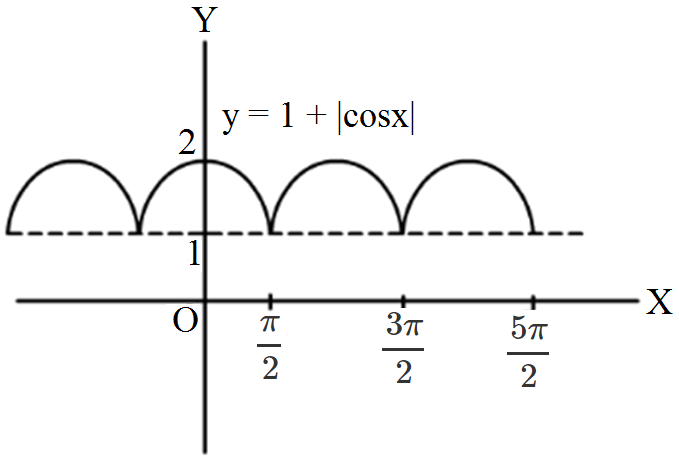
Graph of the function $\text{f(x)}=1+|\cos\text{x}|$ is as show blow:

From the graph, we can see that f(x) is everywhere continuous but not differentiable at $\text{x}=(2\text{n}+1)\frac{\pi}{2},\text{n}\in\text{Z}.$

Need a full question paper?

Generate a complete, print-ready paper with questions like this in minutes — across 16+ boards, with answer keys.

Start Generating Free

Similar questions

The function $(x-\sin x)$ decreases for
$y=x(x-3)^2$ decreases for the values of $x$ given by
The vector having initial and terminal points as $(2,5,0)$ and $(-3,7,4)$ respectively is
$\big(\vec{\text{a}}+2\vec{\text{b}}-\vec{\text{c}}\big).\big\{\big(\vec{\text{a}}-\vec{\text{b}}\big)\times\big(\vec{\text{a}}-\vec{\text{b}}-\vec{\text{c}}\big)\big\}$ is equal to:
  1. $\big[\vec{\text{a}}\vec{\text{b}}\vec{\text{c}}\big)$
  2. $2\big[\vec{\text{a}}\vec{\text{b}}\vec{\text{c}}\big)$
  3. $3\big[\vec{\text{a}}\vec{\text{b}}\vec{\text{c}}\big)$
  4. $0$
If $\text{A}=\begin{bmatrix}\text{i}&0\\0&\text{i}\end{bmatrix},\text{n}\in\text{N},$ then $A^{4n}$ equals$:$
In a LPP, if the objective function $Z=a x+b y$ has the same maximum value on two corner points of the feasible region, then every point on the line segment joining these two points give the same ______ value.
If A and B are independent events such that P(A) > 0 and P(B) > 0, then.
  1. $\text{P}(\text{A}\cup\text{B})=\text{P}(\text{A}).\text{P}(\text{B})$
  2. $\text{P}(\text{A}\cap\text{B})=\text{P}(\text{A}).\text{P}(\text{B})$
  3. $\text{P}\big(\frac{\text{A}}{\text{B}}\big)=\text{P}(\text{A})$
  4. $\text{P}\big(\frac{\text{B}}{\text{A}}\big)=\text{P}(\text{B})$
The value of $\big(\vec{\text{a}}\times\vec{\text{b}}\big)^2$ is:
  1. $|\vec{\text{a}}|^2+\big|\vec{\text{b}}\big|^2-\big(\vec{\text{a}}.\vec{\text{b}}\big)^2$
  2. $|\vec{\text{a}}|^2\big|\vec{\text{b}}\big|^2-\big(\vec{\text{a}}.\vec{\text{b}}\big)^2$
  3. $|\vec{\text{a}}|^2+\big|\vec{\text{b}}\big|^2-2\big(\vec{\text{a}}.\vec{\text{b}}\big)$
  4. $|\vec{\text{a}}|^2+\big|\vec{\text{b}}\big|^2-\vec{\text{a}}.\vec{\text{b}}$
It is given that $X\left[\begin{array}{cc}3 & 2 \\ 1 & -1\end{array}\right]=\left[\begin{array}{ll}4 & 1 \\ 2 & 3\end{array}\right]$. Then matrix $X$ is :
$\int\frac{\cos2\text{x}-1}{\cos2\text{x}+1}\text{ dx}=$
  1. $\tan\text{x}-\text{x}+\text{C}$
  2. $\text{x}+\tan\text{x}+\text{C}$
  3. $\text{x}-\tan\text{x}+\text{C}$
  4. $-\text{x}-\cot\text{x}+\text{C}$