MCQ
The gaseous reaction $A + B$ $\rightleftharpoons$ $2C + D$; $+ Q$ is most favoured at
- ALow temperature and high pressure
- BHigh temperature and high pressure
- CHigh temperature and low pressure
- ✓Low temperature and low pressure
Generate a complete, print-ready paper with questions like this in minutes — across 16+ boards, with answer keys.
$(A) i)$ Lindlar's catalyst, $H _2$; $ii$) $SnCl _2 / HCl$; iii) $NaBH _4$; iv) $H _3 O ^{+}$
$(B) i)$ Lindlar's catalyst, $H _2$; $ii$) $H _3 O ^{+}; iii)$ $SnCl _2 / HCl$; iv) $NaBH _4$
$(C) i)$ $NaBH _4; ii)$ $SnCl _2 / HCl; $iii$)$ $H _3 O ^{+}; iv)$ Lindlar's catalyst, $H _2$
$(D) i)$ Lindlar's catalyst, $H _2$; $ii$) $NaBH _4; iii)$ $SnCl _2 / HCl; iv)$ $H _3 O ^{+}$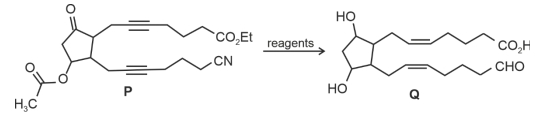
$NH_3{_{(g)}}\ \rightleftharpoons \ \frac {1}{2} {N_2}_{(g)} + \frac {3}{2} {H_2}_{(g)}$ ; $K_P$
The degree of dissociation $(\alpha )$ of $NH_3$ is related to total equilibrium pressure $(P^o )$ as