MCQ
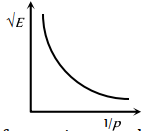
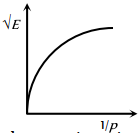
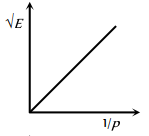
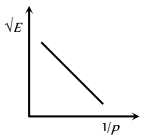
The graph between $\sqrt{E}$ and $\frac{1}{p}$ is $(E=$ kinetic energy and $p=$ momentum)
  • A
    Image
  • B
    Image
  • Image
  • D
    Image

Answer

Correct option: C.
Image
(c) $P=\sqrt{2 m E}$ it is clear that $P \propto \sqrt{E}$So the graph between $P$ and$\sqrt{E}$ will be straight line.but graph between $\frac{1}{P}$ and $\sqrt{E}$ will be hyperbola

Need a full question paper?

Generate a complete, print-ready paper with questions like this in minutes — across 16+ boards, with answer keys.
Start Generating Free

Similar questions

The energy of a photon of light of wavelength $450 \mathrm{~nm}$ is
An ideal gas expands in such a manner that its pressure and volume can be related by equation $P V^2=$ constant. During this process, the gas is
In the above question, the power lost in the cable during transmission is
An observer moves towards a stationary source of sound of frequency $n$. The apparent frequency heard by him is $2 n$. If the velocity of sound in air is $332 \mathrm{~m} / \mathrm{sec}$, then the velocity of the observer is
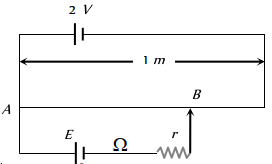
In the given figure, battery $E$ is balanced on $55 \mathrm{~cm}$ length of potentiometer wire but when a resistance of $10 \Omega$ is connected in parallel with the battery then it balances on $50 \mathrm{~cm}$ length of the potentiometer wire then internal resistance $r$ of the battery is

Image

If the increase in the kinetic energy of a body is $22 \%$, then the increase in the momentum will be
In a $P N$-junction
Air is filled in a motor tube at $27^{\circ} \mathrm{C}$ and at a pressure of 8 atmospheres. The tube suddenly bursts, then temperature of air is [Given $\gamma$ of air $=1.5$ ]
The frequency of transverse vibrations in a stretched string is 200 $H z$. If the tension is increased four times and the length is reduced to one-fourth the original value, the frequency of vibration will be
When forces $F_1, F_2, F_3$ are acting on a particle of mass $m$ such that $F_2$ and $F_3$ are mutually perpendicular, then the particle remains stationary. If the force $F_1$ is now removed then the acceleration of the particle is