MCQ
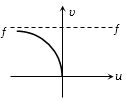
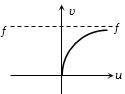
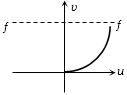
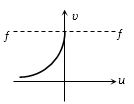
The graph between $u$ and $v$ for a convex mirror is

  • B

  • C

  • D

Answer

Correct option: A.

a
$(a)$ As $u$ goes from $0$ to -$\infty$, $v$ goes from $+ 0$ to $+ f$

Need a full question paper?

Generate a complete, print-ready paper with questions like this in minutes — across 16+ boards, with answer keys.

Start Generating Free

Similar questions

In uniform circular motion
The phenomenon utilised in an optical fibre is
The current is flowing in south direction along a power line. The direction of magnetic field above the power line (neglecting earth's field) is
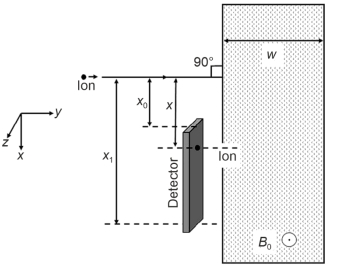
A positive, singly ionized atom of mass number $A_M$ is accelerated from rest by the voltage $192 V$. Thereafter, it enters a rectangular region of width $w$ with magnetic field $B_0=0.1 \hat{k}$ Tesla, as shown in the figure. The ion finally hits a detector at the distance $x$ below its starting trajectory.

[Given: Mass of neutron/proton $=(5 / 3) \times 10^{-27} kg$, charge of the electron $=1.6 \times 10^{-19} C$.]

Which of the following option($s$) is(are) correct?

$(A)$ The value of $x$ for $H^{+}$ion is $4 cm$.

$(B)$ The value of $x$ for an ion with $A_M=144$ is $48 cm$.

$(C)$ For detecting ions with $1 \leq A_M \leq 196$, the minimum height $\left(x_1-x_0\right)$ of the detector is $55 cm$.

$(D)$ The minimum width $w$ of the region of the magnetic field for detecting ions with $A_M=196$ is $56 cm$.
The maximum illumination on a screen at a distance of $2\, m$ from a lamp is $25\, lux.$ The value of total luminous flux emitted by the lamp is
The radius of the Bohr orbit in the ground state of hydrogen atom is $0.5 Å.$ The radius of the orbit of the electron in the third excited state of $H{e^ + }$ will be......$ Å$
A body starts from rest with an acceleration $a_{1},$ after two seconds another body $B$ starts from rest with an acceleration $a _{2}$. If they travel equal distance in fifth second, after the starts of $A$, the ratio $a _{1}: a _{2}$ will be equal to
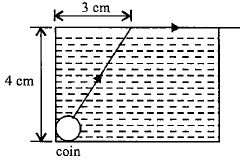
A small coin is resting on the bottom of a beaker filled with liquid. A ray of light from the coin travels upto the surface of the liquid and moves along its surface. How fast is the light travelling in the liquid? 
A couple produces
The bulk modulus of a spherical object is '$B$'. If it is subjected to uniform pressure '$P$', the fractional decrease in radius is