MCQ
The phenomenon utilised in an optical fibre is
  • A
    Refraction
  • B
    Interference
  • C
    Polarization
  • Total internal reflection

Answer

Correct option: D.
Total internal reflection
d
(d)

Total internal reflection is a powerful process since it can be used to confine light. One of the most common applications of total internal reflection is in fibre optics. An optical fibre is a thin, transparent fibre, usually made of glass or plastic, for transmitting light.

If light is incident on a cable end with an angle of incidence greater than the critical angle then the light will remain trapped inside the glass strand. In this way, light travels very quickly down the length of the cable over a very long distance (tens of kilometers).

Need a full question paper?

Generate a complete, print-ready paper with questions like this in minutes — across 16+ boards, with answer keys.
Start Generating Free

Similar questions

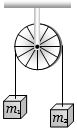
Two masses ${m_1} = 5\,kg$ and ${m_2} = 4.8\,kg$ tied to a string are hanging over a light frictionless pulley. What is the acceleration of the masses when they are free to move  .......... $m/s^{2}$  $(g = 9.8\,\,m/{s^2})$
Bernoulli's principle does not explain
Three concentric conducting spherical shells have radius $ r, 2r$ and $3r$ and $Q_1, Q_2$ and $Q_3$ are final charges respectively. Innermost and outermost shells are already earthed as shown in figure. Choose the wrong statement.
The formula for induced $e.m.f.$ in a coil due to change in magnetic flux through the coil is (here $A$ = area of the coil, $B$ = magnetic field)
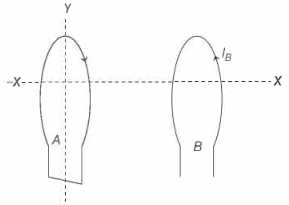
The diagram below shows two circular loops of wire ( $A$ and $B$ ) centred on and perpendicular to the $X$-axis and oriented with their planes parallel to each other. The $Y$-axis passes vertically through loop $A$ (dashed line). There is a current $I_B$ in loop $B$ as shown in the diagram. Possible actions which we might perform on loop $A$ are

$(I)$ move $A$ to the right along $X$-axis closer to $B$

$(II)$ move $A$ to the left along $X$-axis away from $B$

$(III)$ as viewed from above, rotate $A$ clockwise about $Y$-axis

$(IV)$ as viewed from above, rotate $A$ anti-clockwise about $Y$-axis

Which of the actions will induce a current in $A$ only in the direction shown?
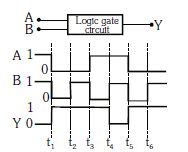
The following figure shows a logic gate circuit with two inputs $A $and $B$ and the output $Y$. The voltage waveforms of $A$, $B$, and $Y$ are as given? The logic gate is
A bullet when fired at a target with a velocity of $100\,\,m/sec$ penetrates one metre into it. If the bullet is fired at a similar target with a thickness $0.5\,\,metre,$  then it will emerge from it with a velocity of
A ball whose density is $0.4 \times 10^3\,kg/m^3$ falls into water from a height of $9\,cm$ . To what depth does the ball sink ? ....... $cm$
In a parallel plate condenser, the radius of each circular plate is $12\,cm$ and the distance between the plates is $5\,mm$. There is a glass slab of $3\,mm$ thick and of radius $12\,cm$ with dielectric constant $6$ between its plates. The capacity of the condenser will be
Nuclear fusion is common to the pair