MCQ
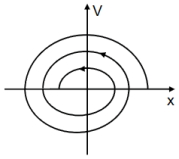
The graph between velocity and position for a damped oscillation will be
  • A
    Straight line
  • B
    Circle
  • C
    Ellipse
  • Spiral

Answer

Correct option: D.
Spiral
d
In damped oscillation, the amplitude will decrease so the graph of $V v / s x$ will be as,

Need a full question paper?

Generate a complete, print-ready paper with questions like this in minutes — across 16+ boards, with answer keys.

Start Generating Free

Similar questions

$Newton/metr{e^{\rm{2}}}$ is the unit of
A flywheel of moment of inertia $2 \,kg - m ^2$ is rotated at a speed of $30 \,rad / s$. A tangential force at the rim stops the wheel in $15$ second. Average torque of the force is ........... $Nm$
A uniform rod of mass $m$ and length $l$ rotates in a horizontal plane with an angular velocity $\omega $ about a vertical axis passing through one end. The tension in the rod at a distance $x$ from the axis is
The length of second's hand in a watch is $1 \,cm.$ The change in velocity of its tip in $15\, seconds$ is
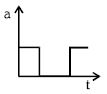
The acceleration-time graph for a body is shown in the graph. Which of the following  graphs would probably represent velocity of the body plotted against time:-
The amplitude of a damped oscillator decreases to $0.9$ times its original magnitude in $5\ s$. In another $10\ s$ it will decrease to $\alpha $ times its original magnitude, where  $\alpha $ equals
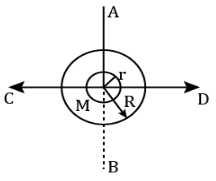
The figure shows two solid discs with radius ${R}$ and ${r}$ respectively. If mass per unit area is same for both, what is the ratio of ${MI}$ of bigger disc around axis ${AB}$ (Which is $\perp$ to the plane of the disc and passing through its centre) of MI of smaller disc around one of its diameters lying on its plane? Given $'M'$ is the mass of the larger disc. ($MI$ stands for moment of inertia)
During illness an $80\, kg$ man ran a fever of $102.2^o F$ instead of normal body temperature of $98.6^o F$. Assuming that human body is mostly water, how much heat is required to raise his temperature by that amount  .......... $kcal$ 
Suppose all the surfaces in the previous problem are rough. The direction of friction on $B$ due to $A:$
When a train is at rest, rain drops fall vertically. When it moves along east with a velocity equal to that of rain, the rain will appear to fall, for a passenger in the train