MCQ
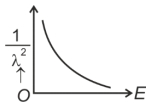
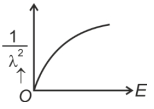
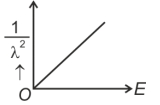
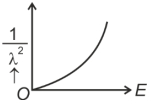
The graph which shows the variation of $\left(\frac{1}{\lambda^2}\right)$ and its kinetic energy, $E$ is (where $\lambda$ is de Broglie wavelength of a free particle):
  • A

  • B


  • D

Answer

Correct option: C.

c
de-Broglie wavelength $\lambda=\frac{h}{P}=\frac{h}{m v}=\frac{h}{\sqrt{2 m E}}$ where $E=\frac{1}{2} m v^2$

Squaring both sides,

$\lambda^2=\frac{h^2}{4 m^2 E}$

$\Rightarrow \frac{1}{\lambda^2}=\text { (constant) } E$

Graph passes through origin with constant slope.

Need a full question paper?

Generate a complete, print-ready paper with questions like this in minutes — across 16+ boards, with answer keys.

Start Generating Free

Similar questions

The mutual inductance of a pair of coils, each of $N\,turns$, is $M\,henry$. If a current of $I\, ampere$ in one of the coils is brought to zero in $t$ $second$ , the $emf$ induced per turn in the other coil, in volt, will be
A coil has resistance $30$ ohm and inductive reactance $20$ ohm at $50\,\, Hz$ frequency. If an ac source, of $200\,\, volt,\,\, 100\,\, Hz,$ is connected across the coil, the current in the coil will be ......$A$
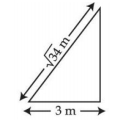
A $\sqrt{34}\,m$ long ladder weighing $10\,kg$ leans on a frictionless wall. Its feet rest on the floor $3\,m$ away from the wall as shown in the figure. If $F_{f}$ and $F_{w}$ are the reaction forces of the floor and the wall, then ratio of $F _{ a } / F _{f}$ will be:

(Use $\left.g=10\,m / s ^{2}\right)$

Who discovered spin quantum number
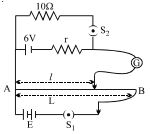
In the arrangement shown in figure when the switch $S_2$ is open, the galvanometer shows no deflection for $l = L/2$. When the switch $S_2$ is closed, the galvanometer shows no deflection for $l = 5L /12$ . The internal resistance $(r)$ of $6\, V$ cell, and the $\mathrm{emf}$ $E$ of the other battery are respectively
A copper ball of radius $'r'$ travels with a uniform speed $'v'$ in a viscous fluid. If the ball is changed with another ball of radius $'2r'$ , then new uniform speed will be
A charged particle going around in a circle can be considered to be a current loop. A particle of mass $m$ carrying charge $q$ is moving in a plane with speed $v$ under the influence of magnetic field $\overrightarrow{ B }$. The magnetic moment of this moving particle
A mass $m$ is placed at point $P$ lies on the axis of a ring of mass $M$ and radius $R$ at a distance $R$ from its centre. The gravitational force on mass $m$ is
The minimum energy required by a hydrogen atom in ground state to emit radiation in Balmer series is nearly :
When white light enters a prism, it gets split into its constituent colours. This is due to