MCQ
Who discovered spin quantum number
  • Unlenbeck and Goudsmit
  • B
    Nell’s Bohr
  • C
    Zeeman
  • D
    Sommerfield

Answer

Correct option: A.
Unlenbeck and Goudsmit
a
George Unlenbeck and Samuel Goudsmit were studying certain details of spectral lines known as the anamalous Zeeman effect. This eventually led them to the realization that Pouli's fourth quantum number must relate to electron spin.

Need a full question paper?

Generate a complete, print-ready paper with questions like this in minutes — across 16+ boards, with answer keys.
Start Generating Free

Similar questions

A ring and a solid sphere roll down the same inclined plane without slipping. They start from rest. The radii of both bodies are identical and the ratio of their kinetic energies is $\frac{7}{\mathrm{x}}$ where $\mathrm{x}$ is___________.
If the radius of a star is $R$ and it acts as a black body, what would be the temperature of the star, in which the rate of energy production is Q? ( $\sigma$ stands for Stefan's constant.)
A solid sphere, a solid cylinder, a disc and a ring are rolling down an inclined plane. Which of these bodies will reach the bottom simultaneously
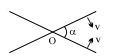
Find the speed of the intersection point $O$ of the two wires if the wires starts moving perpendicular to itself with speed $v$ as shown in figure.
As a wave propagates
An electric charge ${10^{ - 3}}\,\mu \,C$ is placed at the origin $(0, 0)$ of $X -Y$ co-ordinate system. Two points $A$ and $B$ are situated at $\left( {\sqrt {2\,} \,,\,\,\sqrt 2 } \right)$  and $(2, 0)$ respectively. The potential difference between the points $A$ and $B$ will be......$volt$
A radioactive sample has half-life of $5$ years. Probability of decay in $10$ years will be  ........$\%$
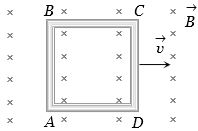
A conducting square loop of side $L$ and resistance $R$ moves in its plane with a uniform velocity $v$ perpendicular to one of its sides. A magnetic induction $B$ constant in time and space, pointing perpendicular and into the plane of the loop exists everywhere. The current induced in the loop is
Two waves ${y_1} = {A_1}\sin (\omega t - {\beta _1})$, ${y_2} = {A_2}\sin (\omega t - {\beta _2})$ Superimpose to form a resultant wave whose amplitude is
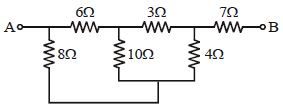
The equivalent resistance between the points $A$ and $B$ is :-