Question
The gravitational attraction between electron and proton in a hydrogen atom is weaker than the coulomb attraction by a factor of about 10–40. An alternative way of looking at this fact is to estimate the radius of the first Bohr orbit of a hydrogen atom if the electron and proton were bound by gravitational attraction. You will find the answer interesting.
Answer

Radius of the first Bohr orbit is given by the relation,
$\text{r}_1=\frac{4\pi\in_0\Big(\frac{\text{h}}{2\pi}\Big)^2}{\text{m}_\text{e}\text{e}^2}\ \dots(1)$
Where,
$\in_0$ = Permittivity of free space
h = Planck ' s constant = 6.63 × 10⁻³⁴ Js
me = Mass of an electron = 9.1 × 10⁻³¹ kg
e = Charge of an electron = 1.9 × 10⁻¹⁹ C
mp = Mass of a proton = 1.67 × 10⁻²⁷ kg
r = Distance between the electron and the proton
Coulomb attraction between an electron and a proton is given as:
$\text{F}_\text{C}=\frac{\text{e}^2}{4\pi\in_0\text{r}^2}\ \dots(2)$
Gravitational force of attraction between an electron and a proton is given as:
$\text{F}_\text{G}=\frac{\text{Gm}_\text{p}\text{m}_\text{c}}{\text{r}^2}\ \dots(3)$
Where,
G = Gravitational constant = 6.67 × 10⁻¹¹ N m/ kg2
If the electrostatic (Coulomb) force and the gravitational force between an electron and a proton are equal, then we can write:
$\therefore\ \text{FG}=\text{FC}$
$\frac{\text{Gm}_\text{p}\text{m}_\text{c}}{\text{r}^2}=\frac{\text{e}^2}{4\pi\in_0\text{r}^2}$
$\therefore\ \frac{\text{e}^2}{4\pi\in_0}=\text{Gm}_\text{p}\text{m}_\text{c}\ \dots(4)$
Putting the value of equation (4) in equation (1), we get:
$\text{r}_1=\frac{\Big(\frac{\text{h}}{2\pi}\Big)^2}{\text{Gm}_\text{p}\text{m}_\text{e}^2}$
$=\frac{\Big(\frac{6.63\times10^{-34}}{2\times3.14}\Big)^2}{6.67\times10^{-11}\times1.67\times10^{-27}\times(9.1\times10^{-31})^2}\approx1.21\times10^{29}\text{ m}$
It is known that the universe is 156 billion light years wide or 1.5 × 1027 m wide. Hence, we can conclude that the radius of the first Bohr orbit is much greater than the estimated size of the whole universe.

Need a full question paper?

Generate a complete, print-ready paper with questions like this in minutes — across 16+ boards, with answer keys.

Start Generating Free

Similar questions

  1. Draw the circuit diagram of a fullwave rectifier using p-n junction diode. Explain its working and show the output, input waveforms.
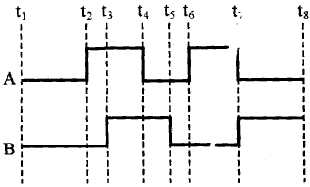
  2. Show the output waveforms (Y) for the following inputs A and B of
    1. OR gate.
    2. NAND gate.

A bulb with rating 250V, 100W is connected to a power supply of 220V situated 10m away using a copper wire of area of cross-section 5mm2. How much power will be consumed by the connecting wires? Resistivity of copper $1.7\times10^{-8}\Omega-\text{m}$.
The work function of caesium metal is 2.14 eV. When light of frequency 6 × 1014 Hz is incident on the metal surface, photoemission of electrons occurs. What is the
  1. Maximum kinetic energy of the emitted electrons,
  2. Stopping potential, and
  3. Maximum speed of the emitted photoelectrons?
  1.  
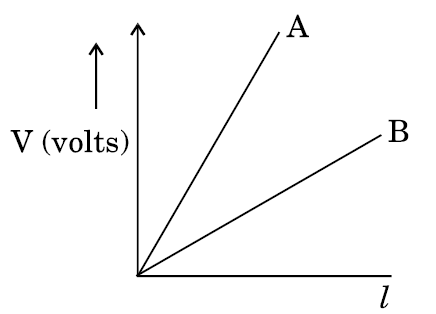
  1. State the principle on which a potentiometer works. How can a given potentiometer be made more sensitive?
  2. In the graph shown below for two potentiometers, state with reason which of the two potentiometers, A or B, is more sensitive.
  1. Two metallic wires, P1 and P2 of the same material and same length but different cross-sectional areas, A1 and A2 are joined together and connected to a source of emf. Find the ratio of the drift velocities of free electrons in the two wires when they are connected (i) in series, and (ii) in parallel.
Find out magnetic force on parallel current carrying conductors and also state their special conditions.
Figure shows a plane mirror M placed at a distance of 10cm from a concave lens L. A point object is placed at a distance of 60cm from the lens. The image formed due to refraction by the lens and reflection by the mirror is 30cm behind the mirror. What is the focal length of this lens?
A resistance thermometer reads R =$20.0\Omega$, $27.5\Omega$, and $50.0\Omega$ at the ice point (0°C), the steam point (100°C) and the zinc point (420°C) respectively. Assuming that the resistance varies with temperature as$\text{R}_\theta=\text{R}_0(1+\alpha\theta+\beta\theta^2)$, find the values of $\text{R}_0,$ $\alpha \ \text{and}\ \beta.$ Here $\theta$ represents the temperature on Celsius scale.
A block of mass 2.0kg is pushed down an inclined plane of inclination 37° with a force of 20N acting parallel to the incline. It is found that the block moves on the incline with an acceleration of 10m/s2. If the block started from rest, find the work done.
  1. By the applied force in the first second.
  2. By the weight of the block in the first second.
  3. By the frictional force acting on the block in the first second. Take g = 10m/s2.
The refractive index of a material M1 changes by 0.014 and that of another material M2 changes by 0.024 as the colour of the light is changed from red to violet. Two thin prisms one made of M1(A = 5.3°) and other made of M2(A = 3.7°) are combined with their refracting angles oppositely directed.
  1. Find the angular dispersion produced by the combination.
  2. The prisms are now combined with their refracting angles similarly directed. Find the angular dispersion produced by the combination.
A wire of length l is bent in the form of an equilateral triangle and carries an electric currrent i.
  1. Find the magnetic field B at the centre.
  2. If the wire is bent in the form of a square, what would be the value of B at the centre?