MCQ
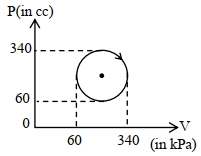
The heat absorbed by a system in going through the given cyclic process is:
  • $61.6 \mathrm{~J}$
  • B
     $431.2 \mathrm{~J}$
  • C
    $616 \mathrm{~J}$
  • D
    $19.6 \mathrm{~J}$

Answer

Correct option: A.
$61.6 \mathrm{~J}$
a
$\Delta \mathrm{U}=0 \text { (Cyclic process) }$

$\Delta \mathrm{Q}=\mathrm{W}=\text { area of } \mathrm{P}-\mathrm{V} \text { curve. }$

$=\pi \times\left(140 \times 10^3 \mathrm{~Pa}\right) \times\left(140 \times 10^{-6} \mathrm{~m}^3\right)$

$\Delta \mathrm{Q}=61.6 \mathrm{~J}$

Need a full question paper?

Generate a complete, print-ready paper with questions like this in minutes — across 16+ boards, with answer keys.

Start Generating Free

Similar questions

The time period of a satellite is related to the density of earth $(\rho)$ as:
A planet is moving in an elliptical orbit around the sun. If $T, V, E$ and $L$ stand respectively for its kinetic energy, gravitational potential energy, total energy and magnitude of angular momentum about the centre of force, which of the following is correct ?
A bulled of mass $a$ and velocity $b$ is fired into a large block of mass $c$. The final velocity of the system is:
A $60 \,kg$ weight is dragged on a horizontal surface by a rope upto $ 2$ metres. If coefficient of friction is $\mu = 0.5$, the angle of rope with the surface is $60^°$ and $g = 9.8\,m/{\sec ^2}$, then work done is ........ $joules$

      Column $-I$

    Angle of projection

    Column $-II$
  $A.$ $\theta \, = \,{45^o}$   $1.$ $\frac{{{K_h}}}{{{K_i}}} = \frac{1}{4}$
  $B.$ $\theta \, = \,{60^o}$   $2.$ $\frac{{g{T^2}}}{R} = 8$
  $C.$ $\theta \, = \,{30^o}$   $3.$ $\frac{R}{H} = 4\sqrt 3 $
  $D.$ $\theta \, = \,{\tan ^{ - 1}}\,4$   $4.$ $\frac{R}{H} = 4$

$K_i :$ initial kinetic energy

$K_h :$ kinetic energy at the highest point
A sample contains mixture of helium and oxygen gas. The ratio of root mean square speed of helium and oxygen in the sample, is:
Two small, equal masses are attached by a light weight rod. This object orbits a planet ; the length of the rod is smaller than the radius of the orbit, but not negligible. The rod rotates about its axis in such a way that it remains vertical with respect to the planet. (Assume in each case perturbation maintains the rate of rotation, so that in the co-rotating frame the rod is  still stationary but at an angle to the vertical.)
The position coordinates of a projectile projected from ground on a certain planet (with no atmosphere) are given by $y=\left(4 t-2 t^2\right) m$ and $x =(3 t)$ metre, where $t$ is in second and point of projection is taken as origin. The angle of projection of projectile with vertical is .........
Choose the correct option:
A body is moving along a circular path. How much work is done by the centripetal force?