The heat developed in an electric wire of resistance $R$ by a current $I$ for a time $t$ is
Easy


Download our appand get started for free
Experience the future of education. Simply download our apps or reach out to us for more information. Let's shape the future of learning together!No signup needed.*
Similar Questions
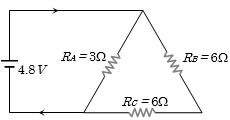
- 1The current in the given circuit is ............ $A$View Solution
- 2View SolutionWhich one is not the correct statement
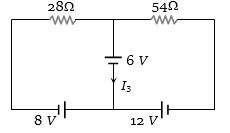
- 3Consider the circuit shown in the figure. The current ${I_3}$ is equal toView Solution
- 4Find potential difference across $24\,\Omega $ ............. $\mathrm{volt}$View Solution
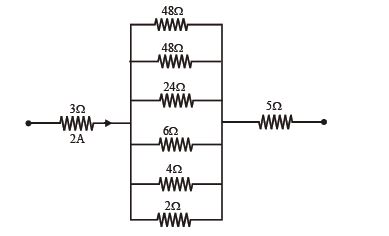
- 5In the given network current through branch $BG$ is almost equal to ............ $A$View Solution
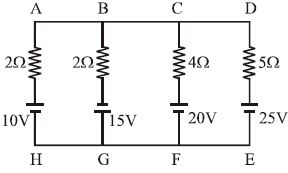
- 6A wire of resistance $160\,\Omega$ is melted and drawn in wire of one-fourth of its length. The new resistance of the wire will be $......\Omega$View Solution
- 7Resistance of a carbon resistor determined from colour codes is $(22000 \pm 5 \%) \Omega$. The colour of third band must be :View Solution
- 8In the circuit shown $E, F, G$ and $H$ are cells of $\mathrm{e.m.f.}$ $2\,V, 1\,V, 3\,V$ and $1\,V$ respectively and their internal resistances are $2\,\Omega , 1\,\Omega , 3\,\Omega$ and $1\,\Omega$ respectively.View Solution
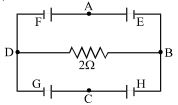
- 9.............. $A$ the current flowing through the resistance $R_2$ of the circuit shown in fig if the resistance are equal to $R_1 = 20\ \Omega, R_2 = 30 \ \Omega$ and $R_3 = 60 \ \Omega$ and potentials of points $1, 2$ and $3$ are equal to $V_1= 20\, V,$ $V_2 = 30\ V$ and $V_3 = 60\ V$View Solution
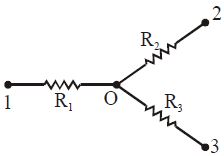
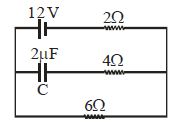
- 10Find the maximum charge on the capacitor $C$ in the following circuit ............ $\mu C$View Solution